The following article appeared in the New York Times. It gives a brief impression of opening night of the 2005 Bayreuth Festival.
Boos at Bayreuth
Boos, jeers and whistles greeted the 94th Bayreuth Festival's new production of Wagner's
The following article appeared in the New York Times. It gives a brief impression of opening night of the 2005 Bayreuth Festival.
Boos at Bayreuth
Boos, jeers and whistles greeted the 94th Bayreuth Festival's new production of Wagner's
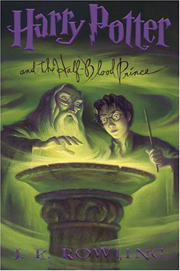 It's now been a little over 24 hours since the publication of Harry Potter and the Half-Blood Prince, J.K. Rowling's latest trip to Hogwarts, and I also know that many of you have already ripped through the 600-plus page novel as if they were giving free magic wands away at the end to the early-finishers.

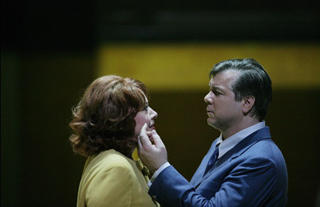
Act II opens with a gigantic projection of an X-ray of a human pelvis, Klingsor, dressed like one of the evil characters from a Kabuki work, appears floating in a kind of bubble, hovering between the sacrum and the symphysis pubis bones. Kundry, in her Act II role as the seductress, shows up with the kind of hair and dress that would make the Versace runways at the annual spring show come to life. Visually, Act II does not leave too much of an impact on the viewer, and it is one of the weakest aspects of this production. Particularly disappointing is the way by which Parsifal obtains the spear from Klingsor. Those familiar with the old MET production of this opera will remember how Klingsor would hurl the spear at Parsifal and he would catch it in midair -- a clever and effective bit of stagecraft that would leave audiences gasping and wondering how it was accomplished.
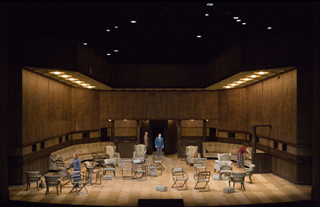
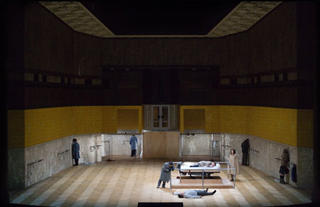
While Act II is a bit disappointing, the concept of Act III is inspired. The same wall that we saw in Act I now opens into a dark tunnel with railroad tracks leading out of it. Where these tracks might be going or where they come from is never answered. To one side, stuffed in a hole, we see the bodies (or are they statues) of dead knights. Once Parsifal brings back the spear Amfortas dies but not before passing down his crown to Parsifal, who rather than accepting it, carries it to the dead body of Titurel and places it on the head of the dead king. Kundry, whose wrappings from head to toe make her look like a mummy, gets up and slowly heads back to the tunnel via the train tracks. From the depths of the darkness now a powerful light shines and drives her forward. Parsifal follows her, and little by little so do a number of knights. It seems as if the brotherhood is desolving itself as the knights, one by one, decide to go somewhere else. Gurnemanz holds the spear with reverential respect, but as the curtain slowly closes, it seems that very soon he will be the only one left, as more and more knights get up to follow the others down the tracks.
The most powerful images and concepts of this production are found in the second scene of Act I. Particularly superb is Lehnhoff's interpretation of the Holy Grail as a radiant blinding light on the other side of the steel wall. Is this powerful glow the aftermath of some recent spectacular nuclear holocaust that has now been accepted as a new god, or is it the light of some older established deity shining on humanity once more in times of trouble? Equally superb is the sequence when the knights meekly exit through the two side doors only to come back through the center glowing opening marching, wearing helmets and carrying spears. The Grail has miraculously metamorphosed them into warriors. This scene, which comments on the link that has historically always exhisted between religion and war, is one of the most memorable statements of this unforgettable production.


In his homily to his fellow-cardinals, on the first morning of their conclave, Cardinal Ratzinger had warned that modern society was threatened by a “dictatorship of relativism.” But it might have been more accurate to say that it is threatened by a dictatorship of absolutisms, including his own. This is a world in the tightening grip of orthodoxy, of literal “truths” and crusading certainties, and early last week it was the hope of many Catholics that the Church would begin to break that grip and return to them the right to exercise their own consciences on matters that do not concern faith so much as the realities of their intimate lives: sexuality, celibacy, choice, the use of condoms in aids-ridden Africa, the use of birth control in the favelas and shantytowns of Central and South America, the acknowledgment that stem-cell research might conceivably be a gift from God.
The question of God and conscience, or, rather, the relation between God and conscience—the central question of Vatican II, and, as such, the source of immense hope to young Catholics in the nineteen-sixties and seventies—was so “deconstructed” (to risk a relativist term) in the twenty-six years of John Paul II’s papacy that raising it now constitutes a kind of doctrinal heresy. Ratzinger maintained, with his friend and predecessor, that a well-ordered conscience is one that submits to the authority of the magisterium. So it is understandable that today those Catholics are asking who exactly is, and was, Joseph Ratzinger. Was he the Pope’s man, the unbending instrument of John Paul II’s insistent orthodoxy, or was he, at least in part, the motor of that orthodoxy, especially in the Pontiff’s last years?
Most Popes of the last century—even John Paul II, for all his groundwork as a priest in Communist Poland—were elevated to that office from relative anonymity. Ratzinger does not have that advantage. He has been well known to Catholic intellectuals since the nineteen-seventies, when he battled Hans Küng, the liberal Swiss theologian and his mentor at the University of Tübingen, on questions of doctrinal dissension, and, as Archbishop of Munich, was instrumental in having Küng barred from teaching Catholic theology. And, of course, he has been very well known to most Catholics since the early eighties, when the Pope installed him at the Vatican. His agenda, or his orders, were always clear. During his first ten years as Prefect, the Jesuits were censured for challenging papal teachings on contraception, parts of their constitution were suspended, and their Vicar General, Vincent O’Keefe, a passionate advocate for social justice, was removed. The reactionary lay order Opus Dei was transformed into a “personal prelature” accountable directly to the Pope. The dioceses of progressive Latin-American bishops were gerrymandered out of existence, liberation theologians like Leonardo Boff were called to Rome and silenced as “Marxists” (they were, more accurately, Christiancommunitarian evangelists), and the priests they had trained, who were responsible for an ebullient Catholic revival in Latin America, were ordered back into the fold of tradition and obedience. The relative autonomy of the North American bishops’ conference was ended, and its most progressive members—most famously Cardinal Joseph Bernardin, of Chicago—were marginalized.
If the Vatican’s project in the eighties was to purge its clergy, its nineties project was to purge its teachings of ambiguity. The dogma of papal infallibility, which dates only from 1870, has been invoked just once since then, in 1950, when Pius XII proclaimed the “truth” of the Assumption of the Blessed Virgin Mary. But in the years of John Paul II’s papacy there was a conflation of the notion of infallibility and what the Church calls “definitive teachings.” The result was that John Paul II’s teachings often carried the imperative of infallibility, and Cardinal Ratzinger’s theological imprimatur on those teachings, together with his power to enforce them, effectively ended the discussion.
These issues were more important to the cardinals than the new Pope’s age or whether he was Italian, or European, or from Latin America or Africa. There are a hundred and eighty-three cardinals, but no cardinal over the age of eighty may vote, and, of the hundred and fifteen who did, all but two owed their appointments to John Paul II. It was probably never in doubt whom they would choose. Joseph Ratzinger speaks for them, and whatever he says about “waves” battering at the boat of the true faith—globalism, feminism, individualism, desire, homosexuality (“an objective disorder”), demands for the ordination of women, mysticism, “gravely deficient” sects, Turkish Muslims in Christian Europe—those words put a full stop to the opening up of the Church of Rome that we still call Vatican II. In the past few days, Benedict XVI has promised the world dialogue and reconciliation, but at the same time he has reappointed the Vatican team that, with him, brought us the spectacle of suffering and death that ended with the funeral of John Paul and secured the veneration, if not the speedy sanctification, of that faithful and controlling Pontiff. (“This is a long way from three people at the foot of the Cross,” one ex-Jesuit remarked last week, not long after Benedict XVI appeared for the first time in his papal vestments.) Most of the Cardinals wanted a continuum of that always spectacular reign. And they wanted a continued enforcement of its most conservative dicta—which may be why they are talking now about cutting their losses for the advantages of a smaller, “purer” Church. But, from what we know, the early Church was a place of risk and debate. They should remember that, too.

| |
PARIS, April 13 - Huge, dense, taxing, with almost all the action taking place in the heart, Wagner's "Tristan und Isolde" is notoriously difficult to stage. Indeed, the composer himself abandoned his first attempt in Vienna in the early 1860's after no fewer than 77 rehearsals. Now, in a daring experiment, the Paris National Opera has invited the American video artist Bill Viola to accompany the work with his own visual commentary.
On a 30-foot-wide screen above and behind the somberly lighted space peopled by the singers, images that recall some of Mr. Viola's well-known video pieces variously offer literal, metaphorical and even spiritual complements to one of mythology's most famous and tragic love stories. With only the preludes played to a closed curtain, Mr. Viola's multi-toned video poem runs for some 3 hours 40 minutes, a full-length spectacle in its own right.
The production, first performed in a concert version at Disney Hall in Los Angeles in December, is directed by Peter Sellars, with Esa-Pekka Salonen conducting the Paris Opera Orchestra.
Its seven performances at the Bastille Opera through May 4 are to be followed by seven more in November, with Valery Gergiev at the podium. It is to return in concert version to Disney Hall in March 2007 and to be staged in New York in April 2007.
Central to this production are the German mezzo Waltraud Meier as Isolde and the Canadian tenor Ben Heppner as Tristan, both given a rousing reception after Tuesday's opening night. In the view of French music critics, the Swiss mezzo Yvonne Naef as Brangäne, the Finnish baritone Jukka Rasilainen as Kurwenal and the German bass Franz-Josef Selig as King Marke also contributed to the high quality of singing.
But the true novelty lay in Mr. Viola's videos, which the artist said in an interview were inspired more by the text than the music. "I listened to it, various versions, for a month and I was stunned, I couldn't see anything," he said. So, no less than Wagner, he started with the myth, the story, the text. "The images tell the inner story in a similar way the music tells the inner story of the emotional and, I would say, spiritual life of these people."
As a result, Mr. Viola shot most of the images before turning back to the music. "I realized the music is not useful to me while I'm shooting," he explained. "The music becomes absolutely necessary in the editing process. So music became for me the last stage. It was then that I tried to fit the images onto this pre-existing landscape that Mr. Wagner has beautifully provided us."
As such, the images echo rather than illustrate the story, with many sequences slowed to harmonize with the protracted development of the plot. For instance, it takes most of Act I, as well as a magic potion, for Tristan and Isolde to recognize they love each other. They enjoy their love in Act II, but it ends with Tristan stabbed by a follower of Isolde's new husband, King Marke. And Act III is devoted to Tristan's extended death and Isolde's decision to join him.
Perhaps the central image used by Mr. Viola for Act I involves a split screen in which two tiny lights gradually take the form of a man and a woman, Tristan and Isolde's surrogates, who slowly strip and then are purified with water. The sequence ends with close-ups of their faces under water, as if they - like Tristan and Isolde who have drunk the love potion - have passed into a new reality. Two other figures then caress each other as they float under water.
With Tristan persuaded that the night is benevolent and the day is evil, Act II opens with an image of sunset and closes with another of dawn, but the most powerful sequences involve fire and water, two of Mr. Viola's preferred opposites. In one, a man slowly approaches a fire from a long distance and finally walks through the burning logs; in the other, a woman - again in slow motion - lights some 150 candles before herself walking through water.
Water too is at the heart of the final near-mystical scene when the now frustated love of Tristan and Isolde becomes, in Mr. Viola's words, "something more profound, something you can't even describe." Here, by reversing the high definition film he has shot, Mr. Viola uses water to lift the dead Tristan from a stone slab and raise him to eternity. "You're looking at death, and in the editing room, it becomes a kind of birth," he noted.
The question already raised by some critics in Los Angeles last December and echoed by some spectators here Tuesday is whether the powerful images distract from the singing. Views seem divided, with the criticism applied mostly to Act I. Mr. Viola recognized the problem. "The images can overwhelm," he said. "It seems like a huge amount to take in, but a lot of them are quite slow and on the screen for quite a time. They function at times as backdrops."
Unusually, Mr. Sellars began working on his production only after seeing Mr. Viola's images. "The staging is built around Bill's images and of course Waltraud Meier and Ben Heppner," he said in an interview, "because the depth they bring to the first rehearsal means you're starting at an advanced level. Waltraud is the reigning Isolde of her generation. Ben is now truly without peer."
With the images in place, Mr. Sellars said, "Bill gives me permission to ground the singers in an emotional depth because I don't have to have them run around the stage and be 'interesting.' " The result is a minimalist staging, with only a square platform as décor and all the intensity reserved for the voices.
Still, with the combination of video, orchestra, singing, acting and text, Mr. Sellars likes to think the team has come up with something resembling a modern Gesamtkunstwerk, the concept of total art that was Wagner's lifelong musical and theatrical objective. "Of course," he added, "Wagner's music alone gives you more than you can possibly take in."


Eichinger has been a prominent figure on Germany's film scene for decades, most recently producing "The Downfall,'' a portrait of Adolf Hitler's final days in his Berlin bunker. It was nominated in the best foreign language film category at this year's Oscars.
However, his excursion into opera met with little enthusiasm from domestic critics. "Eichinger showed a video for every state of the soul, degrading Wagner's music to the status of a soundtrack,'' the daily Sueddeutsche Zeitung wrote.
It's the first time the Staatsoper has done Parsifal, Wagner's last work, in 13 years. The next performance of Eichinger's Parsifal is set for March 28.
Here is the full cast of the opening night performance:
Conductor: Daniel Barenboim
Production: Bernd Eichinger
Set Design: Jens Kilian
Amfortas: Roman Trekel
Titurel: Christof Fischesser
Gurnemanz: René Pape
Parsifal: Burkhard Fritz
Klingsor: Jochen Schmeckenbecher
Kundry: Michaela Schuster
Flower Maidens: Ekaterina Siurina, Adriane Queiroz, Simone Schröder, Anna Samuil, Carola Höhn, Katharina Kammerloher
First Knight of the Grail: Peter-Jürgen Schmidt Second Knight of the Grail: Yi Yang
Squires: Anna Samuil, Katharina Kammerloher, Peter Menzel, Gustavo Peña
Altsolo: Simone Schröder


