Friday, May 26, 2006

Bayreuth 2006 Casts and Production Teams

The Festival Management of the Bayreuth Festspielhaus has announced the following cast lists for the Bayreuth Festival 2006. These lists are, of course, subject to alteration.

DER RING DES NIBELUNGEN
New production.
Conductor: Christian Thielemann
Producer: Tankred Dorst
Stage design: Frank Philipp Schlössmann
Costumes: Bernd Skodzig

DAS RHEINGOLD
Wotan: Falk Struckmann
Donner: Ralf Lukas
Froh: Clemens Bieber
Loge: Arnold Bezuyen
Fasolt: Kwangchul Youn
Fafner: Jyrki Korhonen
Alberich: Andrew Shore
Mime: Gerhard Siegel
Fricka: Michelle Breedt
Freia: Satu Vihavainen
Erda: Mihoko Fujimara
Woglinde: Fionnuala McCarthy
Wellgunde: Ulrike Helzel
Flosshilde: Marina Prudenskaja

DIE WALKÜRE
Siegmund: Endrik Wottrich
Hunding: Kwangchul Youn
Wotan: Falk Struckmann
Sieglinde: Adrianne Pieczonka
Brünnhilde: Linda Watson
Fricka: Michelle Breedt
Gerhilde: Satu Vihavainen
Ortlinde: Amanda Mace
Waltraute: Martina Dike
Schwertleite: Janet Collins
Helwige: Iréne Theorin
Siegrune: Wilke te Brummelstroete
Grimgerde: Annette Küttenbaum
Rossweise: Alexandra Petersamer

SIEGFRIED
Siegfried: Stephen Gould
Mime: Gerhard Siegel
Wanderer: Falk Struckmann
Alberich: Andrew Shore
Fafner: Jyrki Korhonen
Erda: Mihoko Fujimara
Brünnhilde: Linda Watson
Woodbird: Robin Johannsen

GÖTTERDÄMMERUNG
Siegfried: Stephen Gould
Gunther: Alexander Marco-Buhrmester
Hagen: Hans-Peter König
Alberich: Andrew Shore
Brünnhilde: Linda Watson
Gutrune: Gabrielle Fontana
Waltraute: Mihoko Fujimara
First Norn: Janet Collins
Second Norn: Martina Dike
Third Norn: Iréne Theorin
Woglinde: Fionnuala McCarthy
Wellgunde: Ulrike Helzel
Flosshilde: Marina Prudenskaja

TRISTAN UND ISOLDE
Tristan: Robert Dean-Smith
Isolde: Nina Stemme
King Mark: Kwangchul Youn
Kurwenal: Hartmut Welker
Melot: Ralf Lukas
Brangäne: Petra Lang
Young Sailor: Clemens Bieber
Shepherd: Arnold Bezuyen
Steerman: Martin Snell
Conductor: Peter Schneider
Producer: Christoph Marthaler
Costume and stage design: Anna Viebrock

DER FLIEGENDE HOLLÄNDER
The Dutchman: John Tomlinson
Daland: Jaako Ryhänen
Senta: Adrienne Dugger
Erik: Endrik Wottrich
Mary: Uta Priew
Steerman: Norbert Ernst
Conductor: Marc Albrecht
Producer: Claus Guth
Costume and stage design: Christian Schmidt

PARSIFAL
Parsifal: Alfons Erberz
Amfortas: Alexander Marco-Buhrmester
Titurel: Jyrki Korhonen
Gurnemanz: Robert Holl
Klingsor: John Wegner
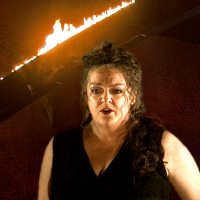
Kundry: Evelyn Herlitzius
Squires: Clemens Bieber, Samuel Youn
Grail Knights: Julia Borchert, Atala Schöck, Norbert Ernst, Helmut Pampuch
Flowermaidens: Julia Borchert, Martina Rüping, Carola Guber, Anna Korondi,
Jutta Maria Böhnert, Atala Schöck
Alto soloist: Simone Schröder
Conductor: Adam Fischer
Producer: Christoph Schlingenschief
Stage design: Daniel Angermayr, Thomas Goerge
Costumes: Tabea Braun

Chorus master: Eberhard Friedrich

Thursday, May 25, 2006

The Joseph Volpe Gala at the MET

It started at 5:30 pm in the house, and it ended about six hours later. On the radio, WQXR started at 8:00 pm in the East Coast and the broadcast ended around 12:30 am. I am not sure what was on tape and what, if anything, was heard live, but I do know that it was a very special event at the Metropolitan Opera.

Not everybody that was due to appear did, but at this kind of event that's to be expected. It would have been fun to have had Luciano Pavarotti serenade the General Director, but he didn't even show up, unlike Mirella Freni, to bid adieu to his former boss.

Plácido Domingo was there conducting and singing. His conducting was secure and pleasant, his singing was not. It was the first time that I have ever heard Domingo give a mediocre performance at a gala like this. Time waits for no man, and Domingo seems to have held its march well. It might have caught with him that evening. His zarzuela aria "No Puede Ser" sounded tight, and the staple "Granada" even tighter. He didn't even attempt to hit the climactic high B flat. However, I still think that Domingo is the operatic man of steel. I can totally see him rebounding and singing a great performance of something (operatic, I hope) in the near future.

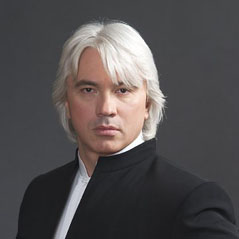
Over the radio, the singer that came off sounding the best was baritone Dmitri Hvorostovsky in Posa's aria from the last act of Verdi's Don Carlo. And while we are at it, the second best singer of the evening was bass René Pape, who sang an amazing rendition of "Ella Giammai M'amo" from the same opera. I can't wait for Pape to sing the role of King Philip after hearing this aria, and I can't wait to hear Dmitri in the role of Posa again. Their fresh young voices made veterans like Domingo, James Morris, and Samuel Ramey sound really old.

By the way, where was Bryn Terfel? I would have loved to have heard some Wagner or Mozart from him.

I hope that there are plans to issue highlights from the evening in DVD. The show will be broadcast on PBS June 1st, so I am sure that the DVD can't be far behind.

When Sir Rudolf Bing retired from the MET in 1972, DG issued an LP of the event featuring the greatest stars of that era. In some ways, the Volpe Gala tried to mimic that incredible event, even to the extend of having a funny song composed just for the occasion (and sung by Deborah Voigt) in the same vein as when Regina Resnik serenaded Sir Rudolf with new words to "Chacon a Son Gout," from Die Fledermaus. Needless to say, the new song just could not compare to the re-worded Strauss composition.

It was a memorable event, but not a perfect one, not by a long shot. Still, I would like to see the video, and I will most likely purchase the DVD of the event when it is issued.

Saturday, May 20, 2006

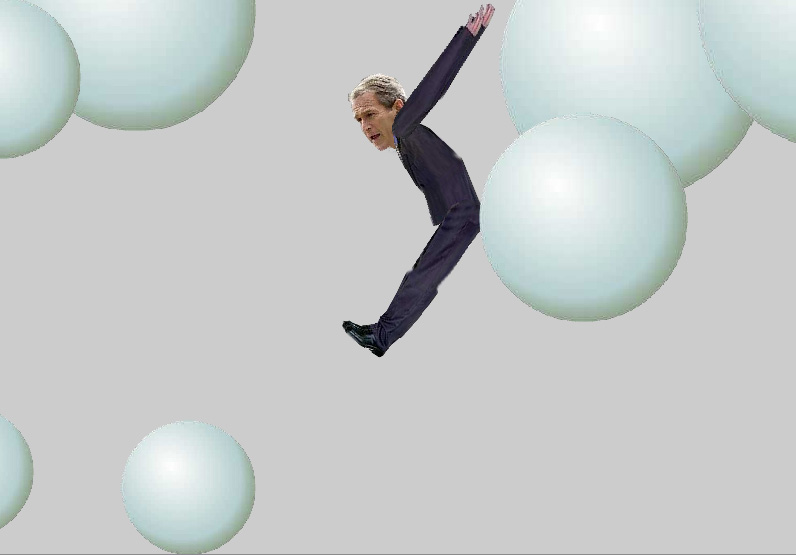
See George Fall!

See George fall, pick him up, or knock him about. Just use your mouse. Click here

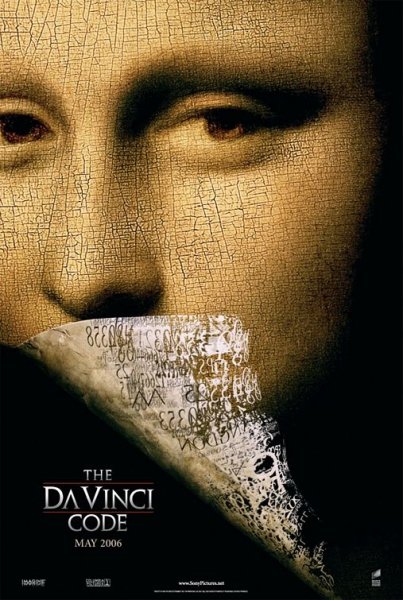
The Da Vinci Code Film Opens Worldwide

It seems to me that if you have a product to sell these days that has something to do, even vaguely, with the Holy Grail, that your numbers have been pretty much in the black for a while, and will continue to remain on that side of the ledger. Just yesterday, for instance, I picked up Piers Paul Read's book The Templars in preparation for the onslaught of Grail talk that will continue to engulf us for a while. The publication of Dan Brown's The Da Vinci Code in 2003 has sparked an interest in this medieval topic, and has already propelled at least one successful legitimate spoof (Monty Python's Spamalot) that lends a welcome respite from all the serious medieval and conspiratorial plots and subplots that we currently seems to crave. Now with the worldwide release of the film The Da Vinci Code, which opened on May 19, we are back on track, once again submerged in the thick of all things conspiratorial and ecclesiastical, getting lost in both, and not being able to tell one thing from the other, which is the main goal of this new movie.


It is the first blockbuster of the summer, and it will do marvelously at the box-office. Most certainly, every other film this summer will have to compare itself to this one in box-office receipts, and I think that they will all fall short. This bonanza will be further sparked by all the talk-show banter about what the film is advocating, by the recent ruling in favor of Dan Brown in the British courts, and by the recent attacks against the movie by The Vatican, who is spending as much money to denigrate the film as Columbia Pictures is shelling out bucks to promote it.

Now to divulge some deep-seeded secrets that will no doubt stand your hair on end: If I told you that Jesus married Mary Magdalene would you believe me? If I told you that I saw this movie in sleepy Danbury Connecticut and that actor Harvey Fierstein was sitting right in front of me (with a woman!) would you think I had some kind of hidden agenda to report? "There are things in Heaven and Earth, Horatio..." let's just leave it at that.

What director Ron Howard has managed to do in his adaptation of the novel is to turn a juggernaut page-turner into a 148 minute boring day at the museum. Novel adaptations are always fun. The masterful ones (A Clockwork Orange, The Godfather) show us hidden potential that the work merely hinted at on the printed page. The truly awful ones like The Bonfire of the Vanities (also starring Tom Hanks) magnify the original work's deficiencies to the point where the once faithful public now begins to question the integrity of the original source.

Tom Hanks with his long locks, which don't look too bad on him, goes through the film with the same quizzical smirk on his face. Also, early on in the film, Mr. Hanks delivers a line from the script that contains a factual mistake concerning the garb penitents (not priests) wear during Holy Week in Spain, and this destroys for me the cinematic character of Robert Langdon right from the outset. A Harvard professor would not make this kind of error. Audrey Tautou plays it much too quiet and insignificant considering the secret that she carries, and Paul Bettany is much too pretty and not threatening enough physically as the deranged monk Silas. This is Paul's second film for Ron Howard where he plays a ghost either literally or figuratively. Jean Reno is not too effective as a French policeman. He was a lot more successful playing Gendarme Gilbert Ponton in this year's The Pink Panther than playing a legitimate cop in this film. The only one who survives this movie is Ian McKellen. That twinkle in his eye, and the way he caresses every line assures us that he knows exactly that all of this is Hollywood dribble. By not approaching it with any kind of seriousness at all, he makes us believe that he is the most serious performer in the entire cast. Bravo Sir Ian for making the two hours plus duration of this film bearable!

It's not that I hated The Da Vinci Code, it's just that I think it could have been trimmed down, speeded up, and it would have made a better film. This is the kind of story that needs Hollywood's smoke and mirrors in order to work. You need to fool the people into believing your side of the story. If you go slowly into it, you end up possibly exposing all the tricks, and the illusion is lost. This is the problem with Ron Howard's movie: it takes the subject matter way too seriously, and approaches it the same way you would a ponderous medieval tome. It's just a novel! It's just a movie! Entertain, don't preach!

Saturday, May 13, 2006

Friday's Parsifal at the MET

After much gossip, a great deal of drama, and impending portents of cancellation throughout the week, tenor Ben Heppner went ahead and sang the tile role of Parsifal on opening night of the revival of this production at The Metropolitan Opera. He did pretty well too -- and so did the rest of the cast!

During the week I reported that Heppner had skipped the dress rehearsal and that the MET had hired two additional tenors for the three scheduled performances of this work. When I got to the MET Friday evening and got my hands on a playbill there was a paper insert inside, but Ben Heppner's name was nowhere on it. His name was most definitely printed on the actual playbill next to the name of the compassionate redeemer, the paper insert only alerted us to a minor cast change involving the Fourth Squire.

Heppner had taken the high road, and he wasn't taking any prisoners. Can you say "He did it!"

Two weeks after a Lohengrin broadcast where his voice cracked in the middle act, Heppner had once again stiffled his critics. Although he was not in choice form for his first ever Parsifal, he looked and sounded strong in the part, showing promise of greatness for the two upcoming performances.

Everyone delivered Friday night: Peter Schneider might not be the most exciting conductor, but he led a competent reading of the score which improved as the evening progressed. René Pape once again proved that he is the Wagner bass of our times with his noble reading of Gurnemanz. He is the only bass I can remember who shows how the character ages throughout the opera. We see him as a young man in the first act, but by the time Act III begins, he has become a gray patriarchal hermit who has trouble kneeling and standing up. Lucky for us. Gurnemanz's voice remains intact during the many years that elapse. Waltraud Meier stole the show on Friday. She first sang this role at the MET fourteen years ago and she made us all believe that she will be able to sing it for fourteen more. She earned a standing ovation after the second act. Thomas Hampson is one of our greatest baritones, but he tried too hard to show the pain of Amfortas' wound and, as a result, his voice lost its focus, especially during Act I. As long as he doesn't shout, Hampson can sing a hell of an Amfortas. His performance of this role in the Nikolaus Lehnhoff production from the Festspielhaus at Baden-Baden (available on DVD) shows what an intelligent approach he can lend to the role. Nikolai Putilin was creepy as Klingsor, but unfortunately he had to cope with extremely silly necromancy stage business. They should get rid of the "fireball" he hurls into the abyss in order to summon the spirit of Kundry back to life. I miss the old MET production with its Wieland Wagner touches of light painting upon a dark canvas. The Klingsor scene in that production had the right scary mood.

A few words about Ben Heppner: it's too bad that he skipped the dress rehearsal. He looked a little unsure of the blocking, and his performance was too broad, almost as if he still had not shaken off the Wilsonian affectations of Lohengrin. In Act I he looked too old and not at all believable as the impetuous youth with little regards for the fauna of Montsalvat. In Act II, surrounded by the Flower Maidens, he looked like a horny Peter Grimes. He has to work on making these two acts truthful for himself so that they will work for the audience. Act III was a lot better: he made a terrific entrance wearing black armor and carrying a great shield and spear. Vocally, it was obvious that he was holding back a bit, scared, perhaps, of having another catastrophic vocal incident. Hopefully, this performance has given him the confidence that he needs to let loose on Monday night.

Those of you who are attending the Monday and Thursday performances might want to add your comments to this blog. I would be interested to hear how the rest of these performances turn out.

The History Boys: on Broadway

The Broadway play to see last year was The Pillowman, so much so that I made sure that I got to the Booth Theater a couple of times; also, Doubt was worthy of all the Tony awards that it received. This year the one you've got to run to see -- and don't you dare miss it because it is going to sweep the Tonys -- is The History Boys, the hilarious, poignant, and often touching smash hit from London's National Theater of Great Britain. It was written by Alan Bennett, and it is one of the delights of this Broadway season. I saw it today at the Saturday matinee, and I think that it one of the great ensemble casts ever assembled on Broadway.

It is not often that this happens, but Actor's Equity has allowed the original British cast, which will be here for only a limited run, to perform the play in America. It is a rare chance to see the kind of work that goes on in London right here in Times Square.

The play is about a small group of British high school seniors who are getting ready to take a series of difficult exams which will determine if they will receive an "Oxbridge" education at the nation's two elite universities. But it is also about the deep relationships that develop between students, between teachers, and more importantly between teachers and students, For anyone who is or has been a teacher it is required viewing. It is the most thought provoking play about a school since Robert Morosco's chilling Child's Play. I am sure that as you watch the play thoughts of your high school days will creep in. Perhaps you will recognize in the boys a former version of yourself, or perhaps someone you know. More than likely, you will find one of your former teachers in the excellent array of adult characters that populate the drama.

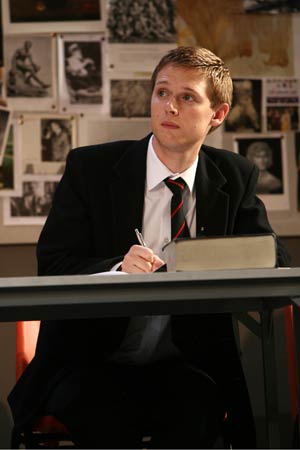
It is such a tight ensemble that it is unfair to signal one actor without mentioning the others. Allow me to be unfair for a moment and signal out Richard Griffiths as the English teacher Hector and Samuel Barnett (pictured above), who plays the shy sensitive student named Posner. Both stand out in a cast which also includes the delightful Frances de La Tour (she played tall headmistress Madame Maxine in Harry Potter and the Goblet of Fire), British character actor Clive Merrison (who has recorded the entire Sherlock Holmes canon for BBC radio), and Stephen Campbell Moore, who can be seen currently in AMC's smash hit Hustle.

Here is the official site of The History Boys. Click to get more information about this play.

In short, one of the most delightful plays Broadway has seen in many seasons, made even more special by the fact that it is currently being performed by the original British cast: don't miss it!

Thursday, May 11, 2006

Heppner Baker and Lehman

Not an uptown New York law firm, but the three tenors, anyone of whom might be singing the title role in Wagner's Parsifal this Friday at the MET. It all started about two weeks ago when Ben Heppner began to lose control of his voice during the run of Lohengrin. After Heppner cracked towards the end of Act II during the Saturday broadcast, the tenor himself must have seen the writing on the wall, and he failed to sing this week's dress rehearsal of Parsifal. In his place, Mark Baker took over the title role and, according to a friend who was at the house for the rehearsal, things were very unsteady for the replacement tenor.

The MET fearing total disaster on opening night this Friday has now hired Gary Lehman (pictured above) who got rave reviews when he filled in for an ailing Plácido Domingo during the run of the Robert Wilson production of Parsifal this past winter in Los Angeles. He will be the understudy to the understudy. I guess we won't know who's going to sing Parsifal this Friday until we open our Playbills!

Wednesday, May 10, 2006

Ben Heppner cancels rehearsal of PARSIFAL

A good friend of mine who attended the Tuesday rehearsal of Parsifal reported that Ben Heppner did not show up and that his understudy for this production, Mark Baker, performed in his place. I wonder if Mr. Heppner is resting his voice for Friday, or if he has decided (given the vocal problems he experienced on the broadcast of Lohengrin two weekends ago) to postpone his MET Parsifal debut until further notice.

The most distressing aspect of all of this is that my friend reported that Mr. Baker was very uneven. On the other hand, she went on to assure me that René Pape was wonderful; although at one point he took the liberty of stopping the rehearsal, breaking character and, stepping to the edge of the stage, he told conductor Peter Schneider that he was conducting the music too fast.

We shall see. They are falling like flies! First James Levine goes down (literally) and now, possibly Heppner. On paper, this once looked like a Parsifal cast for the ages, now, it's all beginning to sound like a bad retelling of Agatha Christie's And Then There Were None.

No performance of Parsifal is ever business as usual, although I must admit that the MET has an excellent track record with this opera when it comes to superior casts and world-class conductors. I just hope that injury and ill-health have not dealt a debilitating blow to this year's production, and that Ben Heppner gets to sing on Friday.

Tuesday, May 09, 2006

Sound and Führer

The Berlin Deutsche Oper opened on November 12, 1912 with a performance of Beethoven's Fidelio. By 1933, the Nazis were in power and Dr. Josef Goebbels, Minister of Culture and Propaganda renamed this institution the Deutsches Opernhaus. This ten-minute B&W film segment shows Goebbels introducing the audience to a performance of Richard Wagner's Die Meistersinger von Nürnberg. The opera house was destroyed in World War II.


I understand that this clip comes from the documentary "Great Conductors of the Third Reich: Art in the Service of Evil," and although I know very few details of the performance, I do know that Hans Sachs is sung by bass baritone Wilhelm Rode, and that conductor Karl Böhm leads the orchestra. If anyone knows more details concerning this performance, feel free to leave a comment on this blog.

Sunday, April 30, 2006

Compassion at the MET: Lohengrin, April 29 2006

This is the second time that I have heard tenor Ben Heppner's voice crack in the middle of a Wagner opera at the MET. The first time that it happened within a personal earshot was at the matinee broadcast of Die Meistersinger a few years ago, and now he did it again Saturday afternoon, at another matinee broadcast, this time during a performance of Lohengrin. The only difference was that I heard the Meistersinger accident on the radio, but Saturday afternoon I was there. My good friend Marta and her husband Bill, members of The Metropolitan Opera Club, invited me to lunch at the club, and then to the performance. Listening to a tenor crack on the radio is one thing, being there is a truly complex musical experience.

Heppner seemed a bit tight during the first act, but managed to finish it with only minor mishaps, really noticeable only on a secondary hearing. However, during the course of the challenging and long Act II, he cracked in two separate places towards the end of the act. Most noticeably on the A natural on the words "Heil dir, Elsa! Nun lass vor Gott uns geh'n!" I am not sure if I can call it "cracking" on the note, it was more like he was vocally unprepared for delivering the phrase, thus leading to the production of one of the ugliest sounds I have ever heard at the MET. Ironically and sadly for Heppner, that was the last phrase that he had to sing before the end of the Act. On the bright side, he was able to finish the performance, singing a lovely third act, and a very effective "In fernem Land."

I think that Ben Heppner has the goods, and oftentimes, he tends to deliver them. Whether or not his voice is that of a true heldentenor (or whether or not he will be the next Siegfried) belongs in another discussion. However, last time this vocal embarrassment happened to Heppner during a MET broadcast, we started hearing reports that he was suffering all kinds of vocal problems that were leading to the cancellation of recitals up and down the U.S. and Canada. Eventually, he took a break from singing for several months and lost weight, which he has managed to keep off.

I am worried that he is going down the same path again, and I am especially worried that his first Parsifal at the MET might be compromised by whatever vocal problems might be plaguing him at the moment. Let us hope that he gets over this, and that he is able to debut in Parsifal successfully.

Friday, April 21, 2006

Lohengrin: Performance of Thursday April 20, 2006

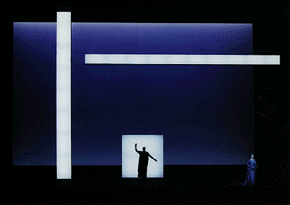
It's wonderful to experience Lohengrin again at the MET, and even more wonderful to have a chance to re-explore Robert Wilson's unusual take on this romantic Wagner opera. I had completely forgotten the off-white curtain with the single blue wing on it that greeets the audience upon arriving in the auditorium (next year, with Peter Gelb introducing so many "new" operas, we may never get to see the Gold Curtain!), and the tremendous impact that this production can have on those willing to take a gamble on it. Back in 1998, I thought that Mr. Wilson's Lohengrin was a totally unique look for the MET. Since then, I have observed that he has pretty much applied a similar formula to his Parsifal in Los Angeles, and his Ring of the Nibelung at the Paris Opera.

The staging has remained pretty much the same: a backdrop of ever-changing hues of blues, and white neon-like monoliths that occasionally invade the stage in order to signal the beginnings or endings of scenes. Thankfully, the conclusion of Act II, involving the character of Ortrud and a crimson red curtain (to my mind, one of the master strokes of this production), remains intact from the first time I saw it.

One aspect that has been eliminated from the production is the rhythmic, but awkward hand-movements that everyone: critics, audience and, in particular, performers alike, complained about back when the production was new. Now, the characters move about the scenic space in a glacial pace, which at times is interrupted by poses which remind one of Kabuki theater. Not everyone is cut out to be a Robert Wilson performer. Some like Karita Mattila (Elsa), Eike Wilm Schulte (The Herald), and Luana DeVol (Ortrud) come naturally to it. Others like Ben Heppner (Lohengrin) struggle not to appear self-conscious.

Vocally, it was a strong evening. All the principals rose to the ocassion. The only weak link was Andrew Greenan who was the last-minute King Henry replacement for Stephen West, who was ill. Both Karita Matilla and Ben Heppner were perfect and made some lovely ethereal sounds as the lovers. Meanwhile, Luana DeVol and Richard Paul Fink as Ortrud and Telramund were evil and dastardly in their respective roles.

I must say that Philippe Auguin led a carefully crafted reading of the score -- his baton marking clear metronomic beats during the Act I prelude. Not the most inspiring of conductors, but definitely easy to follow. He also appears to be a jovial fellow, and during his curtain call he even turned to acknowledge the work of the chorus, who sang brilliantly. But I also have to report that when the cat's away, the mice will indeed play: there were some awful sounds coming from the "banda" backstage. Let's hope this gets fixed by the next performances, and especially for the broadcast.

Overall, this Lohengrin is a strong revival of one of the most important productions that the MET has staged in years. Do not, I repeat: do not miss it.

Thursday, April 20, 2006

British Götterdämmerung: Financial Times Review

Here is a review of the new Götterdämmerung production at The Royal Opera, Covent Garden, from the Financial Times of London.

At curtain-down on Monday the Royal Opera passed the virility test of any self-respecting opera ensemble: it completed a new Ring, the first in its renovated Covent Garden home. It was a cause for minor rejoicing, not just because the evening was more successful than the three previous instalments of the Antonio Pappano-Keith Warner production, but because we can now look forward to the first integrated cycle of Wagner’s tetralogy in London for a decade. Unlike English National Opera’s recent attempt, which foundered through lack of funds and willpower, the Royal Opera promises three complete Ring cycles in 18 months’ time, and is already marketing them.

The engineer of Monday’s success was Antonio Pappano, whose Wagner conducting suddenly seems to have found its pulse and shape. There were no traces of the disjointedness that dogged earlier instalments. The Royal Opera’s music director has finally begun to relax. He now listens to the music in longer breaths, communicating a wider sense of its architecture and a more mature grasp of Wagner’s orchestral palette. The Norns scene is a little slow – better that than starting off fast – but from there it is the most singer- friendly Wagner I have heard, generating Italianate lyricism in the Brunnhilde-Siegfried duet and a suitably high-voltage act two.

With the exception of Peter Sidhom’s muffled Alberich, this is also the finest cast since Das Rheingold 18 months ago. Lisa Gasteen’s Brunnhilde gets better and better: there are no exposed notes to trouble her, she looks more feminine (costumes by Marie-Jeanne Lecca) and she has found a way of singing the German words expressively. Just as important, she manages the transition from spunky bride to heroic tragédienne with ease. She deserves better than John Treleaven’s cautiously crowing Siegfried.

John Tomlinson’s Hagen is another of his clever portraits of evil, while Peter Coleman- Wright gives Gunther welcome substance. I particularly liked Mihoko Fujimura’s Waltraute and Marina Poplavskaya’s Third Norn, the latter a Sieglinde in the making.

It may be hard to come to Warner’s staging without prejudices formed by his previous three Ring evenings, but he nearly wipes those memories in the first two acts of Götterdämmerung. Stefanos Lazaridis’s sets have a clear architectural profile, and the Gibichung scenes – a stretch-settee in act one, a mobile platform in act two, both gilded with statues of the gods – tell us that Hagen & Co have as much sincerity as Hollywood royalty. There is a novel solution to the act one finale: Warner assumes his audience is intelligent enough to know that the Gunther who overpowers Brünnhilde is really Siegfried transformed by the magic Tarnhelm. Why then have Siegfried walking about simultaneously?

If the storyline is otherwise clear, the real thrust of Warner’s staging remains intentionally murky. It is not so much an interpretation, more a narrative overlaid with à la carte references to Wagnerian philosophy, which the audience can either ignore or acknowledge, depending on familiarity with the composer’s influences and intentions. Should Wagner’s idea of the imprisoning power of civil society, for example, have any bearing on the Gibichung scenes? And if so, why does the Tarnhelm come from the same cast? Is Hagen the alter ego, the dark side, of Brünnhilde, just as Alberich is of Wotan? What is the significance of the crown of thorns in which Brünnhilde is borne into the hall of the Gibichungs?

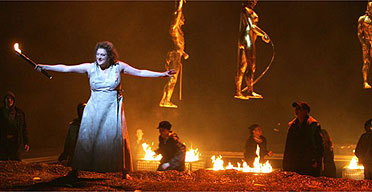
For all its philosophical pretensions this staging is fatally short of attitude or irony, and it limps home in act three. Lazaridis falls back on the clutter that has become a leitmotif of his Ring. Warner neuters Siegfried’s demise and Brünnhilde’s swansong, and the only redeeming factor in the finale – an empty fire-spectacle with an innocent boy raised aloft – is the sight of Heather Shipp’s breasts: she and the other two Rhinemaidens exchange their grunge for the full Monty as they reclaim the cursed gold. Does this Ring have nothing deeper or more original to say?

Wednesday, April 19, 2006

Robert Wilson's Lohengrin at the MET

The reviews are in for Monday's premiere of the revival of Wagner's Lohengrin at the MET. I will have my own review of this production in a few days: I will be going to see it Thursday evening.

Here is an excerpt from Anthony Tommasini's review in the New York Times.

It stands to reason that a high-concept new production at the Metropolitan Opera might take time to settle in and refine itself. The best example in recent years is Robert Wilson's staging of Wagner's Lohengrin.

The revival that opened on Monday night, winning huge ovations, especially for the tenor Ben Heppner as the grail knight Lohengrin and the soprano Karita Mattila as the innocent Elsa, is not the same show that earned Mr. Wilson lusty boos when the production was unveiled in March 1998. Back then the abstract scenic designs, a Wilson trademark, made for some haunting, mystical Wagnerian imagery: against a backdrop with shifting hues of blue, gray and green, slowly moving luminous white rectangular beams crisscross the bare stage. Still, the glacial movements of the singers and the highly stylized hand and arm gestures made everyone look terribly uncomfortable.

When the production returned the next season, the stylized movements had been simplified. On Monday the movements of the cast were simpler still, and the scenic designs as beautiful as ever. Finally, the astute concept behind Mr. Wilson's staging came through.

If the singers seemed self-conscious with their movements at times, for the most part Mr. Wilson's direction empowered them to give bold performances, especially Mr. Heppner. Many heldentenors are actually pushed-up baritones. Mr. Heppner is the real thing, a tenor with a clarion top range and a bright ping in his sound. His voice faltered a couple of times in the punishing Act III monologue, in which Lohengrin reveals the secrets of his origin and the reason for his mission. But it hardly mattered. This was a heroic and thrilling performance.

Ms. Mattila's singing unusually combines cool Nordic colorings with visceral emotional intensity. She was in her glory as Elsa. Coming off her winning Met portrayal of Leonore in Beethoven's Fidelio, where she acted with affecting naturalness, she was equally riveting, and stunningly beautiful, working within Mr. Wilson's stylized concept.

Making her Met debut well into her career, the American soprano Luana DeVol sang Ortrud. Though her voice was sometimes tremulous and hard-edged, she sang with fiery abandon and cut through the orchestra with slicing high notes. Despite some hammy Cruella DeVil moments, she bravely embraced the concept and was a wonderfully malevolent presence. Mr. Fink and the baritone Eike Wilm Schulte, as the king's herald, were also strong. Substituting for the bass-baritone Stephen West, who was ill, Andrew Greenan made his Met debut as King Henry, singing with robust sound until his voice tired in the last act.

Though James Levine had been scheduled to conduct this revival, Philippe Auguin proved an exciting substitute who drew a shimmering, surely paced and incisive performance from the orchestra and chorus. Mr. Auguin has a history of saving the day for Mr. Levine. He made his Met debut in 2001, conducting the new production of Busoni's Doktor Faust, after Mr. Levine withdrew.

Over all, the simpler this production becomes, the better it seems. Even Mr. Wilson, who was in the audience, would probably agree.

Tuesday, April 18, 2006

Bangkok, New York, and London

Richard Wagner is very much in the news these days. On Monday, The Metropolitan Opera revived Robert Wilson's controversial Lohengrin, which I will get a chance to see on Thursday evening. There is a new production of Götterdämmerung at the Royal Opera House, Covent Garden, which, regretfully, I have no plans of attending. And, the biggest news so far is that Thailand has become the first Southeast nation to present Wagner's Der Ring des Nibelungen. The Bangkok's Opera's production (which I will definitely will not be attending) seems to be a very interesting vision of the composer's work. Here are extended excepts from the New York Times review of the event.

Bangkok Opera Presents Wagner's "Ring" With a Difference by Robert Turnball

Thailand's decision to be the first Southeast Asian nation to present the work has surprised even the most ardent Wagnerians. The production, by the Bangkok Opera, has the official blessing of the composer's great-grandson Wolfgang, who inaugurated Bangkok's Wagner Society last year. But it is a huge undertaking for a country that has been producing Western opera for only five years. Will Wagner be raising a quizzical eye from beyond the grave?

To be performed over the next four years, this new "Ring" is being called the first to address a regional sensibility. Instead of Nietzsche, substitute Buddha: the cycle of destruction and rebirth is wrought not so much by power but by the Buddhist pitfalls of desire and attachment.

The design too embraces Thai motifs. A work still associated in many minds with horned helmets and mythical castles features gods as bejeweled classical dancers, entering a Valhalla that imitates the Bangkok skyline.

The impresario behind the project is Somtow Papinian Sucharitkul, a British-educated Thai conductor of vaulting ambitions who also dabbles in painting and filmmaking and has written 47 cult novels under the name S. P. Somtow. As a musician he is a refreshing polymath in an age of increasing specialization. Not content to conduct opera, he also produces, designs and directs it; when inspired, he'll also finish it, as he did with the last act of Puccini's uncompleted "Turandot," once the opera was out of copyright.

Monday, April 17, 2006

Götterdämmerung at Covent Garden

A new production of Götterdämmerung opened tonight at Covent Garden, London. While we wait for the reviews to be in, I thought I would re-print this London Times article from July 14.


Wagner, like Marmite, George W. Bush and Manchester United, is a polarising force in our society. You’re either passionately devoted or implacably hostile. And once people have decided which side they’re on, there’s no shifting them.

Few artists, certainly no other composers, inspire the passionate feelings of hatred and revulsion that Wagner can provoke. But, just as the antagonism that Man U inspires among other fans only attests to their durable quality, and the antipathy that George Bush faces only underlines the importance of his challenge to traditional ways of thinking, so the strength of anti-Wagner feeling proves what his detractors cannot deny — the immense power of his music.

And music is where any encounter with Wagner should begin and end. His mature works have a power to move that no opera written before ever had. While previous operas can enchant, divert, charm, make you think, amuse and, at their best, hint at the sublime, Wagner’s work comes bounding off the stage, wrenches at your heart and tries to make a prisoner of your soul.

For many people a music that sets out so powerfully to seduce is just too much to take. When that music is written, as Wagner’s was, by a sexually manipulative and egomaniac anti-Semite, then resisting it seems almost a moral duty. But if you turn away from Wagner you’re turning your back on the chance to experience some of the most complete, and deepest, experiences you can have with your clothes on. Because Wagner’s operas use music to open up a world in which human psychology, our spiritual yearnings and even our political arrangements are all explored in a way that speaks to us, whatever our background.

Wagner’s operas differ in form from everything that went before by being complete music-dramas, in which every aspect of what goes on before us is conceived as a unified whole. Before Wagner the standard opera form was a mixture of nice incidental music, connecting plot-lines (or recitative), and the set-piece highpoints (the arias), after which everyone applauds. There is a sense of staidness, even formality, about the process.

Wagner’s operas were conceived in a wholly different way, with music, poetry, staging and plot fused so that each reinforces the other. Individual chords, or specific melodic phrases (leitmotivs), become, through their precise musical structure, symbols for characters, concepts and forces. These chords and leitmotivs can convey anything from inexpressible longing to scheming wickedness and the serenity of nature.

In the Ring the leitmotivs become one of the most important element in a multilayered experience in which the sung poetry, the performers’ acting skills and the visual cues of staging and direction all interweave to simultaneously advance the plot, reveal the inner emotional state of characters, remind us of their past interactions and suggest to us the broader allegories behind their acts.

The fusion which Wagner brings about makes his operas, and the Ring in particular, a deep intellectual as well as emotional experience. Once you begin to appreciate the depth of it, and I for one am only just beginning, you have the exhilarating feeling of knowing that this is a world to which you can return many times and find an endless amount more to appreciate, enjoy and reflect on.

Some people, of course, are put off even beginning that journey, not because they want to resist being drawn into such a seductive world, nor even because they find Wagner’s personality an obstacle, but because the whole horns and dwarves, dragons and spears palaver seems so terribly teenage. If they want an epic with swords and sorcery they’ll get The Two Towers out on DVD, because after all you can’t get CGI giants at the Royal Opera House.

But the mythic world that Wagner creates is not an adolescent escape from reality. It is a daring attempt to make genuinely universal themes artistically resonant across generations and cultures by locating them outside history. Epic and myth allow us to see our virtues, and temptations, dramatised on such a scale, and in such a way, that they speak direct to our nature. Myth, rather than distancing us from the action, enables it to cut through the specifics of our time and place and engage our souls. Wotan’s struggle between the need to observe the rule of law and his own ambition has a contemporary resonance in the politics of Britain today. But it will also have had subtly different resonances in different politics of past ages, and other nations.

Allowing the myth to breathe allows us to appreciate the universal insights about the battle between law and passion, power and love.

Sunday, April 09, 2006

A Quarter for Weill and Brecht

If your idea of The Threepenny Opera is Bobby Darrin singing "Mack the Knife" or the early 1930's G.W. Pabst German film, then you are in for a shock. This production of this landmark musical is scathing, sexually provocative, and totally Brechtian in its approach and delivery. Not surprisingly, theater goers raised on The Lion King and Cats will leave the theater with a sour taste in their mouth when it is over, and that's exactly what the original creators of this work would have wanted you to feel.

Written in the heyday of the Weimar Republic, when the number of the poor grew to monumental proportions and a chosen few were rolling in it, the present production tries to make a historical connection between that sorry period of Germany's past and our present state of affairs. The show's economic criticism could very well be directed at its own audience: at $111.25 per tickets the only ones who can afford to see The Threepenny Opera might just be the fatcats that the show rages against. When Broadway starts biting the hand that feeds it that is the sure recipe for slow box-office receipts and short runs.

The show certainly has star power: Alan Cumming, Cyndi Lauper, Jim Dale and Ana Gasteyer (she got a big hand in her entrance -- it was obviously a television SNL crowd that packed the theater today) are all good, but it was Brian Charles Rooney who stole the show with his gender-bending take on Lucy Brown. I see a Tony nomination in his future. I found both Mr. Cumming and Ms. Lauper lacking voice-power, although she sang a memorable "Salomon Song," and he commands the stage with that same genuine presence that he had in Cabaret. Unfortunately he was pushing a bit on his vocal chords, and Ms. Lauper's voice is in need of coaching. I do hope that this run does not harm her voice further.

There is a warning outside the theater that the show has full frontal nudity (yes, it does!) and that the language is adult and not recommended for children. This is true, and although most of the adult moments do come straight from the texture of the narrative, there are a few new indiscretions that were not found in the original Brecht script.

The new translation by Wallace Shawn tries to get back to the spirit of the original Brecht, but it tries too hard, in my opinion, to be lewd. My favorite English translation of this work is the one by Ralph Manheim and John Willett for the New York Shakespeare Festival back in 1976. That production brought the work back to a more authentic Brechtian language. The wondrous LP cast album of that production, featuring Raul Julia as Macheath, has never made it to CD, and it is time that it did.

Finally, the wardrobe by designer Isaac Mizrahi is elegant and sleazy, with the right amount of bling to make it tawdry.

I recommend that you see this production if you have never seen The Threepenny Opera live. It is one of the landmarks of the 20th century, and it can be indestructible no matter what you do to it.

Sunday, April 02, 2006

The Reviews are in for Erika Sunnegardh

Here's what Anthony Tommasini had to say about the surprise debut of unknown soprano Erika Sunnegardh in the role of Leonore in Beethoven's Fidelio, in yesterday's MET broadcast.

"Pressure Abounds as Determined Soprano Makes Debut" by Anthony Tommasini

Some extraordinary performing artists have ordinary life stories. Others, like the Swedish-born soprano Erika Sunnegardh, have dramatic life stories that, for better or worse, will tag them for their entire careers.

Ms. Sunnegardh's story is a tale of early promise, years of frustration, waiting tables and, finally at 40, the biggest break of all: a dream-come-true Metropolitan Opera debut yesterday afternoon in the role of Leonore in Beethoven's Fidelio, in a coveted radio broadcast performance.

A fuller assessment will have to await her future appearances. Ms. Sunnegardh was substituting for the magnificent Karita Mattila, who was sick and who excels in this role. Moreover, Ms. Sunnegardh's story, reported yesterday by The New York Times , seems to have already traveled the world. Talk about pressure.

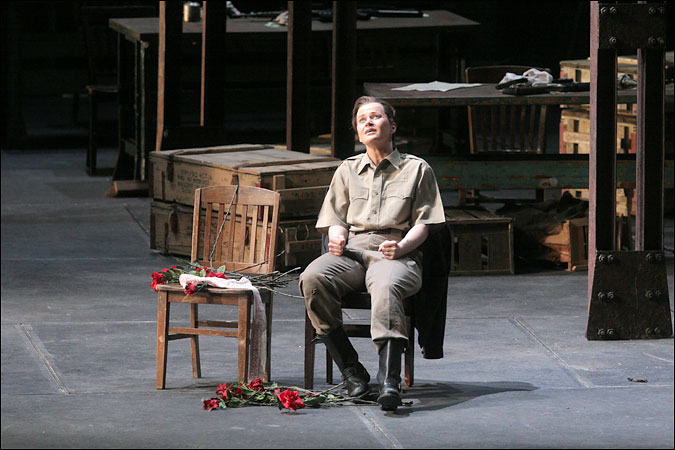
During Act I the pressure got the better of her, it appeared. Small-framed and attractive, she looked suitably boyish as Leonore, a heroic Spanish wife who disguises herself as a young man, Fidelio, and gains a job in a prison where she believes her husband is being unjustly and brutally held. But vocally, Ms. Sunnegardh took a long while to warm up.

Her voice has earthy colorings and warmth. She is especially comfortable in her upper range and has strong, clear top notes. Her midrange singing, though, sounded patchy yesterday.

In Leonore's aria of determination, Ms. Sunnegardh got lost momentarily and dropped a couple of phrases. She and the conductor, Paul Nadler, soon got back in sync. The error must have bothered her more than it bothered her listeners.

But after intermission, in Act II, she seemed more relaxed and took greater chances, especially in the climatic scene when she defies the tyrannical governor of the prison and saves the day. She grew stronger as the opera swept forward to its joyous conclusion.

That said, the difference between Ms. Sunnegardh's tentative performance and the work of the heldentenor, Ben Heppner, who inhabited the role of Florestan, the political prisoner, was hard to ignore. She has lost some time. But she has talent, grit and determination.

She also had the audience at the Met absolutely behind her. I wish I could say that this affecting personal story ended in artistic triumph. Not yet. Opera fans will undoubtedly get a better indication of what Ms. Sunnegardh is capable of when she sings the role again, as previously scheduled, on April 13.

Saturday, April 01, 2006

Erika Sunnegardh: In Good Company

This afternoon the MET got a much needed shot in the arm as it hosted the debut of a rising opera star: Erika Sunnegardh, who assumed the title role in Beethoven's Fidelio, replacing Karita Mattila who is ill. The MET really needed this kind of an event. There has not been so much excitement generated by a debut at the MET since Roberto Alagna debuted here as Rodolfo in La Boheme back in 1996.

It's been a bad year at the MET no matter how you look at it. Sales have been weak, attendance poor, and although there have been some artistic highlights thus far in the season (this production of Fidelio being one of them), and promising productions later on to follow (Lohengrin and Parsifal), it has been a disappointing opera season in New York City. Of course, James Levine's unfortunate injury, which has sidelined him for the rest of the season, was the last straw. Joseph Volpe will never forget his last year at the MET.

But back to Ms. Sunnegardh: her exciting debut, which was sparked by a wonderful article in the New York Times this morning, went well for her, but not without a hitch, as apparently she got lost during during the first act. Her nerves must have been working overtime knowing that potentially millions of picky opera lovers were listening to the broadcast. I am looking forward to listening to a recording of the broadcast next week.

She is in good company, though: the following singers all made their MET debuts in a broadcast: Jan Peerce, Bidú Sayao, Kirsten Flagstad. Gwyneth Jones, Hermann Prey, and Alan Titus.

Tuesday, March 28, 2006

How American is the new Washington Rheingold?

Here is Anthony Tommasini's review from The New York Times:


WASHINGTON, March 26 — If you put on a production of Wagner's monumental "Ring" cycle, you'd better have a novel concept. That's accepted wisdom in the opera world. We have had industrial age "Rings," an environmentally green "Ring," and several cosmic "Rings" with mystical lighting and abstract scenery.

On Saturday night the Washington National Opera introduced its new production of "Das Rheingold," the first installment of its first complete "Ring" cycle (a co-production with the San Francisco Opera), which will unfold over the next three seasons at the Kennedy Center. For months, the director Francesca Zambello's staging had been touted as a provocatively American "Ring" steeped in American mythology and iconography.

There are many fresh and impressive elements to the company's colorful, abstract and well cast "Rheingold." But its success is only partly attributable to overtly American imagery.

It's true, for example, that in the opening scene Ms. Zambello, working with the set designer Michael Yeargan and the costume designer Anita Yavich, portrays Wagner's Alberich, the dwarf who dwells among the lower race of Nibelungs, as a hulking forty-niner, with thick boots and suspenders, panning for gold; the Rhine Maidens are a trio of sassy gals in fleecy dresses who cavort on a mining sluice, a wonderful wood contraption with chutes and ladders.

But the visual imagery that really gives this scene its impact is the depiction of the pristine river. Rushing water is suggested through swirling video projections by Jan Hartley. When the magic gold glows from the river bed, the Rhine Maidens do a celebratory dance with a billowing silken sheet atop this abstract river's sleek, clear plastic surface. Shafts of golden light (courtesy of the lighting designer Mark McCullough) fill the stage. None of this would matter, though, without the powerful singing of the baritone Gordon Hawkins as Alberich, who nearly stole the show all evening.

The giants Fasolt and Fafner (the bass-baritones John Marcus Bindel and Jeffrey Wells), having just finished building Wotan's castle Valhalla, first appear sitting on a steel beam as it is lowered from an unseen crane. They are blue-collar laborers in matching overalls with elongated legs and huge clodhopper feet. If they look a little like Gumby giants, the cartoonish humor seems intentional. Ms. Zambello is refreshingly attentive to the whimsical side of Wagner's mythological tale. The audience, sensing it was O.K. to laugh, did.

Wotan and the gods are portrayed as entitled 1920's characters out of "The Great Gatsby," arrayed in white summer suits and dresses. Loge, the god of fire, is a wily lawyer in a tailored overcoat (the tenor Robin Leggate). Still, there is nothing especially American about his look, which has a hint of Inspector Clouseau. The rich-voiced mezzo-soprano Elizabeth Bishop is excellent as a matronly and prideful Fricka, the long-suffering wife to the inconstant Wotan.

With his goatee and fedora, the sturdy bass-baritone Robert Hale makes an unusually lanky and disdainful Wotan. Still, in the scene when he descends to the lower world to wrest the magic ring from Alberich, he seems too aloof for the job. Mr. Hawkins's booming and husky Alberich looks as if he could take down the surly god — no problem.

The Americanization concept turns political when the all-knowing earth goddess Erda (the tremulous-voiced mezzo-soprano Elena Zaremba) appears with her ominous warning for Wotan. She is costumed as a Native American princess, and looks as if she had wandered in from Buffalo Bill's Wild West Show.

The lingering image of this production comes in the deep, dank and sulfurous mine where Alberich brutally drives his slaves to hew rock and forge gold. The workers are played by a roster of some 50 mostly minority children, large and small, with tattered clothing and sooty faces. Evoking the history of slavery in America is the idea, but the image of child labor, which remains an international outrage, is what came through for me.

With about 65 players, the orchestra is a little undersize for Wagner. But the veteran conductor Heinz Fricke, the company's music director, turns this to advantage and elicits playing of rewarding clarity and, at times, chamber music-like intimacy. Wagner's two-and-a-half-hour score emerges in a calmly paced and shapely arc.

Though there are still three operas, lasting almost 15 hours, to go, the Washington National Opera is off to a good start with "Das Rheingold." But they might want to damp down all the talk about their American spin on Wagner's "Ring."