Wednesday, June 22, 2005

Nikolaus Lehnhoff's Parsifal on DVD

Wagner's concept of "total art work" was not something that he liked to share. Mozart and Verdi were fortunate to have had Lorenzo Da Ponte and Arrigo Boito respectively writing their lyrics. Wagner, whose abilities as poet and dramatist were not equal to his prodigious gift for composing, aimed to achieve his Gesamtkunstwerk by writing his own ponderous libretti that were mired in 19th century dramatic forms. The conventionality of his dramaturgy also extended to his conservative views on scenic design. His stage concept for Parsifal, his last opera, came to be regarded as his sacred legacy, and the sets of the original production were not replaced until the 1930's.

The 1951 production of Parsifal at Bayreuth was an economic and socio-political necessity, and it radically changed the course of Wagnerian staging. Wieland Wagner needed to rid his grandfather's works of the Nazi legacy that they had acquired and, in the harsh economic reality of post-World War II Germany, the operas needed to be mounted as cheaply as possible: the true reason for the simple sets, plain costumes, and the inventive use of lighting of the so-called "New Bayreuth" style.

It was the 1976 Bayreuth Centenary Ring, brilliantly conceived by Patrice Chéreau, that brought us to a new era in Wagnerian staging: the age of the director. That landmark production, gave carte blanche to stage directors and scenic designers to take liberties with Wagner's works, and offer the public concept productions. This is where we find ourselves in 2005. A few of these experiments have achieved a certain amount of brilliance, while the large majority of them have been downright silly, ridiculous, and even offensive. The 2004 Parsifal at Bayreuth might have been a new low in Wagnerian staging.

The new Parsifal DVD from Opus Arte captures for posterity the Nikolaus Lehnhoff, Kent Nagano production from the stage of the Festspielhaus in Baden-Baden, Germany. It was recorded live in 2004. This DVD was put together from the three performances that the opera received at the Festival in the month of August, last summer.

This production, which was originally conceived by Mr. Lehnhoff for the English National Opera was also performed in San Francisco as well as in Lyric Opera of Chicago, before arriving last year at Baden-Baden. The cast for this DVD is superb with Christopher Ventris as Parsifal, Waltraud Meier as Kundry, Matti Salminen as Gurnemanz, Thomas Hampson as Amfortas, and Tom Fox as Klingsor. The Deutsches Symphonie-Orchester Berlin under conductor Kent Nagano plays the work with flair and precision, in what I would call a swift reading of this Wagner work.


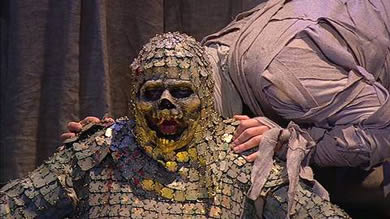
If you like your visual representation of Parsifal to be as the composer intended, then stay far away from this production. It is abstract, unconventional, "Euro-trashy" to some, and totally fascinating to any lover of contemporary Wagnerian staging. The curtain rises on a post-apocalyptic world, strewn with debris and painted in submarine grey. The set is an unwelcoming steel platform which curves up at the back showing suspended chairs that seem to defy all sense of gravity. To add to the clutter, a giant meteor is lodged on the wall. Gurnemanz's young knights are dressed like the statues of the famous terracotta army in Xian, and Kundry wears the kind of "roadkill" fashion that makes her look like one of the less fortunate felines in the musical Cats. The first time we meet Parsifal he makes his entrance wearing a headband and war-paint. Amfortas is a feverishly tormented character, plagued with self doubts and wrapped like a mummy. Even Titurel makes a rare appearance in this production, looking like a medieval George Romero flesh-eating zombie.

Act II opens with a gigantic projection of an X-ray of a human pelvis, Klingsor, dressed like one of the evil characters from a Kabuki work, appears floating in a kind of bubble, hovering between the sacrum and the symphysis pubis bones. Kundry, in her Act II role as the seductress, shows up with the kind of hair and dress that would make the Versace runways at the annual spring show come to life. Visually, Act II does not leave too much of an impact on the viewer, and it is one of the weakest aspects of this production. Particularly disappointing is the way by which Parsifal obtains the spear from Klingsor. Those familiar with the old MET production of this opera will remember how Klingsor would hurl the spear at Parsifal and he would catch it in midair -- a clever and effective bit of stagecraft that would leave audiences gasping and wondering how it was accomplished.
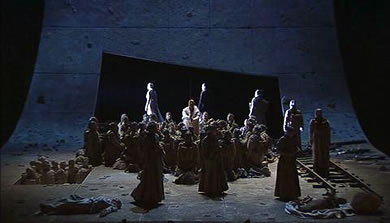

While Act II is a bit disappointing, the concept of Act III is inspired. The same wall that we saw in Act I now opens into a dark tunnel with railroad tracks leading out of it. Where these tracks might be going or where they come from is never answered. To one side, stuffed in a hole, we see the bodies (or are they statues) of dead knights. Once Parsifal brings back the spear Amfortas dies but not before passing down his crown to Parsifal, who rather than accepting it, carries it to the dead body of Titurel and places it on the head of the dead king. Kundry, whose wrappings from head to toe make her look like a mummy, gets up and slowly heads back to the tunnel via the train tracks. From the depths of the darkness now a powerful light shines and drives her forward. Parsifal follows her, and little by little so do a number of knights. It seems as if the brotherhood is desolving itself as the knights, one by one, decide to go somewhere else. Gurnemanz holds the spear with reverential respect, but as the curtain slowly closes, it seems that very soon he will be the only one left, as more and more knights get up to follow the others down the tracks.
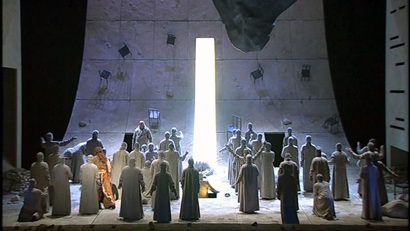
The most powerful images and concepts of this production are found in the second scene of Act I. Particularly superb is Lehnhoff's interpretation of the Holy Grail as a radiant blinding light on the other side of the steel wall. Is this powerful glow the aftermath of some recent spectacular nuclear holocaust that has now been accepted as a new god, or is it the light of some older established deity shining on humanity once more in times of trouble? Equally superb is the sequence when the knights meekly exit through the two side doors only to come back through the center glowing opening marching, wearing helmets and carrying spears. The Grail has miraculously metamorphosed them into warriors. This scene, which comments on the link that has historically always exhisted between religion and war, is one of the most memorable statements of this unforgettable production.

Wednesday, June 15, 2005

Dirty, Rotten... / Piazza

Over the years, the Broadway musical has developed into two stylistic entities. At the risk of offending the buffs, one of these camps is occupied by the serious musical, and the other, well, ... shall we say, the not so serious musical. Always a risky thing to call a musical creation not serious, especially since these creations have been more popular and more profitable than the so-called serious ones; and when it comes to money, seriousness is everyone's middle name.

Stephen Sondheim's musicals, brilliant in their execution and thought-provoking in their ideas, are the pinnacle of the genre of our time. The audiences to these works, however, are limited and as a result the shows themselves have always suffered disappointing runs. The recent revival of Pacific Overtures, one of Sondheim's most interesting shows, closed prematurely despite favorable reviews and positive audience reaction.

It's been the mind versus the heart when it comes to Broadway musicals. In 1939 the incredibly popular show Hellzapoppin opened, and so did Marc Blitzstein's The Cradle Will Rock; the year 1954 saw the Broadway premiere of the sardonic The Threepenny Opera as well as The Pajama Game. More recently, Cats and Little Shop of Horrors opened the same year as Maury Yeston's Nine; and to the great delight of Broadway audiences, who normally relish the great variety that a rich theater seasons can bring, at one point you could see Annie, Sweeney Todd, Sugar Babies, and a nifty revival of Oklahoma! all running simultaneously. Many times, in shows such as A Chorus Line, My Fair Lady, West Side Story, and almost everything by Rodgers and Hammerstein, and Lerner and Loewe the mind and the heart meet, and masterpieces are born.

Two shows this season, Dirty Rotten Scoundrels and The Light in the Piazza are representative of this stylistic split down the middle between the heart and mind that we have come to know (and love) about Broadway.


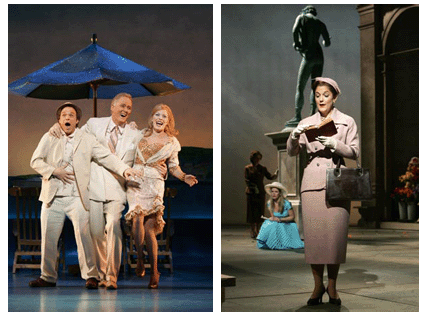
Dirty Rotten Scoundrels at the Imperial Theater is tacky, loud and filled to the brim with fun. It is a funky romp where the best thing for the audience to do is just let it all hang out and go for the ride. There is an inherent slyness to the show, as well as an inherent crudeness, and all of it is cleverly sugar coated by the wonderful performances of the five talented principals. David Yazbek's music is a hodgepodge of styles, all with a decidedly agreeable Broadway swagger. The songs are loaded down with lowbrow humor and range from the unforgettably delish to the instantly forgettable. Norbert Leo Butz steals the show. His Tony Award was well-deserved. I dare anyone not to laugh out loud when he performs the number "Great Big Stuff," which at this point of the run flows out of him so effortlessly that it will be hard to see anyone else doing it. It's like he owns it! It is an early showstopper that gets the audience going, and it alone is worth the exorbitant price of admission. "All About Ruprecht," another number also prominently featuring Mr. Butz, is what Dirty Rotten Scoundrels is all about: sheer zaniness translated as popular entertainment. It is the kind of show that can run for years if properly taken care of.

The Light in the Piazza is as ephemeral as Dirty Rotten Scoundrels is brassy. Currently running at the Vivian Beaumont Theater at Lincoln Center, this musical is based on a novella that first appeared in the pages of The New Yorker magazine. The show has the radiance of summertime in Florence, and it flows with a calculated delicacy that not even the Arno river can equal. The show is all about restraint, both musically and dramatically. Adam Guettel's music and lyrics are rooted in operetta, which is to say that the musical language is post-Sondheim with a backward glance to Gian-Carlo Menotti. The result is music that Guettel's grandfather, the great Richard Rodgers, would have never written for a Broadway show, but could have written any time he wanted. The music is subtle, intelligent, at times extremely complex, expertly written and orchestrated and, like the worst moments of Dirty Rotten Scoundrels, utterly forgettable as well. (Just to be fair, though, did audiences come out humming the music of Maurice Ravel when they first heard it at the beginning of the 20th century? Of course they didn't!) The music to this show is not really pretentious -- it just sounds that way! In this regard, The Light in the Piazza is the "serious" show of the season. It is the one that intelligent critics will discuss intelligently; it is the one that won the Tony award for best score, and of course, it is the one that will give its final performances at the same time that the producers of Dirty Rotten Scoundrels will be busy trying to find a replacement cast.

Sunday, June 05, 2005

The Light in the Piazza is the Big Winner!

The Light in the Piazza was the big winner at the Tony Awards this evening. The elegant, subtle musical about a Southern mother and daughter vacationing in Florence in the 1950's won six well-deserved Tonys, including the award for Best Actress in a Musical for the wonderful Victoria Clark, and best Score to composer Adam Guettel.

I didn't do that badly in my Tony predictions, and actually some people that I was secretly rooting for won. Here are the winners of the big categories. The ones in red are the ones I called correctly.

Best Musical: Monty Python's Spamalot
Best Play: Doubt
Best Musical Revival: La Cage aux Folles
Best Play Revival: Glengarry Glen Ross
Best Actress in a Musical: Victoria Clark (The Light in the Piazza)
Best Actress in a Play: Cherry Jones (Doubt)
Best Actor in a Musical: Norbert Leo Butz (Dirty Rotten Scoundrels)
Best Actor in a Play: Bill Erwin (Edward Albee's Who's Afraid of Virginia Woolf?)
Best Featured Actress in a Musical: Sara Ramirez (Monty Python's Spamalot)
Best Featured Actress in a Play: Adriane Lenox (Doubt)
Best Featured Actor in a Musical: Dan Fogler (Spelling Bee)
Best Featured Actor in a Play: Liev Schreiber (Glengarry Glenn Ross)
Best Director of a Musical: Mike Nichols (Monty Python's Spamalot)
Best Director of a Play: Doug Hughes (Doubt)
Best Musical Score: Adam Guettel (the Light in the Piazza)

So, out of fifteen categories I called nine of them correctly. And although I didn't think they were going to give it to him, I was very happy that Bill Erwin received his Tony for his wonderful performance as George in Who's Afraid of Virginia Woolf?

Congratulations to John Patrick Shanley

The day after I saw the play Doubt, I wrote to its author, John Patrick Shanley. (He includes his e-mail address in the Playbill, and urges theater-goers to write to him.) In my e-mail I basically congratulated him on his play and on his Pulitzer prize, and wished him luck at the Tony Awards. I also sent him the address of this blog which has my impressions about his play as well as some thoughts about education and the role that nuns played in it. He wrote back yesterday. This is what he had to say:


"Thank you Vincent! The nuns are still out there, but few and old and invisible. My best, Shanley."

Antoinette Perry Awards Predictions


The Tony Awards are being presented tonight at Radio City Music Hall, and will be telecast by CBS. This season I got to see three of the nominated musicals (Chitty Chitty Bang Bang, The Light in the Piazza, and Monty Python's Spamalot) and three of the new or revived plays (Democracy, Doubt, and Edward Albee's Who's Afraid of Virgina Woolf?)

Based on my own excursions to Broadway this year, and totally relying on news articles, reviews, hearsay, and gossip, here are my predictions for some of the big awards being presented tonight:

Best Musical: Monty Python's Spamalot
Best Play: Doubt
Best Musical Revival: Sweet Charity
Best Play Revival: Edward Albee's Who's Afraid of Virginia Woolf?
Best Actress in a Musical: Victoria Clark (The Light in the Piazza)
Best Actress in a Play: Cherry Jones (Doubt)
Best Actor in a Musical: Norbert Leo Butz (Dirty Rotten Scoundrels)
Best Actor in a Play: Brí­an F. O'Byrne (Doubt)
Best Featured Actress in a Musical: Kelli O'Hara (The Light in the Piazza)
Best Featured Actress in a Play: Heather Goldenhersh (Doubt)
Best Featured Actor in a Musical: Dan Fogler (Spelling Bee)
Best Featured Actor in a Play: Liev Schreiber (Glengarry Glenn Ross)
Best Director of a Musical: James Lapine (Spelling Bee)
Best Director of a Play: Doug Hughes (Doubt)
Best Musical Score: Adam Guettel (the Light in the Piazza)

Saturday, May 28, 2005

To Live is to Doubt

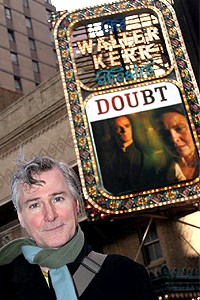
Last Saturday afternoon I tried, without much success, to get tickets to see Doubt. Unfortunately, all they had left were partial-view seats. I decided instead to go across the street to the Longacre and attend the matinee of Who's Afraid of Virginia Woolf? from a full-view seat. On the strength of its multiple Tony nominations Doubt has been doing bang-up business at the box office. These days, arriving at the box office a few hours before curtain will not guarantee that you will get in. (It might be a first that on the same street, right across from one another, two plays are running where the entire cast of each production is nominated for the Tonys). Doubt is a hit, and I decided to go back to the Martin Beck after work yesterday and try my luck and see what tickets they had available for the next day. Wouldn't you know it: they had front row center seats for the Saturday matinee. I scooped up that ticket up so fast! I've never gotten a front row seat to a show before. At my first Broadway show I came pretty close -- fourth row on the aisle to see Christopher Plummer's Tony award performance in the musical Cyrano. No wonder I've been hooked on theater ever since.

Watching Doubt from the front row is an experience that absorbs you even closer inside the actor's playing area. You can't get over the incredible proximity and all that goes with it: cinematic closeups, pores, wrinkles, lint on black costumes, flying saliva that could spray you, the natural tones of the unmiked voice, and, because of the lack of an audience in front of you, the incredibly privileged certainty that this play is being performed only for you. And, of course, there are the magical moments that can only happen when you sit this close. I don't think that I will ever forget the scene between Father Flynn and Sister James as they sat on a bench, their emotions exposed and raw. Heather Goldenhersh, giving the performance of a lifetime in the role of Sister James, breaks down and cries, her hand going up to cover her face. When she lowers her hand again, a single solitary real tear slowly rolled down her right check, followed by another from her left eye. It was one of the most magical moments I have ever experienced in the theater. It left me with much admiration for this new star, (this play marks her Broadway debut) and I hope that next Sunday Tony puts out the welcome mat for her.


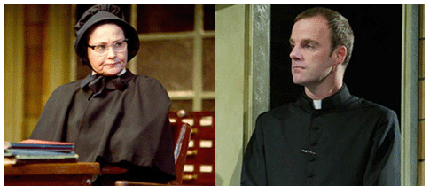
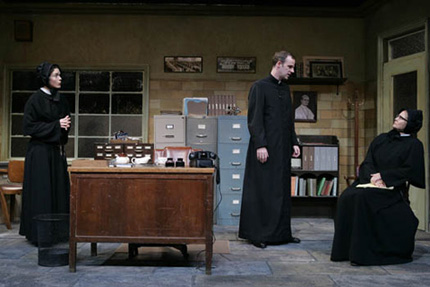
Cherry Jones is currently giving the best performance by a woman on Broadway. As the tough-as-nails Sister Aloysius, the principal of the St. Nicholas School in the Bronx, she wears her inscrutable Sisters of Charity habit as an armor for the fight that will follow as she intends to bring down the jockish parish priest Father Flynn, whom she fears might be molesting the school's first black student. Brí­an F. O'Byrne's Father Flynn is an unforgettable creation: enlightened by Vatican Council II, but possibly racked by private demons brought on by a new freedom, this priest wants to be relevant and bring this Bronx parish into the twentieth century. He can coach the basketball team after school, while delivering sermons on Sundays based on jottings from a little notebook he always keeps with him. If he represents the uncertain future of the Catholic Church, then Sister Aloysius is the institution's anchor, always advising the young Sister James to stay true to ideals that could probably be traced back to Elizabeth Ann Seton, the founder of the Sisters of Charity.


One of my colleagues at work, who as a child was taught by nuns in the fifties, has nothing but admiration for these wonderful creatures who commanded respect and attention, and who could control an overcrowded classroom with their mere presence. My friend is fond of saying that the cure for today's education woes is "a five-foot nun with a six inch ruler." Doubt's author John Patrick Shanley seems to be of the same opinion. The playwright dedicates Doubt to "the many orders of Catholic nuns who devoted their lives to serving others..." He then adds: "Though they have been much maligned and ridiculed, who among us has been so generous?"

After the play I met two of its stars, Adriane Lenox, who is nominated for the Tony for her fine work as the boy's mother, and Mr. O'Byrne. As Ms. Lenox was signing my playbill, I told her that I was rooting for her next Sunday at the Tonys. She seemed genuinely pleased to hear this. She smiled, patted me on the arm and said "Thank-you, its really tight!" I agreed with her. The category of Best Featured Actress includes great performances from Dana Ivey (The Rivals), Mireille Enos (Who's Afraid of Virginia Woolf?), Amy Ryan (A Streetcar Named Desire) and her own colleague, Ms. Goldenhersh. It was also a pleasure to shake hands with Mr. O'Byrne, congratulate him on a job well done, and wish him luck on his own nomination for Best Actor.

Doubt is one of the finest American plays in years. That generosity that Mr. Shanley writes about seems to be present on and off the stage at the Martin Beck Theater. You should go and experience it for yourself.

Sunday, May 22, 2005

"Jesus... I am..."

Who's Afraid of Virginia Woolf? was Edward Albee's first full-length play, his first play on Broadway, and surely the work for which he will be remembered. Since its legendary 1962 premiere (starring Uta Hagen and Arthur Hill) theatergoers and academics have been debating what the play is truly about. Is it a naturalistic setting of an absurdist melodrama? The playwright's previous plays The Zoo Story, The Sandbox, and The American Dream all were heavily influenced by the Theater of the Absurd. Is it a long night's journey into day in the house of two aging homosexuals entertaining a younger gay couple? Albee has, time and again, refused to give his approval to present the play with an all-male cast. Or is it really, on a larger scale, about the inability of America to fulfill its historical idealistic dreams? Albee has pointed out that he named his leading characters George and Martha as an obvious allusion to America's first president, and the missus.


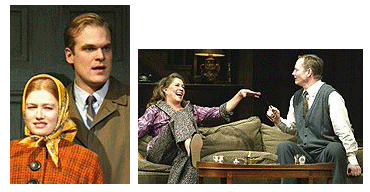
I saw the current Broadway production at the Saturday matinee on May 21. The four members of the cast were present. George was played by Bill Irwin, Martha by Kathleen Turner, Nick by David Harbour, and Honey by Mireille Enos. All four actors are nominated for this year's Tony awards in their respective categories.

The most memorable performance in this production is being given by the talented Bill Irwin. In the role of George, Irwin, who is better known for his life-long work as a clown, and for the plays Largely New York and Fool Moon has not left behind his artistic roots. In the great tradition of the great sad clowns of stage and screen (Buster Keaton, Charlie Chaplin, Emmett Kelly) he brings to the role of George an alooft sense of defeat and resignation that makes his characterization poignant and brings out the absurdity that's already present in the inner marrow of this work. The backbone of his performance radiates with a bittersweetness that only a clown can produce. His performance is superb on all accounts, and it deserves to be honored with the Tony this year.

Kathleen Turner's performance is very good: her smoky voice and ample form lend themselves ideally for this role. What's missing from her interpretation is a certain grandeur that all great Marthas must deliver. She effectively portrays the tawdry boozy Martha who loudly slaps her chest to accentuate her histrionic rage. But in Act III, when she tells Nick "You're all flops. I am the Earth Mother, and you're all flops" this is one of the rare moments when the play rises above the muck and mire to become mythic, and the actress playing Martha must rise right along with it. Sadly, Kathleen Turner remains very much eathbound during these climactic times, and it hurts her performance.

Edward Albee suggested that the name Nick was derived from Soviet Cold-War premier Nikita Khrushchev, and in this role David Harbour plays the opportunistic all-American biologist with a disingenuous grin and frat-boy attitude. Mireille Enos plays his wife Honey with a proper Midwest accent and the required innocent inhibitions. As the evening progresses and her character's layers are peeled away, Ms. Enos' performance becomes even more interesting, and she ends up giving us a very intelligent reading of this difficult part.

Who's Afraid of Virginia Woolf? (according to theater lore, Edward Albee found the words that make up the title of this play scribbled in the bathroom of a bar in the Village) is a demanding play for both audiences and performers. Its three-hour length and its disturbing subject matter is not always easy to take. The work has not been on Broadway in over 30 years, and if you have only seen the Mike Nichols film (with Elizabeth Taylor and Richard Burton) then it will be worth your while experiencing it in the theater: the place where it was meant to be seen.

Saturday, May 14, 2005

Chitty Chitty Bang Bang on Broadway

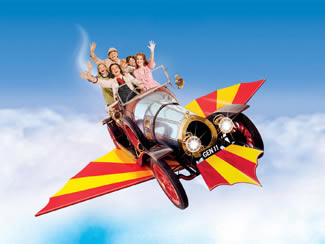
Chitty Chitty Bang Bang, one of the last big movie musicals written for the screen -- it opened in 1968!, is now the latest "film-turned-musical" to come to Broadway this season. A British import, coming to America from a successful West End run, CCBB is already a hit. Along with Dirty Rotten Scoundrels and Spamalot, CCBB is finding appreciative audiences with those familiar with the original films who just can't wait to see what they've done to the movie. In a season that features such shattering new plays as Doubt and The Pillowman, playing alongside such revivals as Tennessee Williams' The Glass Menagerie and A Streetcar named Desire, as well as Edward Albee's Who's Afraid of Virginia Woolf?, entertainment such as CCBB is finding an audience with theatergoers that value wholesome entertainment and family-oriented shows.


The original film was by no means a masterpiece. It was already a dinosaur when it opened at the end of the turbulent sixties, and Julie Andrews was reported to have turned down the role of Truly Scrumptious after she read the script and realized that she was going to be upstaged by a flying car. The movie does have a very likeable musical score by Richard and Robert Sherman, better known as the award-winning composer and lyricist of Walt Disney's Mary Poppins and The Jungle Book.

At the Hilton Theater, the members of the competent Broadway cast headed by Raúl Esparza, Erin Dilly, and Philip Bosco seem comfortable with the fact that they are playing second banana to a wondrous invention. And the car is just that: a wondrous piece of technology that leaves audiences wondering how on earth stagecraft succeeds in getting a car airborne in such a seemingly effortless way. The performances from the three principals are quite good, but their characters are really nothing more than modified stock-figures: the widower-inventor father, the single, young, and very available daughter of a candy magnate, and the doddering grandfather always thinking of India when nature calls. It is particularly gratifying, though, to see a veteran like Philip Bosco singing and dancing the role of the grandfather that in generations past would have gone to the great George Rose.

I found the comprimario roles a lot more interesting. First there are the two Vulgarian spies, Boris and Goran, played by Robert Sella and Chip Zien, respectively. They spark up Act I with their duet "Act English." In the London show this song does not exist, instead the spies sing something called "Think Vulgar."

Marc Kudisch and Jan Maxwell are delicious in the roles of the Baron and Baroness of the country of Vulgaria (which looks a bit like a cartoon version of Nuremberg, circa 1936). Ms. Maxwell is hilarious as a Marlene Dietrich look-alike with a Freudian fear of children. Mr. Kudisch ably plays the role of the Baron: a despot, in turn ruled by an uncontrollable id, with a fascination for toys, stuffed animals, and thumb-sucking.

In the movie, two roles always stood out in my mind. One was the evil Childcatcher, memorably played by Robert Helpmann, and the Toymaker played by Benny Hill, a year before his bawdy shenanigans hit UK TV and would have probably cancelled out his chances of playing this sweetly natured role on CCBB. In this Broadway production the role of the Toymaker is played by Frank Raiter, and he leaves much to be desired, especially his club-footed readings of the last lines of his part. On the other hand, the Childcatcher is an inspired creation. Played memorably by Kevin Cahoon, and dressed all in black, with a wing-like cape, he is a slithering and disturbing vampire of a figure, clearly separated at birth from actor Max Schreck in the 1922 German Expressionist film Nosferatu. His solo song "Kiddy-Widdy-Winkies," sung with an unnatural Michael Jackson-like falsetto (Your reference has been "Duly Noted," Brian!) on a foggy Vulgarian street will scare the little ones and fascinate the adults -- or vice-versa.

Here lies the success of this show: like Sesame Street, the show appeals to both children and adults. The kids (and some adults I know) will love the dogs, the toys, and of course the flying car itself. But the adults will also love the double-entendres in such songs as "Toot Sweets," and "Truly Scrumptious," and also in the Baroness' line, when she looks at her childish husband, and regrets that she allowed "toys" into the marriage.

It's a nice show. You'll have fun. Go see it!

Saturday, April 30, 2005

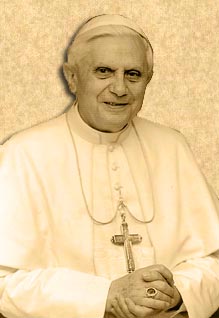
Habemus Papam! -- Pope Benedict XVI


I knew it was going to happen, and I called it at the end of my entry for April 8. As the winner of the Papal election, the former Cardinal Joseph Ratzinger, now Pope Benedict XVI, cut a unique figure during John Paul II's funeral. As he presided at the mass for the late Pontiff, there was a feeling that it was a done deal. A week later he was elected Pope after one of the shortest conclaves in recent history.

Since his election much ink has been spilled about Ratzinger's past. Pictures of young Josef in his Hitlerjunge uniform seemed to be everywhere, and the London Times reminded everyone that "unknown to many members of the church ... Ratzinger’s past included brief membership of the Hitler Youth movement and wartime service with a German army anti- aircraft unit." The article, written a few days before his election, goes on to report that "in 1937 Ratzinger’s father retired and the family moved to Traunstein, a staunchly Catholic town in Bavaria close to the Führer’s mountain retreat in Berchtesgaden. He joined the Hitler Youth at age 14, shortly after membership was made compulsory in 1941." Also, we learn that "two years later Ratzinger was enrolled in an anti-aircraft unit that protected a BMW factory making aircraft engines. The workforce included slaves from Dachau concentration camp."

Pope Benedict XVI should be a very busy man from now on. He needs to heal a Catholic Church (in particular the American Church) which has been wounded. He needs to overcome his past, which is tied to the history of his country, and he needs to shed the tough outer skin he developed as John Paul II's defender of the faith. He has to go from being the German rottweiler to becoming the German shepherd -- the Shepherd of the flock, that is.

The following article, written by Jane Kramer, appeared in the May 2 issue of The New Yorker magazine. Although it presents a largely negative reaction to last week's events in Vatican City, her ideas are interesting, and her writing style fresh and informative.

"Holy Orders" by Jane Kramer

Cardinals of the Church of Rome do not normally hold press conferences to spin their choices, but that is precisely what many of them did last Wednesday, less than a day after they named Cardinal Joseph Ratzinger, the Prefect of the Congregation for the Doctrine of the Faith, and arguably the most powerful person in the Vatican, to St. Peter’s chair. They wanted the world to know that Ratzinger has a “great heart,” that he is “compassionate,” “collegial,” even “shy”—that, in fact, it was shyness and humility that had made him seem so strict and pitiless in the job of doctrinal enforcer that he held for the past quarter of a century.

In his homily to his fellow-cardinals, on the first morning of their conclave, Cardinal Ratzinger had warned that modern society was threatened by a “dictatorship of relativism.” But it might have been more accurate to say that it is threatened by a dictatorship of absolutisms, including his own. This is a world in the tightening grip of orthodoxy, of literal “truths” and crusading certainties, and early last week it was the hope of many Catholics that the Church would begin to break that grip and return to them the right to exercise their own consciences on matters that do not concern faith so much as the realities of their intimate lives: sexuality, celibacy, choice, the use of condoms in aids-ridden Africa, the use of birth control in the favelas and shantytowns of Central and South America, the acknowledgment that stem-cell research might conceivably be a gift from God.

The question of God and conscience, or, rather, the relation between God and conscience—the central question of Vatican II, and, as such, the source of immense hope to young Catholics in the nineteen-sixties and seventies—was so “deconstructed” (to risk a relativist term) in the twenty-six years of John Paul II’s papacy that raising it now constitutes a kind of doctrinal heresy. Ratzinger maintained, with his friend and predecessor, that a well-ordered conscience is one that submits to the authority of the magisterium. So it is understandable that today those Catholics are asking who exactly is, and was, Joseph Ratzinger. Was he the Pope’s man, the unbending instrument of John Paul II’s insistent orthodoxy, or was he, at least in part, the motor of that orthodoxy, especially in the Pontiff’s last years?

Most Popes of the last century—even John Paul II, for all his groundwork as a priest in Communist Poland—were elevated to that office from relative anonymity. Ratzinger does not have that advantage. He has been well known to Catholic intellectuals since the nineteen-seventies, when he battled Hans Küng, the liberal Swiss theologian and his mentor at the University of Tübingen, on questions of doctrinal dissension, and, as Archbishop of Munich, was instrumental in having Küng barred from teaching Catholic theology. And, of course, he has been very well known to most Catholics since the early eighties, when the Pope installed him at the Vatican. His agenda, or his orders, were always clear. During his first ten years as Prefect, the Jesuits were censured for challenging papal teachings on contraception, parts of their constitution were suspended, and their Vicar General, Vincent O’Keefe, a passionate advocate for social justice, was removed. The reactionary lay order Opus Dei was transformed into a “personal prelature” accountable directly to the Pope. The dioceses of progressive Latin-American bishops were gerrymandered out of existence, liberation theologians like Leonardo Boff were called to Rome and silenced as “Marxists” (they were, more accurately, Christiancommunitarian evangelists), and the priests they had trained, who were responsible for an ebullient Catholic revival in Latin America, were ordered back into the fold of tradition and obedience. The relative autonomy of the North American bishops’ conference was ended, and its most progressive members—most famously Cardinal Joseph Bernardin, of Chicago—were marginalized.

If the Vatican’s project in the eighties was to purge its clergy, its nineties project was to purge its teachings of ambiguity. The dogma of papal infallibility, which dates only from 1870, has been invoked just once since then, in 1950, when Pius XII proclaimed the “truth” of the Assumption of the Blessed Virgin Mary. But in the years of John Paul II’s papacy there was a conflation of the notion of infallibility and what the Church calls “definitive teachings.” The result was that John Paul II’s teachings often carried the imperative of infallibility, and Cardinal Ratzinger’s theological imprimatur on those teachings, together with his power to enforce them, effectively ended the discussion.

These issues were more important to the cardinals than the new Pope’s age or whether he was Italian, or European, or from Latin America or Africa. There are a hundred and eighty-three cardinals, but no cardinal over the age of eighty may vote, and, of the hundred and fifteen who did, all but two owed their appointments to John Paul II. It was probably never in doubt whom they would choose. Joseph Ratzinger speaks for them, and whatever he says about “waves” battering at the boat of the true faith—globalism, feminism, individualism, desire, homosexuality (“an objective disorder”), demands for the ordination of women, mysticism, “gravely deficient” sects, Turkish Muslims in Christian Europe—those words put a full stop to the opening up of the Church of Rome that we still call Vatican II. In the past few days, Benedict XVI has promised the world dialogue and reconciliation, but at the same time he has reappointed the Vatican team that, with him, brought us the spectacle of suffering and death that ended with the funeral of John Paul and secured the veneration, if not the speedy sanctification, of that faithful and controlling Pontiff. (“This is a long way from three people at the foot of the Cross,” one ex-Jesuit remarked last week, not long after Benedict XVI appeared for the first time in his papal vestments.) Most of the Cardinals wanted a continuum of that always spectacular reign. And they wanted a continued enforcement of its most conservative dicta—which may be why they are talking now about cutting their losses for the advantages of a smaller, “purer” Church. But, from what we know, the early Church was a place of risk and debate. They should remember that, too.

Thursday, April 14, 2005

Tristan und Isolde at the Bastille


Finally, the awaited new Peter Sellars production of Tristan und Isolde premiered at the Bastille. The following is the New York Times review by Alan Riding.

In Pursuit of a Total Art, the Paris Opera Adds Video to 'Tristan und Isolde'

By ALAN RIDING

PARIS, April 13 - Huge, dense, taxing, with almost all the action taking place in the heart, Wagner's "Tristan und Isolde" is notoriously difficult to stage. Indeed, the composer himself abandoned his first attempt in Vienna in the early 1860's after no fewer than 77 rehearsals. Now, in a daring experiment, the Paris National Opera has invited the American video artist Bill Viola to accompany the work with his own visual commentary.

On a 30-foot-wide screen above and behind the somberly lighted space peopled by the singers, images that recall some of Mr. Viola's well-known video pieces variously offer literal, metaphorical and even spiritual complements to one of mythology's most famous and tragic love stories. With only the preludes played to a closed curtain, Mr. Viola's multi-toned video poem runs for some 3 hours 40 minutes, a full-length spectacle in its own right.

The production, first performed in a concert version at Disney Hall in Los Angeles in December, is directed by Peter Sellars, with Esa-Pekka Salonen conducting the Paris Opera Orchestra.

Its seven performances at the Bastille Opera through May 4 are to be followed by seven more in November, with Valery Gergiev at the podium. It is to return in concert version to Disney Hall in March 2007 and to be staged in New York in April 2007.

Central to this production are the German mezzo Waltraud Meier as Isolde and the Canadian tenor Ben Heppner as Tristan, both given a rousing reception after Tuesday's opening night. In the view of French music critics, the Swiss mezzo Yvonne Naef as Brangäne, the Finnish baritone Jukka Rasilainen as Kurwenal and the German bass Franz-Josef Selig as King Marke also contributed to the high quality of singing.

But the true novelty lay in Mr. Viola's videos, which the artist said in an interview were inspired more by the text than the music. "I listened to it, various versions, for a month and I was stunned, I couldn't see anything," he said. So, no less than Wagner, he started with the myth, the story, the text. "The images tell the inner story in a similar way the music tells the inner story of the emotional and, I would say, spiritual life of these people."

As a result, Mr. Viola shot most of the images before turning back to the music. "I realized the music is not useful to me while I'm shooting," he explained. "The music becomes absolutely necessary in the editing process. So music became for me the last stage. It was then that I tried to fit the images onto this pre-existing landscape that Mr. Wagner has beautifully provided us."

As such, the images echo rather than illustrate the story, with many sequences slowed to harmonize with the protracted development of the plot. For instance, it takes most of Act I, as well as a magic potion, for Tristan and Isolde to recognize they love each other. They enjoy their love in Act II, but it ends with Tristan stabbed by a follower of Isolde's new husband, King Marke. And Act III is devoted to Tristan's extended death and Isolde's decision to join him.

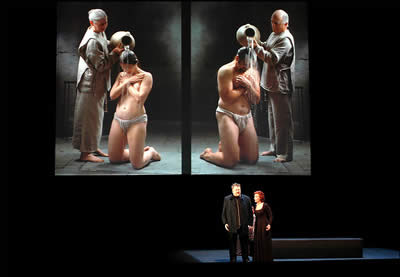
Perhaps the central image used by Mr. Viola for Act I involves a split screen in which two tiny lights gradually take the form of a man and a woman, Tristan and Isolde's surrogates, who slowly strip and then are purified with water. The sequence ends with close-ups of their faces under water, as if they - like Tristan and Isolde who have drunk the love potion - have passed into a new reality. Two other figures then caress each other as they float under water.

With Tristan persuaded that the night is benevolent and the day is evil, Act II opens with an image of sunset and closes with another of dawn, but the most powerful sequences involve fire and water, two of Mr. Viola's preferred opposites. In one, a man slowly approaches a fire from a long distance and finally walks through the burning logs; in the other, a woman - again in slow motion - lights some 150 candles before herself walking through water.

Water too is at the heart of the final near-mystical scene when the now frustated love of Tristan and Isolde becomes, in Mr. Viola's words, "something more profound, something you can't even describe." Here, by reversing the high definition film he has shot, Mr. Viola uses water to lift the dead Tristan from a stone slab and raise him to eternity. "You're looking at death, and in the editing room, it becomes a kind of birth," he noted.

The question already raised by some critics in Los Angeles last December and echoed by some spectators here Tuesday is whether the powerful images distract from the singing. Views seem divided, with the criticism applied mostly to Act I. Mr. Viola recognized the problem. "The images can overwhelm," he said. "It seems like a huge amount to take in, but a lot of them are quite slow and on the screen for quite a time. They function at times as backdrops."

Unusually, Mr. Sellars began working on his production only after seeing Mr. Viola's images. "The staging is built around Bill's images and of course Waltraud Meier and Ben Heppner," he said in an interview, "because the depth they bring to the first rehearsal means you're starting at an advanced level. Waltraud is the reigning Isolde of her generation. Ben is now truly without peer."

With the images in place, Mr. Sellars said, "Bill gives me permission to ground the singers in an emotional depth because I don't have to have them run around the stage and be 'interesting.' " The result is a minimalist staging, with only a square platform as décor and all the intensity reserved for the voices.

Still, with the combination of video, orchestra, singing, acting and text, Mr. Sellars likes to think the team has come up with something resembling a modern Gesamtkunstwerk, the concept of total art that was Wagner's lifelong musical and theatrical objective. "Of course," he added, "Wagner's music alone gives you more than you can possibly take in."

Monday, April 11, 2005

Sin City

The collaborative culmination between director Josef von Sternberg and superstar Marlene Dietrich ocurred in 1935 with the last film that the two made together: The Devil is a Woman. Superb cinematography was always one of the key ingredients of these elaborate, baroque fantasies made at Paramount, and some of the best studio cameramen -- Lee Garmes, Lucien Ballard, James Wong Howe, and Bert Glennon -- worked with the director in defining the sultry and unforgettable look of these B&W films. In The Devil is a Woman, von Sternberg, credited in the film with his American Society of Cinematographers (A.S.C.) title, took the directorial as well as the cinematographic credit, an aspect of his films to which he always payed the utmost attention.

Sin City, Robert Rodriguez's new film, adapted from Frank Miller's graphic novels is, technically, a worthy successor to von Sternberg's early work in Hollywood. Rodriguez takes the cinematographic as well as the editing credit, and also shares directorial credit with Mr. Miller.

When was the last time that a major motion picture was released in black and white? The last that I can remember was Jim Jarmusch's 1995 iconoclastic western Dead Man, and that was an independent film that received limited release.

Sin City is visually a unique film. That alone demands that the work be seen, and it is reason enough for me to not go at length about it; for how can you faithfully describe with words what one needs to experience with your sense of sight? Miller's noirish sleaze is brought to life in a panoramic style that captures the pulp essence of the work, but allows the medium of film to expand on it. The results are truly stunning. Go see it. Post your comments about the film here.

Friday, April 08, 2005

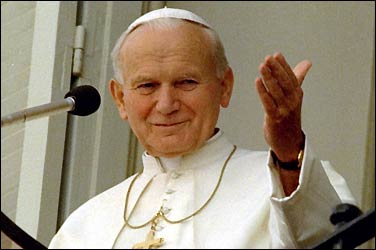
Pope John Paul II is Buried

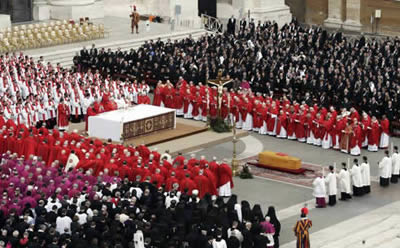
Thursday, April 7 was a long day's journey into night and beyond for me. I taught the entire day, and during the afternoon showed my Film Club The Producers, a film which they enjoyed very much. Then, I watched the first act of the dress rehearsal of HMS Pinafore at school. Then, I got a call from my friend Brian inviting me to a free showing of the film Donnie Darko at the 34th street Loew's Cineplex. Awesome film, by the way, and I recommend it to everyone who likes science-fiction, horror, time travel, and movies that are carefully crafted puzzles. It ended after ten o'clock (it was the director's cut, after all), then I had dinner at the "Tick-Tock Dinner" (they make great roadside sliders there!), then went back home in a taxi, under a huge downpour -- needless to say, I did not have an umbrella. These days, it's been raining a lot in NYC. When I finally got home, I went to sleep at midnight, and got up at 5 AM to watch the Pope's funeral on TV.


I was surprised that the Pope's Requiem Mass was held outdoors, Spring weather being so unpredictable. Then again, how could they hold this mass indoors and deny the millions of people who had flocked to Vatican City at least a far-away glimpse of the events. Thousands stood shoulder to shoulder on St. Peter's Square and beyond. There were people as far back as the eye could see, and overhead threatening clouds were evident. The robes and vestments of the prelates gathered were blowing in the howling winds of St. Peter's Square. However, miraculously the rain held up, and the ceremony went off without a hitch. It was a memorable service -- moving at times. I don't believe there has ever been so much clapping and cheering at the funeral mass of a pope before -- but it never turned into an irreverent scene at all. The crowd chanted either "Santo" or "Magno" (Saint or Great) or both: a reference to the grassroots movement, that started the very day the pope died, which aims to cannonize the Pontiff and attach the term "The Great" to his name. This has not happened in centuries, and as I was watching the telecast I knew that I was witnessing history in the making.

I also could not help but wonder if I was watching the next pope at the altar. Cardinal Joseph Ratzinger, the current Prefect of the Congregation for the Doctrine of the Faith, Dean of the College of Cardinals, and Cardinal from Germany sayed the Mass, and rumors are swirling that he might be the successor to John Paul II. Hopefully, in a few weeks we will know.

Thursday, March 31, 2005

A Bloody and Noisy Julius Caesar


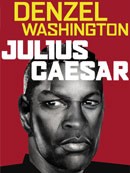
The production of William Shakespeare's Julius Caesar, that is about to open at the Belasco, is a bloody and noisy reading of this venerable warhorse. The arriving audience is greeted by muted martial music that sounds like it's coming from a junkyard band consisting of rusty horns and tattered bagpipes. This drone -- which after a while almost becomes contagious, but ends up ultimately being annoying -- is played up to the start of the performance. On stage, we see a curtainless stage cluttered with dilapidated Roman ruins, a couple of headless and armless classical statues near the side balconies, as well as a shopping cart filled with junk. Before the start of the play a homeless man staggers onstage, sits on the floor by his cart, and scratches his scraggly beard. He is, of course, the Soothsayer. Not the seer that Shakespeare intended, I'm sure, but then again, this is not the production that he had in mind either. A giant banner on stage with Julius Caesar's image is adorned with a laurel wreath and a crown. Caesar wears a beret and fatigues, as if he were the ruler of some modern police state.

And that's exactly the point of departure of this production: to make it modern. Set in a contemporary dictatorial country, the largely male cast is dressed in suits and ties during Rome's times of peace, and when civil war erupts after the title character is assassinated everyone switches to military fatigues and camouflage.

But this conceit by director Daniel Sullivan is obviously not new. As a matter of fact, it has almost become a cliché by now to set a classic play in a time period other than what the author originally intended. By the way, everyone should know that back in 1937, the then newly-formed Mercury Theater staged a modern-dressed production of Julius Caesar. That brave experiment revolutionized modern Shakespearean staging. That ground-breaking production was produced and directed by Mercury Theater founder Orson Welles.

I attended the Wednesday matinee on March 30, not so much because I wanted to see this play, but more because I wanted to experience Denzel Washington on the stage once again. Many years ago, when I was a freshman undergraduate at Fordham University in Lincoln Center, my English professor, Robert Stone, urged us to see a performance of a play that had been written by a student at the college. In the cast, playing a wheelchair-bound, cantankerous old man was a senior making his last performance at Fordham. His name was Denzel Washington. As a junior he had starred in Eugene O'Neill's The Emperor Jones, and Shakespeare's Othello. By the time he was a senior, thanks largely to the tutelage of Robert Stone, Denzel Washington was on his way to becoming a star.

He gives a very powerful and believable performance in the role of Brutus. It is the best role Washington has had since he starred in Spike Lee's film Malcolm X. The declamatory style that he adopts for the role of Brutus reminds me very much of the cadences he adopted when he played the slain civil rights leader. He is the star of this show, the reason for its existence, and the sole reason why you should go to the Belasco to see it.

Otherwise, the production is confused, bloody and very noisy. I don't remember ever having seen a more graphically violent play on Broadway. The stage blood flows freely in this production, not only during the murder of Caesar, but in the second act scenes of war. Also, in an effort to make things really relevant, the director has staged a particularly disturbing torture and decapitation scene that will remind everyone of the realities of the current situation in Iraq. The second act also features unnecessary, earth-shaking special sonic effects that, although very realistic, also go overboard. I am certain that the people outside the Belasco Theater can hear the roars coming from within.

The only roars that matter, in my opinion, are those coming from Mr. Washington's performance, and those from the appreciative sold-out crowds.

Sunday, March 27, 2005

Wall to Wall Sondheim Saved for Posterity


Last Saturday, March 19, Symphony Space celebrated composer Stephen Sondheim's 75th birthday with a gigantic marathon of the composer's music called "Wall to Wall Sondheim." I was scheduled to perform in that concert as a member of the Juilliard Choral Union. Unfortunately, personal and professional conflicts did not allow me to participate in the event. The Choral Union sang during the last hours of the show, and closed the evening with "Sunday in the Park with George," arranged and played by composer Jason Robert Brown. Luckily, the entire affair was broadcast by XM Satellite Radio, and the buffs were quick to post it to Usenet. I downloaded and burned all twelve hours into one shiny CD-R -- don't you love the MP3 format?! -- and have plans to spend my Easter week vacation listening to the whole thing.

I hope this will be a great week of listening and discovery. Truthfully, though, I am riddled with fears of interruptions. I remember that funny, clever British comedy by Simon Gray Otherwise Engaged, where London publisher Simon Hench buys a recording of Wagner's Parsifal, and all he wants to do is unwind in his den with the recording and a glass of brandy. His prospects are dashed, time and again, by annoying interruptions.

I must say that the first two hours (I am listening to it as I blog) have already featured "Into the Woods," "Gypsy," "Company," and esoterica from Sondheim's days as an undergraduate in Williams College. It promises to be a very enjoyable marathon. Click here for a complete schedule of the event, with a list of performers and musical numbers.

Der Rosenkavalier at the MET

On Saturday night, I went to the MET to hear my first Der Rosenkavalier. After almost thirty years of attending opera, I had never gone to hear this great work anywhere, although I had seen the MET telecast many years ago, had listened to many Saturday broadcasts of it, and was somewhat familiar with the score. A few years ago, I realized that I had not gotten around to studying the great opera comedies. Over the past few years I have tried to do something to rectify this, and thus far have also attended performances of Verdi's Falstaff and Wagner's Die Meistersinger von Nürnberg.


Saturday night was Der Rosenkavalier's turn. It was extraordinary! One of the best performances I have ever attended! Memorable in all accounts, how many times does an opera-goer have a chance to say this? In the pit, Donald Runnicles led the orchestra, and this well-oiled ensemble has not sounded better. I was excited about going to see Runnicles conduct since I own a recording of the Parsifal that he recently led in Vienna in April of 2004. Runnicle's take on Wagner's last work rivals James Levine's reading when it comes to beauty of expression and expansive tempi. I was sitting on the side of the orchestra (M-35), and I must say that the side overhang reflected sound quite nicely without the flatness that tends to be the major complaint of the orchestra seats at the MET.

What a cast! Susan Graham's Octavian was a very likeable interpretation, her voice secure throughout her range. She is such a sensitive artist. The Marschallin was sung by Angela Denoke, who is making her debut at the MET this season. This German soprano is a rare find, and she conveyed both the beauty and the inherent sadness of the character perfectly. Sophie was endearingly portrayed by Russian soprano Lyubov Petrova. The scene in Act II where she rattles off Octavian's baptismal names was superb. Baron Ochs was Peter Rose, and about him all I can say is that I have so much admiration for any non-German (he was born in Canterbury) that can learn this vocally demanding role with its tricky rhythms, low E's, and generally talky and complex nature. He was superb, and a wonderful actor as well. His dismissal of the Italian tenor in Act I was brilliant (he clapped twice after the aria, and boorishly motioned him to go away). By the way, Matthew Polenzani was superb in his cameo as the Italian tenor. His fine instrument soared above the orchestra, having no problem whatsoever with the devilishly high tessitura that culminates in a high C-flat.

The rest of the large cast was also superb. The three noble orphans sang harmoniously, Annina and Valzacchi (Wendy White and Greg Fedderly) were deliciously oily, and Håkan Hagegård's Feninal was hilariously befuddled. It is captivating to see how this artist has mellowed since the days when he starred in Ingmar Bergman's film of Mozart's The Magic Flute.

On the other hand, it is sad to report that Paul Plishka's voice has not weathered the test of time as well. Now in the sunset of his career, he was quite wobbly throughout the small Act III role of the Police Commissary. There is a rumor that he was booed at the opening night performance, and has not taken a curtain call since. Last night, to the best of my recollection, he did not appear for a curtain call.

This revival of Der Rosenkavalier best exhibits the MET's ability to command the best singers in the world, and present performances the likes of which will rival and surpass those of any other opera house in the world. This kind of quasi-perfection happens very seldom, but when it does, it is beautiful and memorable.

Tuesday, March 22, 2005

A Rowdy PARSIFAL In Berlin

At the Berlin Staatsoper Unter den Linden, the new production of Parsifal, which premiered on March 19, was greeted with roars of boos from a shocked and angry crowd. Filmmaker Bernd Eichinger, who is directing opera for the first time, set Wagner's work in an Apocalyptic, post September 11 New York City. Using video projection extensively, the director's vision included Kundry as a homeless bag lady in Central Park, the Knights of the Grail as East Village punks, and the city as a nightmarish urban landscape of exploding skyscrapers.

For those familiar with this summer's Bayreuth production of Parsifal by artist Christoph Schlingensief, the use of video and prominent and frequent lapses in bad taste is nothing new. In that production, which is set in Africa, the conclusion of Act III features video images of a maggot-infested rotting carcass of a rabbit projected on a screen in the background as Parsifal brings a tribal spear to a group of tribesmen.

What next? Can the necrophilia Parsifal be far behind? My production of this work, which I always thought was a little out there, now seems downright tame these days.

The following is the review of the production from the Associated Press.

"Parsifal Draws Boos and Shouts in Berlin"

BERLIN (AP) -- A German film producer's version of Richard Wagner's Parsifal was greeted with boos and shouts from the audience and sharp criticism in newspapers Monday following its debut at Berlin's Staatsoper. Reviewers attacked Bernd Eichinger's production as dull and confused, singling out its use of video clips including the Earth seen from space and pagan temples. The capital's Berliner Morgenpost daily said Saturday's premiere was greeted by "a concert of boos.''

The staging included scenes in modern-day New York in an apparent reference to the Sept. 11 attacks, a marked departure from the traditional medieval Spanish setting. The contrast was very apparent with the depiction of exploding high-rises. Kundry, one of the main characters, is led around on a dog leash by the sorcerer Klingsor. The Berliner Zeitung reported that the applause afterward dwindled in a few minutes to about 30 people still applauding when the performers took their final bows.

Eichinger has been a prominent figure on Germany's film scene for decades, most recently producing "The Downfall,'' a portrait of Adolf Hitler's final days in his Berlin bunker. It was nominated in the best foreign language film category at this year's Oscars.

However, his excursion into opera met with little enthusiasm from domestic critics. "Eichinger showed a video for every state of the soul, degrading Wagner's music to the status of a soundtrack,'' the daily Sueddeutsche Zeitung wrote.

It's the first time the Staatsoper has done Parsifal, Wagner's last work, in 13 years. The next performance of Eichinger's Parsifal is set for March 28.

Here is the full cast of the opening night performance:

Conductor: Daniel Barenboim
Production: Bernd Eichinger
Set Design: Jens Kilian

Amfortas: Roman Trekel
Titurel: Christof Fischesser
Gurnemanz: René Pape
Parsifal: Burkhard Fritz
Klingsor: Jochen Schmeckenbecher
Kundry: Michaela Schuster
Flower Maidens: Ekaterina Siurina, Adriane Queiroz, Simone Schröder, Anna Samuil, Carola Höhn, Katharina Kammerloher
First Knight of the Grail: Peter-Jürgen Schmidt Second Knight of the Grail: Yi Yang
Squires: Anna Samuil, Katharina Kammerloher, Peter Menzel, Gustavo Peña
Altsolo: Simone Schröder

Thursday, March 17, 2005

The MET -- 2005-2006 Season Preview

The roster of works and performers for the Metropolitan Opera's 2005-2006 season has just been posted on the MET's new website. The season is replete with Wagnerian good news. Not quantity, but lots of promise for quality.

The 1998 Robert Wilson Lohengrin, which I have written about on the pages of Wagner Operas, will be making a return. If you have not seen this production, do not miss it. It is an unforgettable rethinking of the opera. This time around, the cast features Karita Mattila, Luana deVol, Ben Heppner or Klaus Florian Vogt, Richard Paul Fink or Greer Grimsley, and Stephen West or René Pape. James Levine will be conducting. To read further about this production click here.

Parsifal will be back for three performances in mid May, 2006. The cast will include Waltraud Meier, Ben Heppner, in his first Parsifal in the house, and Thomas Hampson singing his first Amfortas at the MET. René Pape will reprise his memorable portrayal of Gurnemanz, which he sang here back in 2003. James Levine is scheduled to conduct.

Other non-Wagnerian highlights of the up-coming season include the return of Verdi's La Forza del Destino and Falstaff. Bryn Terfel will bring us once again his amazing interpretation of Shakespeare's boozy, lovable knight, and James Levine will lead the MET orchestra. The Forza cast includes the interesting casting of Deborah Voigt and Salvatore Licitra, and will be lead by Gianandrea Noseda, the principal conductor of the BBC Philharmonic in Manchester. During late December and early January Alban Berg's Wozzeck will come back to challenge MET audiences. This amazing score will also be led by James Levine, and will feature Katarina Dalayman, Clifton Forbis, Graham Clark, Alan Held, and Walter Fink.

For a complete list of next season's works click here.

Tuesday, March 15, 2005

T&I at the Bastille

The new production of Tristan und Isolde that is currently in preparation at the Bastille Opéra in Paris is the culmination of "The Tristan Project," a conceptual piece that began at the Walt Disney Concert Hall in Los Angeles, and is the brainchild of the Los Angeles Philharmonic Music Director, Esa-Pekka Salonen, stage director Peter Sellars, and video artist Bill Viola: the same creative team which is now preparing the Bastille's premiere on April 12. The production will play for eight performances until May 7.


"The Tristan Project" was described by a Los Angeles Philharmonic press release as "a multi-discipline arts experience" presenting one semi-staged act of the opera on one night, along with works influenced by the opera; the kind of works that, in the opinion of maestro Salonen, could not have been composed without Tristan und Isolde having paved the way. The other pieces accompanying Wagner's opera were a suite from Claude Debussy's "Pelleas et Melisande," Alban Berg's "Lyric Suite," and the West coast premiere of Finnish composer Kaija Saariaho's "Cinq reflets de l'Amour de loin." On artnet.com you can read all about the performances that took place in Los Angeles.

It is my understanding that the Paris Opéra production will not be "The Tristan Project" but T&I itself; it will not include the other pieces that played in L.A., and the entire opera will be performed in one night, as is the customary fashion. Performing the role of Tristan, Ben Heppner will sing seven out of the eight performances, and Waltraud Meir will be his Isolde throughout the run. It promises to be "the" opera event in Paris. For a preview of this production go directly to the Opéra National de Paris website.

Saturday, March 12, 2005

"The Gates" -- Gone but not Forgotten

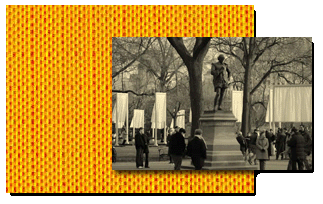
Christo and Jeanne-Claude's "The Gates" an installation that was in the works for two decades, and which captivated New York City for a mere sixteen-day stay is now history. As I write these words, the last of the 7, 500-plus gates still left in Central Park are being dismantled, according to the wishes of the artists, and nothing of the exhibit will remain for posterity. All will disappear except for thousands of swatches of saffron-colored cloth, millions of pictures, miles of film and videotape, and the lingering memory of the structures, forever preserved in the minds of people from around the world who came to New York City to experience this event.


According to the Pricewaterhouse Coopers Hospitality & Leisure practice, "The Gates" contributed to record February hotel occupancy in New York City during the last two weeks of the month. Occupancy averaged 84.2 percent during the weeks that the Christo and Jeanne-Claude project was in place, compared to an average of 71 percent for the preceding six weeks. The project brought an additional $26 million to New York City, and that is good for the city.

I visited "The Gates" four times. Twice on my own, and twice with friends. On three of those occasions I had my Nikon D-70 with me, and during my visits I took over 100 photographs of Central Park and the installation. There was snow on the ground during my second and third visits. That definitely added to the visual terrain of the park. "The Gates" photographed nicely against the snow, I think.

If you click here, you can see sixteen of those photographs, one for every day that "The Gates" were on public view. I hope that you enjoy these pictures.