Sunday, March 22, 2026

TRISTAN UND ISOLDE at the MET

Tristan und Isolde might be Richard Wagner's greatest work for the stage. A work inspired by the philosophy of Arthur Schopenhauer and his writings about mankind's insatiable striving. Since its creation, it is his most talked-about, most written about, and most dissected creation. The opera was born out of Wagner's ideas about transcendental love beyond death, and an episode of infidelity (Wagner had an affair with Mathilde Wesendonck, the wife of his Swiss benefactor). Its pioneering soundscape, so vastly different from the conventional opera of his time, led to countless volumes written about the dissonant chord found in the third measure of the prelude -- the so, called "Tristan Chord," -- a deviation from the traditional harmonic practice of Wagner's day that many scholars argue eventually led the way to the dissonance of 20th century music.

At a time when the Metropolitan Opera is facing a financial crisis, this new production is the kind of event that is actually filling the seats. The matinee performance I attended yesterday seemed to be sold out, and there was an energy in the house which has not been felt in quite a while.The source of that energy is soprano Lise Davidsen, who is singing the role of Isolde for the first time at the MET after taking it "on the road" singing it for the first time at the Gran Teatre del Liceu in Barcelona, a performance I also attended.

American director Yuval Sharon is responsible for the new production which is filled with perhaps too many complex ideas. It attempts to be a visionary look at the work, and oftentimes it succeeds brilliantly, while at other times you question his directorial decisions. One thing is certain, like the best in theater, less is more, and Mr. Sharon's best moments are when he keeps things simple.


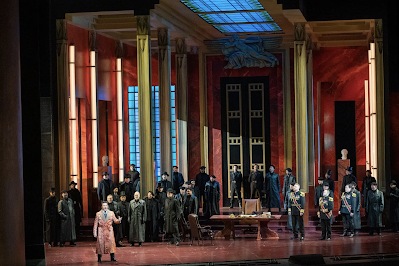
At the center of his production is a tunnel, a kind of vortex where the main action is played. Aside from the fact that it is aesthetically beautiful and complex in all its permutations, it also serves as a kind of funnel-like speaker which throws the voices back to the house. Not that Ms. Davidsen needs any amplification which this set might give her, but it really helped tenor Michael Spyres in the Act II love duet, and in the difficult music of Act III. The same can be said about Ekaterina Gubanova, who plays Brangäne. Hers was the smallest voice in the entire cast.

At times, the vortex breaks into two parts, separating the main characters from each other -- perhaps foreshadowing the events to come, or maybe it's just an example of the technical wizardry the MET can pull off and Mr. Sharon is showing off.

Throughout the production there is a long table on the stage. Here, silent doppelgängers of the characters silently mimic the action that is being sung inside the vortex. For the most part, I found this multiplication of characters distracting during the first two acts. But in Act III it suddenly worked. On the stage lies the dying Tristan, being attended by Kurwenal (a rather boisterous and vocally strong Tomasz Koniezny), and inside the vortex Mr. Spyres sings his mournful longing phrases for the return of Isolde. These are the inner thoughts of a dying man, and the audience is made witness to his last moments.

The other trick in Mr. Sharon's magic bag are projections which fill the entire proscenium of the house -- and that's a really tall proscenium! I must say that the resolution of these projections are not the greatest. Perhaps in the future the projections of live events can be improved. Although when pictures are projected, the image is quite sharp. Sometimes the pictures can be outright silly. When Isolde and Brangäne discuss potions a projection of an elegant feminine hand holding an alluring vial appears. The image is right out of Coco Chanel or Cristóbal Balenciaga -- you pick your favorite perfume ad! 

But when the projections work dramatically, they are memorable. During the confrontation between Tristan and Isolde in Act I, the characters appear to be walking the razor's edge, a powerful image that brings back the violent back-story of this tale: the slaying of Morold at the hands of Tristan.

It is a production not to be missed, filled with interpretive ideas that makes for a rich evening at the opera. It is also a harbinger of things to come: Ms. Davidsen is slated to sing the role of Brünnhilde in the MET's new Ring production which will also be directed by Mr. Sharon. Let's just hope that the MET gets its finances in order so that these wonderful future events can happen. 

Sunday, September 28, 2025

ONE BATTLE AFTER ANOTHER - “¡Viva la revolución!”

  Mikhail Bakhtin, the great Russian literary critic, wrote that the novel as a literary genre is a series of carnivalesque episodes; essentially an empty bag where anything can be stuffed in. Of course, he was thinking of François Rabelais, a French writer whose novels cemented the framework for the genre. Gargantua and Pantagruel, Rabelais's great work, brings to life the essence of what a medieval carnival must have been like: loud, dirty and infinitely grotesque.  It is no wonder that Thomas Pynchon's novels are often referred to as carnivalesque and Rabelaisian. If Bakhtin theorized that the novel can subvert social norms and hierarchies through humor and chaos, then Pynchon's novel Vineland, the inspiration for One Battle After Another, is a perfect example of Bakhtin's theory. And Paul Thomas Anderson's film takes the theory a step further and adds politics to the stew in its quest to break down society's standards. Let the revolution begin!

With his incredible flair for telling a story with images that linger in one's mind, Anderson fashions a tale of an underground group of violent radicals vent on a quixotic quest to bring down the government. The story of French 75, the name of the group, (and also the name of everybody's favorite drink at "Rick's Café Américain" in the film Casablanca), has been told in VistaVision, the most celebrated of all the widescreen 35mm formats developed in the 1950's. The Searchers, Vertigo and The Ten Commandments are just three of the many films shot in this process -- a quixotic quest to bring families back to the theaters instead of sitting at home watching Milton Berle on that new invention: television. Mr. Anderson's choice to use VistaVision is also a rallying plea for people to get their ass off their streaming-den couches and come back to the place where movies are meant to be seen.

The focus of the story is the love between Bob Ferguson, in an amazingly satisfying performance by Leonardo DiCaprio and Perfidia Beverly Hills, a powerhouse of a performance by Teyana Taylor. They live in their scrappy revolutionary echo chamber, and they are very much in love. Their nemesis comes in the form of Colonel Steven J Lockjaw (an outlandish and utterly remarkable Sean Penn) who is seduced by Perfidia during a raid on a migrant detention center. As Manohla Dargis wrote in her review of the film in the New York Times "Lockjaw will spend the rest of the film trying to reassert his supremacy."

Years pass and Bob is living with his teenage daughter Willa (Chase Infiniti). He has let go of the rebellion and is now a burnout watching TV and smoking weed all day. That is until Col. Lockjaw invades his house in a quest to find Willa and discover who her real father is. This puts Bob on the run once again, this time aided by Sensei Sergio St Carlos (Benicio Del Toro), Willa's martial arts instructor and an underground migrant leader.

Meanwhile Lockjaw has been invited to join the Christmas Adventurers Club (talk about carnivalesque!) a white supremacist organization. During his interview with them he lies about having had sexual relations with a black woman. This lie will result in disastrous consequences for the colonel.

That Bahktin empty bag has been overfilled with so much Pynchon, Vineland and Anderson that a whole lot of intelligent, calculated cinematic explosions will follow!

 A friend reacted to the release of this film by saying "finally a movie worth seeing." I agree, and I'll add that it is worth seeing multiple times. And perhaps in multiple formats, especially if it is playing in VistaVision near you. It is by far the best film of 2025, and it has Oscar potential written all over it. I would not be surprised if we see DiCaprio winning his second Oscar, and Sean Penn his third. Both give fantastic performances.

And for Chrissake, finally give P T Anderson an Oscar!  He so deserves it for this film.

Tuesday, August 05, 2025

Twenty-two Wagner Years Ago

I can't believe that WagnerOperas.com is twenty-two years old. Not to sound cliché about it, but it only seems like yesterday when I decided to put together a website after I heard the new Parsifal production from the stage of the Bayreuth Festival that was causing a furor. If you've been following my website, or if you are a lover of Wagner you will certainly remember the Christoph Schlingensief staging that transferred the setting of the opera to Africa and replaced the Grail with a decaying rabbit. There was no live video in those days, only audio and some published photographs. Not really being able to see what audiences were violently booing at the Green Hill made the production even more mysterious. In an outrageous kind of way, it was the kind of event that inspired one to go out and put a website together. 

 The production was so creative and outrageous at the same time, and director Schlingensief had taken such a plunge into an unknown world (he had never directed a Wagner opera before) that in my mind I must have said in my own small way I can also go to the edge and produce something that will either delight or upset people. Well, I'm sure my website did neither. The aim of the site was not to entertain, but to instruct, and to serve as a repository of all things Wagner. And, by the way, for those of you who remember, and it may not be many, WagnerOperas looked like this when it appeared on the Internet for the first time on 2004:
 I always had a fondness for that layout, if you want to know the truth. There was something pleasing to the layout. But as things changed in the online world, so did the site. Hopefully, its present look reflects the current visual tastes when it comes to an online presence. My further hope is that it is as pleasing to the eye as the original was.

Perhaps one day there will be a radical change to the look of WagnerOperas. And why not! The site should always reflect the current tastes of the opera world.

Monday, August 04, 2025

A New and Improved Wagnerians Page

 I spent this weekend updating the Wagnerians page of the Wagneroperas site. Click here to go to the page, and take a listen to the new added audio that now accompanies each of the artists featured.

Sunday, August 03, 2025

Bayreuth: The New Meistersinger Misses the Mark


I imagine that after a notorious Meistersinger production by Katharina Wagner that brought to mind the dark days of National Socialism; and the production that followed it, by Barrie Kosky, that explored the anti-Semitic undercurrents of the work, it was time to free this opera of its sociopolitical trappings and remind us all that it is a comedy. That is the impression that this new staging by Matthias Davids seems to want to put forth. However, if the aim was to remove the corset and let it all hang out, then that was partially achieved arguably by the last scene, which brought to mind a kind of Germanic hoedown, complete with bails of hay, lederhosen and an inflatable cow hovering overhead. Beckmesser unplugs the damn cow in retaliation for being ridiculed in front of the entire Nuremberg, but the cow gets inflated at the end to show that everything is fine in the dear old city.

But it is not! After Walther wins Eva in the song contest, they both storm out of the city hand in hand. Yes, they listened to Hans Sachs's speech about securing holy German art, but they're not buying it. They turn their backs on the old guard, and leave behind Sachs and Beckmesser upstage, both confused, asking each other what went wrong.

You can check out more pictures from the production by going to wagneroperas.com and checking out my 2025 Bayreuth page.

But what about the rest of the production? The first scene of Act I is dominated by a gigantic staircase that leads to a very tiny white church teetering at its zenith. The faithful descend after the service is over. All dressed in costumes that bring to mind the late 1800's. These elegant church goers find Walther wearing modern, contemporary clothing, but wait, is that a chain mail hoodie under his jacket to remind us that he is a knight? Throughout, the costumes seem to be divided in two worlds. David wears a t-shirt and oxblood color Doc Martens, but the Meistersingers dress in ceremonial robes of another time when they gather for a meeting. And what about that visually stunning staircase, the first visual treat we see when the curtain opens? It just goes away never to return. Why have it there in the first place?

The second scene of Act I presents the meeting place of the Meistersingers, and whadda ya know, it looks like a copy of the Festspielhaus auditorium, complete with wooden seats. Many patrons of the Bayreuth Festival complain about the un-cushioned seats, especially those that experience the Festspielhaus for the first time. There must be more complaints about the seats than about the heat in a theater that is not air conditioned. Was this the way to humor the audience? Was the audience at Bayreuth subconsciously supposed to feel good about the fact that the artists were just as uncomfortable, if not more, than they were. There must be a streak of Schadenfreude in Mr. Davids a mile long. 

 The best reaction to this production that I have heard since the premiere on July is that while Davids is busy at work trying to put the yucks back in Wagner's only comic opera, down in the hidden pit Daniele Gatti is trying to find the work's profundity. Perhaps this is the eternal question when it comes to staging  Meistersinger. Despite the humorous situations one might find in the narrative, the story does contain undercurrents of Antisemitism and the glorification of German art, which is called holy. Sachs demands that is be respected and defended, but Walther and Eva give their backs to it. 

Without a doubt, this is the most interesting part of this production, and it should not be. There is more to Meistersinger than just what Mr. Davids has been able to come up with. He's only skimmed the top of the surface, and perhaps has been advised not to seek further inner meaning -- the previous productions had done that already. It was time to allow hilarity to come back to the Green Hill. But in actuality there is very little that is genuinely comical here except for what Wagner has written. Davids just misses the mark.

A note about the cast: Michael Spyres, with his wonderful baritenor voice stole the show. A beautifully crafted performance that was vocally secured at every turn, especially in the difficult third act where he has to perform the "Prize song" three times. It was wonderful each time. Christina Nilsson proved to be a very pretty Eva with. secured top nd a sunny disposition. In Act III she is place inside what looks like a life-sized flower vase reminiscent of Ari Aster's film Midsommar. When I saw this, I asked myself "is this production going to go that way? Thankfully, it did not. George Zeppenfeld was George Zeppenfeld, a little too stern, too philosophical -- not my idea of a warm cobbler. Michael Nagy played Beckmesser, not as a caricature of a Jew, but as a lovesick guy who wants to court and win Eva with a heart-shaped neon musical instrument.

As the seasons come and go at Bayreuth, I am sure that Mr. Davids will change many things in this half-baked attempt to stage Meistersinger. It is not as easy one to pull off. My recommendation is to stay as close to Wagner's original intention, and you will have a successful revival of this dear, beloved work. 

Saturday, June 21, 2025

Sunset Blvd. The Musical on Broadway

 In Jamie Lloyd's minimal staging of Andrew Lloyd Webber's Sunset Blvd., based on Billy Wilder's film noir, so much is left to the audience's imagination that if you have not seen the original film, you might be confused by the action onstage. Why is that man, who we eventually find out is named Joe Gillis, (Tom Francis) coming out of a black body bag? Yes, he is dead, and soon we realize that he's going to tell us his story from beyond the grave, a common film noir approach to story telling. For those of us who know the film, we miss the incredible cinematic image of Joe Gillis's body floating dead in a pool. 

If Mr. Lloyd's numerous tattoos represent a maximalist approach to his personal body art (he recently got the number "10086" tattooed under his ear -- Norma Desmond's address), his professional directorial art depends on having very little onstage. A dark empty arena with actors wearing black and white clothing is enough to bring to life the year 1949. To remind us that the source material is a classic film, videographers with Steadicam rigs project black-and-white images of the actor's faces on a gigantic screen, while also giving us opening and closing credits. This revival of Sunset Blvd. is both a stage and film adaptation of a movie that had already been turned into a musical back in 1993.

The not so-secret weapon of this production is Nicole Scherzinger, a powerhouse performer who embodies the aging silent film star Norma Desmond barefooted and, following the style of this production, wearing only a black negligee. On London's West End she won the Laurence Olivier Award, and last week she won the Tony for her performance. It is a not-to-be-missed star turn (her Broadway debut!) that might demand more than one viewing to fully absorb its layers of brilliance. Last night, the crowd at the St. James Theatre went crazy when she just appeared onstage without singing a note. After she sang "With One Look," the beautiful anthem to the joys of the silent era, something happened that I have never seen before on Broadway: a standing ovation in the middle of the performance. And more of those followed during the evening. This is the kind of idolization reserved for rock and pop stars (Scherzinger was, after all, the lead singer of the group the Pussycat Dolls). By the end of the show, where Broadway seems to give every production a standing ovation, the act of standing up to applaud felt quite anti-climactic.

 There are amazing moments in this production, the most impressive of all is when the production goes outside to 44th street with Tom Francis leading the cast walking to Shubert Alley and back to the theater (you have to see it to believe it), and it is all captured by those ubiquitous Steadicam rigs. The moment has the same gravitas found in those long shots in classic films everyone talks about (the opening shots of Touch of Evil and The Player, and the Copacabana shot in Goodfellas) where every element has to be there at the right time otherwise the magic is lost.  And this is done live, eight shows a week, rain or shine! It is a coup-de-téâtre that you will not soon forget.

The run has been extended to late July. Do not miss this great production and the amazing performance of Nicole Scherzinger. 

Sunday, January 05, 2025

A New AIDA at the MET

 At a time when the popular sentiment seems to be to return plundered antiquities to the country from which they came; and as more and more people agree that the Parthenon sculptures at the British Museum, once upon a time labeled as the "Elgin Marbles," should be returned to Greece, the Metropolitan Opera's new staging of Verdi's AIDA seems to contradict the current vox populi. In a staging which can best be described as Indiana Jones meets Italian opera, 21st century archeologists rummage through ancient ruins filled with decrepit stones carved with hieroglyphics. However, when they get out of the way and the action reverts back to ancient Egypt the stones come alive thanks to the lighting scheme of Kevin Adams, and the carvings suddenly acquire their original colors. The play of light is possibly the best aspect of Michael Mayer's concept. The modern intruders, however, just clutter up the stage; their wordless comings and goings reminiscent of tourists who do not recognize the importance of a famous place. When they leave the stage and the ancient characters of Verdi's opera are given room to move about that's when the opera breathes once more. If perhaps the two worlds would have interacted with one another in some way it would have given this production a greater gravitas. At the moment it just feels like another gimmicky approach to one of opera's best known works.


The most interesting moment of this production is also partly the most objectionable, and partly the most thoughtful. During the triumphal scene, specifically while the well-known march plays, instead of the usual parade of Ethiopian riches that the Egyptian army has plundered we get another view of plundering: this time a parade of archeologists carrying away the riches of ancient Egypt. A meditation on the historical looting that has gone on between nations -- yes, but does it have to be shown to the tune of triumph? There's nothing triumphant about one nation stealing the riches of another. One can only wonder if this intercontinental robbery was the intended subtext in the original concept of Antonio Ghislanzoni, Verdi's librettist. Something tells me it was not.

This production premiered on New Year's Eve, but Saturday night was filled with illness and cancellations. It was clear on December 31st that tenor Piotr Beczała, who struggled through "Celeste Aida," his Act I aria, was very sick. Last night tenor SeokJong Baek came to the rescue. The young Korean is making a name for himself all over the world, with debuts at Covent Garden, San Carlo in Naples and Deutsche Oper Berlin. He possesses the kind of strong, stentorian voice that MET audiences adore. He is loud, and yes, my ears were ringing. It's great to experience that, but I wish he would trust the house's acoustics and realize that not every note has to be sung forte. Lise Davidsen has learned that over the years. Morris Robinson filling in for Dmitry Belosselskiy as Ramfis was cavernous, making mostly unpleasant bass sounds, and from the rear of the orchestra boos were heard. Harold Wilson was excellent as the King, the role that Mr. Robinson was supposed to have sung. Quinn Kelsey was strong as Amonasro, his heavy baritone lending a bellicose air to his character.

Judit Kutasi was a reliable Amneris, but her acting belongs in the silent film era. As the New York Times reported she "has a loud, wavering voice and a campy gift for staggering around the stage in despair, clutching her head." Arguably the night belonged to Angel Blue, who warmed up to the title role as the evening progressed. If she was a bit unsure in "Ritorna Vincitor" in Act I, by the time "O Patria Mia" came around she had comfortably settled into the role, and for the rest of the evening she delivered beautiful, elegant phrases filled with longing and honest emotion, her voice secure throughout her range.

What if you take away the modern explorers? I kept asking myself. What you'll have left over is a very conservative, old-fashioned production; the costumes, for instance, are right out of a Hollywood biblical film of the 1950's. Let's face it, what MET audiences relish is a production that rings true to the original intention of the work's creators. I'm sure that many a patron last night was thinking "get those silly Indiana Jones clones out of the way, and let old-man Verdi get through."

Sunday, March 17, 2024

Verdi's La Forza del Destino at the MET


The last time the Metropolitan Opera presented Giuseppe Verdi's titanic opera La Forza del Destino it was the 1970's: a decade that saw some of the reigning voices of the MET take their last bows (Leontyne Price, Robert Merrill, Franco Corelli) and give way to the new kids on the block (Plácido Domingo, Luciano Pavarotti, Renata Scotto).  It was the decade when voices ruled, and productions were carefully overseen by the MET's general director Joseph Volpe, an administrator who believed in spending millions on a new staging because it was his belief that a production must last at least twenty years. In those days productions were lush, detailed and faithful to the libretto. The last time I saw Forza at the MET Leontyne Price and the young Domingo sang a memorable performance, dressed in the cloak-and-dagger finery of eighteenth century Spain.

Peter Gelb is no Joseph Volpe. Since he assumed the general management of the MET he has tried to bring the institution into the 21st century, meaning, replacing the old tried-and-true stagings with "Regietheatre" productions (which some call Eurotrash) where the voices become secondary and the director is the star of the show. 2024 was the year for Verdi's grim melodrama to get the Gelb treatment. There were rumors that he sought out Calixto Bieito, the iconoclastic Catalan director, but Mr. Bieito's plans for the opera, coupled with his track record of avant-garde productions around the world, proved to be too much for the MET's board of directors. Finally, Gelb settled on Mariusz Treliński, the artistic director of the Grand Theatre of Warsaw. 


Mr. Treliński gives us a modern staging devoid of any certain locale. It could be Eastern Europe or even a banana republic. Given the fact that the last act takes place in a decrepit New York subway station gives us the clue that we are in The United States of America after the killing of an important official has thrown the country into the chaos of a second Civil War.  All references to Spain in the Francesco Maria Piave libretto have been eliminated. For instance, in the recitative to the poignant "Oh, tu che in seno agli angeli" Don Alvaro sings "Seviglia..." reminiscent of his homeland. The English translation of this reads "happier days."  This translation change of the libretto's original words is not something new. During the MET run of the "Las Vegas Rigoletto," the libretto's words were updated into a "Rat-Pack" argot worthy of Frank Sinatra and Joey Bishop.

If the production is dark and grim, gray and steely, the singing was luminous from the superb cast headed by superstar Lise Davidsen who is on a roll these days. As the NY times wrote she has "become the rare singer you want to hear in everything." Perhaps her voice does not have the inherent sweetness of a Price or a Renata Tebaldi (and the jury is still out whether or not Ms. Davidsen is a true Verdi soprano), but with the MET absence of Anna Netrebko, Ms. Davidsen is the best we've got, and that is a great thing.  I'm looking forward to the day when Ms. Davidsen gleefully faces her father Wotan and greets him with a fiery "Hojotoho."  It's coming!

The rest of the cast was very strong, especially Igor Golovatenko as Don Carlo di Vargas.  He has a wonderfully pleasant baritone with a clear attractive top. Tenor Brian Jagde as Leonora's beloved Don Alvaro, has a stentorian dark voice with ringing high notes. The roles of the Marquis of Calatrava and Padre Guardiano were played by bass Soloman Howard: a strange choice, but one that almost worked except when the ghost of the dead Marquis kept popping up at melodramatic instances (way too many times!). Fra Melitone was sung with dour perfection by Patrick Carfizzi. He was the rudest religious friar I've ever seen. Maestro Yannick Nézet-Séguin led an exciting reading of this memorable score, and the orchestra sounded strong and together.

I found the performance last night powerfully cathartic, like a Greek play that dares to show unbelievable tragedy and somehow purifies the audience. Perhaps a curious output from such a melodramatic piece, but it worked, strangely enough, in that respect. The production had something to do with it, but in the final analysis it is Verdi's music that has the power to elevate your soul into a different realm; and in that respect, having one of the world's greatest soprano stop the show with the incredible "Pace, Pace mio Dio" doesn't hurt either.

Sunday, October 22, 2023

Killers of the Flower Moon: a new Scorsese film

When the Osage people find oil in their newly acquired land, hungry, greedy wolves come prowling in the guise of white cattle barons: white men courting and marrying Osage woman only to kill them in order to get their new-found wealth. This is the bare bones plot of Martin Scorsese's new film Killers of the Flower Moon, an epic film clocking in at just under four hours. The film is an examination of American greed and the relationship between the native nations of America, and the settlers that hungered for their land. Scorsese has made a film that is part western, part murder mystery, and court-room drama with shades of the conclusion of Goodfellas. The film premiered out of competition at the 76th Cannes Film Festival earlier this year, and it was curiously absent from the film festival circuit. With a budget reported to be over $200 million, the film avoided the film festival circuit in order to make money, but with such a massive running time, which means fewer daily showings, the film is going to have a hard time making its money back in its initial theatrical run.  As of today, the film has grossed $23 million in the United States and Canada, and $11 million in other territories, for a worldwide total of only $44 million.

I saw the film today, and it is the best work that Robert de Niro and Leonardo DiCaprio have done in quite a while. This is De Niro's tenth collaboration with Scorsese, and he gives a subtle performance as William King Hale, the mastermind of the Osage massacre. It is great to witness such inventive acting from De Niro, even mastering a Midwestern accent to perfection. Mr. DiCaprio is no stranger to Scorsese's films either. In this, his sixth collaboration with the director, he also gives a performance rooted in nuance; and although he seems to progress through the role with a permanent frown on his face, he brings to life the role of Ernest Burkhart, who becomes a pawn in Hale's greedy schemes.

But is is Lily Gladstone, an actress that portrays Mollie, Ernest's Native American wife, who casts the longest shadow in the film. Ms. Gladstone, who is part Native American (and who is related to British Prime Minister William Gladstone), grew up in the Blackfeet Nation reservation, and has only made a handful of films before this one. You will not forget her expressive face and her sorrowful eyes. Many of the members of the Osage Nation also took part in the film behind the scenes, as well as taking important roles in the film.

Mr. Scorsese is in top form as a director, even making an Alfred Hitchcock-like cameo appearance in a denouement to the film that I can only describe as inspired. The final shot of the film, as memorable a shot as can be, brings to mind scenes from Scorsese's 1997 Kundun, and it populates the field of flowers of the title with a vibrant homage to the Osage people.

Saturday, November 12, 2022

A Mahler Fall

My Mahler fall continues. Let me explain. No sooner did autumn start turning leaves a myriad of seasonal colors, and the weather bid goodbye to summer heat, that Gustav Mahler began to make itself present in my life. In many ways this is not unusual. Mahler has always been one of my favorite composers. Very few composers can reach the heights like he can: those lush melodies, those exciting, ear-splitting crescendi, and best of all his concentrated effort time and again for his music to reach the sublime.


In a completely roundabout way, but maybe not, it all started with my introduction to Alban Berg’s Violin Concerto: that popular but strict twelve-tone composition written to honor the death of Manon Gropius, the teenage daughter of Bauhaus giant Walter Gropius and Mahler’s wife, Alma.


What strange times those must have been for Viennese society.  The child of the great architect, and the wife of Vienna’s greatest composer dead at a tender age, and Vienna’s other great composer writing what many consider his masterpiece only to die a short time after its completion. Berg never heard his elegy for Manon, and the piece served to be Berg’s own requiem.


As autumn progressed, the New York Film Festival came to town, and Tár made its debut. In what arguably is this year‘s most interesting film, Cate Blanchett plays Lydia Tár, a virtuoso conductor who is preparing Mahler’s Fifth Symphony with the Berlin Philharmonic for a live recording. I saw the movie back in October. Today is November 12 and I’m at the Redeye Grill having dinner before going to see The Berlin Philharmonic led by their music director Kirill Petrenko. They will be playing Mahler’s seventh. And, oh yes, how can I forget. In October I also went to Carnegie to hear Gustavo Dudamel and the LA Philharmonic. I didn’t know what they were going to play, but when I got there I saw the poster outside of Carnegie Hall and to my great surprise they were going to perform Mahler’s First. Perfect!


Yesterday I was at the Longacre Theatre. I went to see Leopoldstadt, the great new play by Tom Stoppard. Gustav Mahler’s name was on the lips of those Jewish Viennese characters. Sigmund Freud’s name and his radical theory of dreams was also bandied about, but Mahler was praised: he was their composer, the recipient of rousing L’Chaim. A toast I’ll also take a part in for making this autumn so musically memorable.

Monday, July 25, 2022

NOPE - Don't Look Up!

 On the 19th of June, 1877 British pioneering photographer Eadweard Muybridge made a series of photographs of the race horse Sallie Gardner, owned by the former governor of California Leland Stanford. The result is well-known to every student of film. When the photographs are shown in sequential succession the horse is seen at full gallop, at one point all four legs off the ground.

 
Arguably the beginning of motion pictures, or at least an intermediate stage towards true cinematography. This, and the fact that the jockey riding the horse is an African-American man is the genesis of Jordan Peele's latest film NOPE. But that's just the beginning. The writer/producer/director starts there and his imagination propels him towards not just a rumination of motion pictures, but also its link to the American West, or better yet: the myth of the American West as created by Hollywood, and how this myth continues to survive in our collective unconsciousness. And, oh yeah the film also explores the afterlife of child actors once the limelight has either faded away, or in this case, ripped apart. And, oh yeah, it's also about aliens. Not the ones that cross our American border everyday, but the ones that they say come from many light years away, from another galaxy, and who reach us via flying saucers.
 
In the last few months, the various trailers have revealed some of the cryptic images of the film: a veiled lady with no lips and a horrific smile (shades of Conrad Veidt's character in the silent film The Man Who Laughs), a chimp with bloody hands and mouth, and most mysterious of all those colorful dancing man ballons that dot the western valley prairie, and rise up to the sky. Also we can't ignore the fanboy Internet chatter that the title of the film is an acronym for Not Of Planet Earth. Guess what? All of those images are tied together in what has to be Mr. Peele's most audacious and bewildering reflection on modern American culture. And the meaning of the title? Yeah, there's something to that as well.

And of course there are the stars of the film: OJ, played memorably by Daniel Kaluuya, and his sister Emerald, the incredible Keke Palmer. These siblings own a ranch where they breed and train horses for the Hollywood and TV industry, a business started by their father who early on in the film dies a rather mysterious death. To further make ends meet, OJ sells horses to Ricky “Jupe” Park (Stephen Yeun), a former child star who now runs a Western-themed amusement park called Jupiter’s Claim, and who is haunted by a terrible event that happened on the set of his TV show. When strange occurrences begin happening at the ranch they seek the help of an IT guy (Brandon Perea), and later on when things really start getting weird, they bring on an even weirder cinematographer (Michael Wincott) to photograph the event and get "the Oprah shot." Angel, the IT guy installs surveillance cameras at their house, but Antlers, the cinematographer, comes in with a hand-cranked IMAX camera. Even though this is a contemporary story, you'd think all of this this was happening forty years ago: the film is filled with turntables, VHS recorders and all kinds of obsolete technology.

NOPE is an entertaining movie that will produce interesting conversations. It is certainly one of the most thought-provoking films this summer by a filmmaker that specializes in making sure you think. And at the risk of further spoiling the film, let me just say that you will be doing a lot of unpacking when you go to see this movie.

Thursday, April 21, 2022

FUNNY GIRL back on Broadway

For Sarah Bernhardt, the great actress of the turn of the century, playwright Victorien Sardou wrote the melodrama La Tosca in 1887.  From then on Bernhardt owned this role until Giacomo Puccini turned Sardou's work into one of the seminal operas of the Verismo period, and Maria Callas came along to usurp the role, albeit in its musical form. As time erased the collective memory of audiences who actually saw Bernhardt on stage, and as video of the second act of the opera surfaced, La Callas became the soprano against who all subsequent performers must measure themselves against. Is it the same with Barbra Streisand and her portrayal of comedienne Fanny Brice in the musical Funny Girl?

The musical is back on Broadway at the August Wilson Theatre, starring Beanie Feldstein as Ziegfeld's funny girl. Sarah Bernhardt not only created some of the great stage roles of the 19th and early 20th century, but she was also a film pioneer, and a number of her performances were filmed. Of course, when we watch these early films the first thing we notice is how artificial stage acting of the turn of the century feels to modern audiences. Since Bernhardt's time acting has passed through Stanislavsky and the Method, and Maria Callas on stage, although operatic acting of her time maintained more than an ounce of the histrionics of the past century, feels very modern when compared to Bernhardt's technique. And the camera does not lie. Most people today know Ms. Streisand's girl not through her 1964 breakthrough role in the original Broadway production of Funny Girl, but through the 1968 William Wyler film that earned Ms. Streisand her first Academy Award as Best Actress -- "Hello Gorgeous!" 

So, this is what Ms. Feldstein is up against: the collective memory of a great performance forever preserved in celluloid. In 2016 The Library of Congress selected it for preservation in the National Film Registry. It's an uphill battle that requires all the help she can get. And many come to the rescue with varying degrees of success. First, there's Harvey Fierstein, whose name alone (and his reworking of the original book) helps box office receipts. Ms. Feldstein is also aided by Ramin Karimloo, as her lover Nick Arnstein. He has the charms and good looks that Sydney Chaplin (the original Nick) and Omar Shariff (The film's Nick) both had. Add to this a pleasant singing voice, and you have a memorable performance. The idea of putting Jane Lynch in the role of Mama Brice might have looked great on paper, but unfortunately she is horribly miscast, possessing little of the proper "Yiddishkeit" needed to bring this character to life. Help or no help, when it comes to Ms. Feldstein, I can't help but think that a star is born with this role. She is a trooper: loads of charm, huge energy, good comic timing, and a beautiful, smooth soprano that makes those Jules Stein/Bob Merrill songs come to life. (and no, you won't find the song "My Man" in this revival, oddly enough.) For a musical that tries to please an audience weened on the film this was a brave directorial decision by Michael Mayer, who otherwise has overproduced most aspects of this musical. A true standout are the beautiful costumes by Susan Hilferty: truly inspired creations that bring to life the period in which this musical takes place.

Is it a good revival? Should you go to see it?  I say yes, go see Ms. Feldstein, it's always exciting to see a star in the making. But be aware that the show tries way too hard to please you. The orchestra at times is a tad sloppy, and it is really loud. I don't remember such a loud, miked show. Performers address the audience directly, throw money in the direction of the first few rows near the stage for no reason at all, and confetti falls upon the orchestra section. Great theater tricks to get the Big Black Giant on your side. Most of the time it works, when the strings don't show. This time they do. But what bothered me most were the lights around the proscenium of the stage. They light up time and time again to give those songs that extra oomph they really don't need. Some of the time in rhythm to the music. Tacky! Already the creative team of this production feels that every song in the score deserves a loud, crescendo fortissimo style. It brings them out of their seats during the curtain-calls, but then again what show these days does not end with a standing ovation? Broadway audiences pay a lot for those seats, and they want to be entertained or talked into the illusion that they are being entertained. If a show doesn't get a standing ovation, it's in trouble.

Sunday, April 10, 2022

ELEKTRA at the MET


When the 2021-2022 MET season was announced, this revival of Patrice Chéreau's production of Richard Strauss's Elektra immediately became the one to see. And yet, last night there were two empty seats right next to me in the center of the Orchestra section, row K. Was it the persistent April showers that dominated Saturdays weather that caused some people to stay home, or did they have advanced word that Nina Stemme, in the title role, was suffering from seasonal allergies? This was announced to the audience last night, together with the news that she would go on and sing. The announcement was greeted by thunderous applause. I've been noticing this year that pre-curtain announcements have become the norm at the Metropolitan Opera. While the appearance of a MET staff member's appearance before a performance usually brings jitters to an audience, this season is being used more as a friendly reminder to keep those masks covering one's mouth and nose. 

As expected, the pollen that's floating around everywhere did have an effect on Ms. Stemme. She is onstage from beginning to end, and most of the time trying to rise above one of Strauss's wildest, most savage music played by an ensemble of over one hundred musicians. It is one of the composer's largest orchestrations. It mostly affected her lower notes, although during her opening monologue some of the notes leading to the high notes suffered as well. It might not have been one of Ms. Stemme's greatest performances, but it was great that she attempted it and was able to achieve such high standards. I always marvel at how professional singers can sing over a cold or an allergy and still manage to sing such a poignant performance as Ms. Stemme was able to do last night.

Lise Davidsen as Elektra's sister Chrysothemis continues her New York love fest tour with these performances. What a season it has been for her! Also how well calculated it has been, starting slowly with the role of Eva in Die Meistersinger, then increasing the odds with Ariadne aux Naxos. Her Chrysothemis is the culmination of an incredible season of singing. I have been critical of her that she overpowers all the other singers with her enormous voice. Last night was different. She seems to have been holding back (perhaps because she knew that her co-star was not in good voice), and this was good for the entire production. What a contrast in voices we have in these two women. Ms. Stemme's lush but powerful soprano against Ms. Davidsen's loud, strident, bottom heavy voice (she started her career as a mezzo!). This is what we come to see in opera: two amazing singers approaching those notes from different camps and offering a delicious contrast that also speaks volumes about the characters they are playing.


Mr. Chéreau's production updates the action to the present, and thus makes a firm statement of the universality of this story. His staging, however, comes close to robbing the work of the purpose of some of the music. For example, Klytemnestra's entrance is some of the most evocative music Strauss ever wrote. It is a wild depiction of an old lady whose guilt over the murder of her husband, Agamemnon, is plaguing her. I always pictured this character, weighed down by amulets, stomping in to this music. Perhaps this approach is way too stereotypical for today's audience. Perhaps it is too much like a silent movie villain entering to the tune of brutal, dissonant chords. Here she just walks in. It can be argued that now Strauss's music, meant to accompany a more melodramatic entrance, now sounds over the top. In the pit, Donald Runnicles offered an intelligent reading of this work in tune with this production. The orchestra sounded incredible under his baton.

If you want to see two of the great singers of our time together on the same stage, then do not miss this revival of Elektra.

Saturday, March 05, 2022

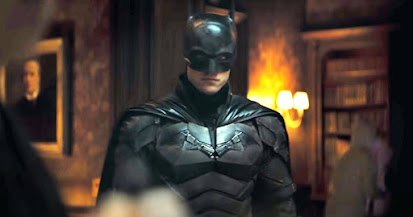
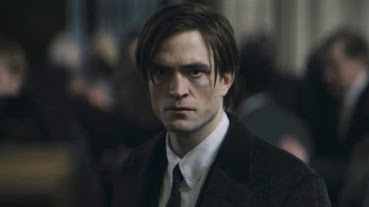
THE BATMAN - Robert Pattinson in the suit

In the new film The Batman, Gotham City is an amalgamation of 1970's urban blight New York City with surreal touches of London and Chicago. Add to that geographical stew that unnamed city where David Fincher's SE7EN takes place (where it never stops raining), and you got the makings of a brooding chapter in the Batman saga. In addition to the downbeat atmosphere already described, director Matt Reeves and his cinematographer, Australian Greig Fraser, turn down the lights to gloom level just to make things really "noir." It is three hours of a cinematic universe where lights rarely shine, and where most of the denizens seem to live only in the nighttime hours. 

The story begins on the night of October 31st, and half of Gotham City is masked and reveling in a Halloween night where the other half is engaged in various criminal activities. The Bat Signal is up, its weak light shining against the ominous clouds, and the Batman has heeded its call. This is a caped crusader full of doubts and misgivings about his choice to be a vigilante. He calls himself "vengeance," and he ably saves a subway passenger from the wrath of a gang in skull makeup. This is a world-weary crime fighter, worlds away from being a super hero.

 And when Batman's alter-ego, Bruce Wayne, shows up, Mr. Pattinson, lighted in the film's muted colors, looks more spectral than ever. Surrounding him are a cast of characters all played memorably by a great cast. Jeffrey Wright as Lieutenant James Gordon seems to be the only good cop in the whole city. Colin Farrell is a round, scarred mobster they call The Penguin, John Turturro is memorable as a mafia boss that likes to wear shades despite the gloom that surrounds him, and Andy Serkis is given very little screen time as Alfred, Bruce Wayne's butler and confidant. A sick-in-the-head masked serial killer, who likes to leave riddles inside greeting cards for the Batman after he murders important civic leaders, ends up being Paul Dano, who regretfully performs the worse rendition of Franz Shubert's "Ave Maria" I've ever heard. This well-known song is used as a leitmotif throughout the film, but I fail to see its connection with anything happening on the screen. Alongside the Batman we also have another costumed vigilante played by Zoë Kravitz. She likes to wear slin-tight leather outfits and loves cats.

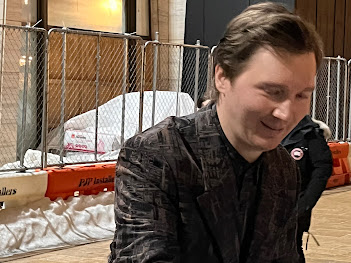
To be honest, I usually don't run out the first weekend to see a film like this. But the other night I was at Lincoln Center for the premiere of Ariadne aux Naxos, the Richard Strauss opera starring superstar soprano Lise Davidsen. Little did I know it was also the New York premiere of this film. So, the entire Lincoln Center Plaza was mobbed: barriers everywhere and autograph seekers running around. Serkis and Pattinson passed by surrounded by a horde of bodyguards. Jeffrey Wright stopped by to sign a few autographs, and so did Paul Dano. He stopped next to me to sign a fan's poster, fast enough for me to snap a picture of him.

So, I said to myself, "maybe I should go see this movie." And I did, this afternoon, and I had a great time, even though we had to get moved to another screening room because they were having technical problems with the projector. In any case, it was an enjoyable afternoon at the movies, and I recommend this film. It's a very entertaining way to spend 176 minutes of your life.

Thursday, February 24, 2022

Broadway is Back: THE MUSIC MAN

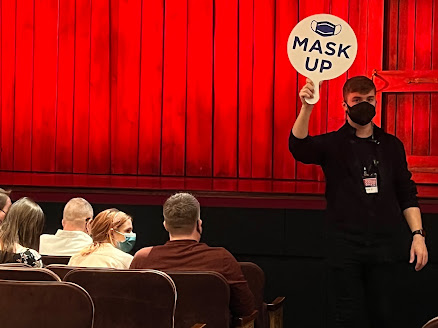
 Yes, Broadway has been back for a while, stumbling out of the COVID-19 nightmare in spurts. But this afternoon was MY first time back inside a Broadway theater since 2020. And if it wasn't for the masked crowds and a new job for ushers (see the picture below) the magic is back, and the audiences are more excited than ever.

 
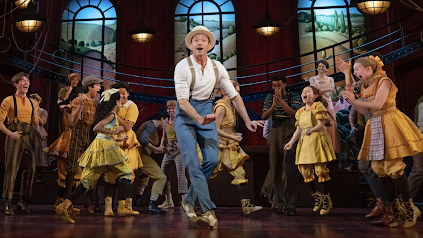
So, it really does not matter that New York Times critic Jesse Green panned the new production of Meredith Willson's The Music Man. Audiences are hungry for live theater, especially when it features superstars like Hugh Jackman and Sutton Foster whose names appeared on the marquee of the Winter Garden Theatre months before the virus hit, only to be silenced until the end of 2021. And just as the production got going, Mr. Jackman tested positive and had to quarantine, shutting down the show once again. It's been tough going for this production, and just about any other production currently on the boards.  All Mr. Jackman and Ms. Sutton had to do this afternoon was show up on stage. Before they uttered one word or sang one note the audience roared. Live theater is indeed back!

Mr. Green feels that this Music Man lacks the necessary fire to ignite this piece into relevancy. He cites a Stratford Festival production that comments on race and social relations by casting an African American actor as Professor Harold Hill. No doubt Mr. Green would have been pleased with a Broadway production that places concept over star power. But, is that the job of a musical comedy? If it is, then the genre is in danger of falling into the same conundrum we face in the opera house, where director's ideas trump casting. These days the need for true opera superstars has been eliminated -- after all it's the concept that matters. At Broadway prices, it's hard to experiment. Not even Bartlett Sher at Lincoln Center, responsible for some of the most memorable revivals in recent years, has avoided any real experimentation with the works he has chosen to stage: (South Pacific, The King and I, My Fair Lady) I'm happy that Jerry Zaks, the director of this revival, still believes in old fashioned theater, and this time he has assembled a talented cast that raises the roof off the Winter Garden with a traditional staging of this classic.  It doesn't go flat as the Times headlines stated, not with the chemistry that ignites in the pairing of Jackman and Foster and in the spark that is present in the work itself.
 
 
Hugh Jackman is having a lot of fun playing Professor Harold Hill. You can tell. There is a twinkle in his eye and a spring in his step that humanizes this traveling flim-flam man. But in his swindle talk he oozes charm and warmth, especially effective is his relationship to Winthrop, Marian the librarian's little brother who has a lisp and prefers not to talk. Mr. Jackman is no Robert Preston, who originated this role on Broadway in 1957, and who starred in the 1962 film that shows the perfection of his characterization.  As a matter of fact, I was disappointed with Mr. Jackman's version of "Trouble." He had the verbal patter down flat, but his musical intonation in his Sprechstimme left me cold. Is it that Robert Preston just owns this role perpetually as Maria Callas made Tosca her own? In 2000, in Susan Stroman's production of this musical, actor Craig Bierko fared better with this song. The timbre of his voice was closer to that of Preston, and the song worked. It was clear that Ms. Stroman's goal was to provide a Robert Preston sound-alike, although the relatively unknown Mr. Bierko made a true splash earning a Tony Award nomination for his fine performance next to Broadway superstar Rebecca Luker. The present production is a vehicle for Mr. Jackman, and one which is generally suited to his many talents. His co-star Sutton Foster is wonderful as Marian. Her comedy gifts and beautiful soprano are great assets to this production, and her entrance received a great ovation. I also want to mention the participation of Jefferson Mays who is quite funny as Mayor George Shinn. Mr. Mays is having a good year: he is also featured in the film The Tragedy of Macbeth where he plays the Doctor.

 
The set by Santo Loquasto is inspired by the art of Grant Wood (born in Anamosa, Iowa), a town which may not be too different from River City. There is even a backdrop inspired by Wood's "The Midnight Ride of Paul Revere." Interestingly enough, from my seat in the house (Orchestra, Row J seat 2) I couldn't see Paul Revere. Why was he eliminated?  

In general, this show was a very entertaining; a very fun afternoon at the Winter Garden Theatre. It is a production that you will thoroughly enjoy whether you are a Jackman or a Foster fan -- or both. I only have one little caveat with this production, and it comes from my knowledge of the aforementioned Stroman production. The post curtain call in that 2000 staging involved the entire cast, dressed in bright red band costumes actually playing their instruments. It was so unexpected to suddenly hear that sound from the stage from actors who had memorized and learned to play these band instruments just for that closing moment. Imperfections and all, it was a remarkable moment, a true coup de théâtre. In the current production the entire cast is once again dressed in Professor Hill's imaginary, colorful band costumes, but their instruments remain conspicuously silent.

Sunday, January 16, 2022

A new RIGOLETTO at the MET

The problem with Bartlett Sher is that he is a gifted theater director, but those same creative gifts don't materialize when he dons his opera hat. Those memorable musical productions at Lincoln Center, both originals and revivals (The Light in the Piazza, South Pacific, The King and I, and My Fair Lady) have made him a household name for Broadway fans. I wish we could say the same for his operatic output at the Metropolitan Opera, which at best can be classified as uneven.

Mr. Sher began his association with the MET at the start of Peter Gelb's tenure. His production of The Barber of Seville featured an extension of the stage in front of the orchestra pit -- the infamous passerelle that many critics pointed out was not made for the MET's acoustics. There were also cartloads of pumpkins, and a giant anvil that threatened to fall on the characters Wile E. Coyote style. Perhaps his most successful production at the MET is his staging of The Tales of Hoffman, with its René Magritte bowler hats and homages to different films from Federico Fellini to Ingmar Bergman.

This season Mr. Sher has staged a new production of Rigoletto, Giuseppe Verdi's masterpiece of 1851. As is the current trend in opera staging, God forbid the director set the scene according to the wishes of the original creators. So, instead of traveling to Mantua we get Germany during the period of the Weimar Republic. Now, I have to be careful here criticizing the change of locale. After all, this opera is based on a Victor Hugo play (Le Roi s'Amuse) which takes place in the depraved French court of François I. Verdi's lyricist Francesco Maria Piave thought it best to transfer the scene to Italy. So, the original setting of this work is the depraved court of the Duke of Mantua, a made-up person who was based on Vincenzo Gonzaga, a 1500's royal scoundrel whose family motto, according to the program notes on the playbill, was "Forse che si, forse che no" (Maybe yes, maybe no).

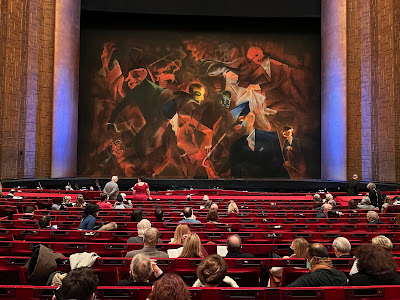
 As we come in the auditorium we are faced with a show curtain filled with nightmarish characters right out of the canvases of Max Beckmann, Otto Dix and George Grosz. But again: why Germany's Weimar Republic? Certainly the unit set built on the MET's turntable (which spins around too much for my taste) by Michael Yeargan recreate a period of grandiose Fascist architecture that was already entrenched in Mussolini's Italy years before Hitler brought Fascism to Germany.

Why not set it in Fascist Italy, then? All the ingredients are there. There's the work of poet Gabriele D'Annunzio, whose writings serve as the precursor of the ideals of Italian Fascism. And of course, there's Pier Paolo Pasolini's film Salò, or the 120 Days of Sodom, a work very much entrenched in the work of D'Annunzio. If you want depravity don't look any further. Salò is the GOAT.

Piotr Beczała has returned to play the Duke, as he did in the last MET production of this work which took place in Las Vegas. He returns with a more mature voice. It is now deeper and his memorable ringing timbre of years past seems to be disappearing. Could it be that he has sung too many performances of  Lohengrin at the Bayreuth Festival, a role that many tenors stay away from because it tends to cloud the voice? I would recommend Mr. Beczała to stay away from the swan boat and concentrate more on the Italian and French repertory.

Quinn Kelsey is a huge, bruiser from Honolulu Hawaii with a voice to match. His instrument fills the house, and then some.  It is not a particularly beautiful sound, but then again if you are playing a hunchback jester you want a growl in your voice, and Mr. Kelsey can provide that in spades.

For me, if the Sparafucile stinks, then the opera doesn't work. What I mean is that he has to have a strong sustained low F that ends the Act II duet with Rigoletto. Thank goodness the MET has re-hired Italian basso Andrea Mastroni (he made his MET debut in this role in the previous production). Once again he made a vocally chilling assassin, and that outstanding low F is his bread and butter. He has sung this role everywhere from Covent Garden to Madrid.

Unfortunately, I did not get to hear Rosa Feola as Gilda. She could not sing because she had just gotten boosted and was suffering through the effects of the injection.  The understudy was announced from the stage. It was a late cancellation for Ms. Feola so there was no paper insert in the programs. So, I have no idea who I heard. She did have a pretty soprano voice, and her "Caro Nome" was greeted with a healthy ovation. MET audiences always treat understudies well, especially if they are able to deliver.

Daniele Rustioni, the new principal guest conductor of the Bavarian State Opera led an enthusiastic reading of the score. Under his direction, the orchestra brought out the transparent and sonorous beauty of Verdi's orchestration which many times is just taken for granted. Particularly fine was the backstage storm chorus, one of the great innovations of this score.

So, there's a new Rigoletto in town. Maybe not the most memorable of productions, but the New York crowd will continue to support this staging as long as the MET management fills it with fine international singers.

Sunday, November 28, 2021

Licorice Pizza by Paul Thomas Anderson

I was there. Well, not exactly there, because Licorice Pizza, Paul Thomas Anderson's latest film is so SoCal that even its title, the name of a record store chain during the director's youth, has to be explained to someone like me whose memory of the 1970's means remembering (or forgetting) the gritty urban decay of New York, complete with graffiti-filled subways and dangerous city sectors.

I saw this film in 70mm at the Village East theater, a landmark building that presented Yiddish entertainment at the beginning of the century. Very few people will be able to tell you who played this house. I noticed the young crowd around me that gathered to see this movie, and I realized that even fewer had any clear memory of the 1970's. And yet, PT Anderson's film, filled with such loving nostalgia for days gone by, his days gone by, resonated with this young audience. The director presented a very personal story, but he also knows that if you grew up at the turn of the century in New York's Jewish ghetto, or in the Taxi Driver New York blight, or in any other decade, or any place on Earth, one thing is certain: everyone goes through adolescence and everyone falls in love. That is the simple reality and universal theme of this film.

So, the director's approach is to mine his memory banks. Episodes of his life are beautifully recreated, focusing on a young 15 year-old high school student and child actor Gary Valentine (Cooper Hoffman) and his pursuit of Alana Kane (Alana Haim), a twenty-something who eventually becomes his business partner and main squeeze. Together, they travel the landscape of Southern California at a time when prices were so low that a high school kid could open a water bed store and sell one to Jon Peters (a hilarious Bradley Cooper) during the time the ex-hairdresser turned producer was dating Barbra Streisand.

In PT Anderson's coming-of-age enchantment, Old Hollywood is still hanging on as the new lions are storming the gates. We don't get a glimpse of Stephen Spielberg or George Lucas in this film, but figures like Jack Holden (Sean Penn as William Holden), and Rex Blau (Tom Waits as an aging film director -- a John Huston / John Ford composite), play memorable parts in this film. The movie is also filled with cameos. Blink and you'll miss John C. Reilly, a PT Anderson stalwart, as Herman Munster. But you won't forget Christine Ebersole as a Lucille Ball-like character who beats up Gary after he commits a faux-pas on live TV.

The San Fernando Valley has never been portrayed so charming before. Especially during the gas shortage sequence, when Gary runs past lines of cars to the tune of David Bowie's "Life on Mars?" In this film we find a softer PT Anderson. Boogie Nights, Magnolia, and The Master were tough subjects, and his scalpel had to be sharper and cut deeper. Here, the director's main prop is his camera (he takes the DP credit for the first time), and it seems that his main concerns are to present a rosy recreation of his coming-of-age years, and to make sure Cooper Hoffman and Alana Kane come out of this as bright new Hollywood stars. Not a bad reason to create this film. Cooper's dad, the late Philip Seymour Hoffman had a long association with PT Anderson, the actor giving some of his best, defining performances under this director's lens. Now is the time for a new generation to spring forward, as the director turns his gaze back to the past.

Friday, November 26, 2021

Stephen Sondheim is Dead

I knew one day we would all have to go through this. The once young, vibrant enfant terrible of the Broadway stage, the one who dazzled us with the youthful lyrics of West Side Story and who matured into the greatest American lyricist/composer since Cole Porter is dead. Stephen Sondheim seemed to be an eternal presence. Although his name had not graced any Broadway marquee in quite a while, revivals of his classic work often adorned the Great White Way. And in the back of every theater-goers mind there was always the hope that there was one more in him. One more masterpiece before the long sleep; like Giuseppe Verdi who produced two of his greatest operas, Otello and Falstaff after he had called it quits.

His shows almost never made money. Sure, when he started out at first as the young lyricist to Leonard Bernstein's music in West Side Story that show was a hit. And so was Gypsy, for which he almost wrote the music, however Ethel Merman did not want to star in a show written by an unknown composer. So Stephen reprised his role as lyricist, this time to Jules Stein's great score. He was soon to come into his own as a composer and lyricist with his farce A Funny Thing Happened on the Way to the Forum.

And then, magic happened. His collaboration with director Harold Prince produced some of the greatest American musicals. Lightning kept striking every time. Follies, Company, A Little Night Music, Pacific Overtures, Sweeney Todd the Demon Barber of Fleet Street, Sunday in the Park with George, Merrily We Roll Along, Into the Woods, Assasins, and Passion. There were Tony Awards galore, as well as the Pulitzer Prize. If you have followed his career you have your favorites. I know I fell in love with Sweeney Todd the moment I heard the downbeat chord on the organ that begins the score. For Sondheim it was a revenge story, for director Hal Prince it was about the dehumanization of man during the Industrial Revolution. 

Definitely the Stephen Sondheim musical was not the feel good, warm and fuzzy product that Broadway audiences expected. The shows made very little money, but he was expanding the horizons of musical theater. He couldn't compete with the likes of an Annie, Les Misérables or with Andrew Lloyd Weber's British invasion. And, of course, he just could not bring in the crowds that were starting to flock to the corporate Disney shows that were filling the theaters.

I remember a radio interview Sondheim gave at the time of the premiere of Sweeney Todd, a show I got to see three times. He was talking about the struggle to find a musical language to fit a particular show. He reminisced about Pacific Overtures, a daring show about the opening of Japan in the 1800's and the  eventual westernization and commercialization of the country. Like Richard Rodgers in the 1950's who struggled with how Eastern to make the music of The King and I, Sondheim could not get the feeling for this show right. Until, as so often happens, one day it hit him. In the staccato rhythms of Spanish flamenco music somehow he found the necessary voice for his show about Japan's floating kingdom. I never forgot this incredible journey of discovery that this artist went through, and was able to tell us about it. At that moment I realized that Sondheim was not just the cerebral creator of Broadway entertainment. He had become a musical advocate for the globalization of music. The show was the customary Sondheim flop. Imagine a show where the Americans are the bad guys for destroying the beautiful traditions of Japan, playing during 1976: the year where jingoism was at its highest as America celebrated its Bicentennial.

As a composer Sondheim was unique among his peers. Everybody always said one did not leave the theater humming a Sondheim score. That might have been true, but what was always certain was that his choice of a musical idiom fitted the show like a glove. His music could be brassy as in Company, operatic with a touch of the gothic as in Sweeney Todd, and even minimalist and filled with a dash of pointillism in Sunday in the Park with George. And sometimes it could just simply sway in perfect Johann Strauss three quarter time in A Little Night Music, one of my favorite Sondheim shows, adapted from Smiles of a Summer Night, one of the great Ingmar Bergman films.

We have lost one of the great ones. I do not think we will see another one like him in our lifetime.