Monday, March 06, 2006

James Levine's Health

I saw James Levine on a beautiful Sunday afternoon, in the spring of 2004, walking outside the MET. He was walking very gingerly, lagging behind a female companion, and carrying in his hands a folded Playbill to the Christopher Plummer production of King Lear that played at the Vivian Beaumont from February to April of that year. Looking at him, walking like a tired old man, his gaze lowered to the ground, almost afraid of taking the next step, I assumed that he had been overcome by Christopher Plummer's stellar performance. But when he walked passed me, I could see in his face the unmistakable pain of someone deeply suffering from his sciatica. James Levine's journey from young energetic prodigy to infirm middle age came too fast.

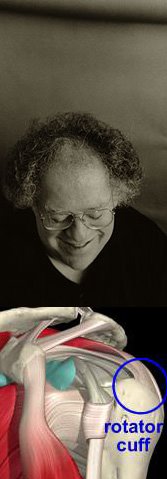
This weekend the news broke that he had fallen onstage at Boston's Symphony Hall after a rapturous performance of Beethoven's Ninth Symphony. The preliminary reports are that he fell right on his shoulder and injured his rotator cuff. The fall has now forced Maestro Levine to cancel his participation in the Boston Symphony's upcoming tour and, depending on the extent of his injury, possibly the rest of the performances at the Metropolitan Opera. He was scheduled to undergo an MRI today, and the best that he can hope for is that the rotator cuff is only bruised. Anything more damaging, such as a tear, would require surgery and put him out of commission for many months. His schedule at the MET for the remainder of the season, is quite hectic, with upcoming performances of Fidelio, the return of Robert Wilson's production of Lohengrin and three performances of Parsifal. Also, he is scheduled to conduct the upcoming new production of Donizetti's Don Pasquale.

If James Levine is forced to cancel his Wagner performances during April and May, it will be interesting to see who the MET gets to replace him. Will these performances be led, by default, by Maestro Valery Gergiev (who in April of 2003 conducted a number of memorable performances of Parsifal with Domingo, Pape and Struckmann)? Or will David Robertson or Marek Janowski (both of whom are taking over the Boston Symphony's tour) be hired to fill in for the ailing maestro in New York.

Listen up, Mr, Volpe: desperate times require desperate measures. If Maestro Levine is unable to fulfill his duties for the rest of the season, I recommend Christian Thielemann (an amazing Tannhäuser at Bayreuth this summer), Kent Nagano (his vivid reading of Parsifal from Baden-Baden is now available on DVD) or Esa-Pekka Salonen, whose Tristan Project and Tristan und Isolde last year in Los Angeles and Paris respectively electrified the musical and artistic world.

But make no mistake, what we all really want is for James Levine to get healthy and to conduct the rest of the operas he is scheduled to lead. The A-list of star conductors that I recommended above would be great ringers, but I think it would be better if they just became part of the MET's regular roster of house conductors under the upcoming Peter Gelb tenure.

Saturday, March 04, 2006

Mark Morris Dance Group does Vivaldi

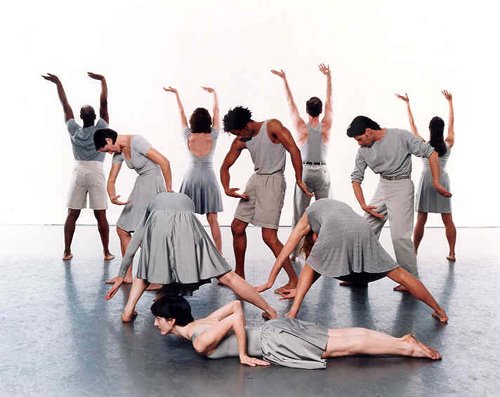
The Juilliard Choral Union, to which I belong, will be performing at BAM with the Mark Morris Dance Group. The ballet is called Gloria, and it features the music of Antonio Vivaldi. This week, Time Out New York published some reflections from the choreographer on the 25th anniversary of the founding of his Dance Group. Here's what Mark Morris had to say about the upcoming performances of Gloria: "Here's the thing: it's one of my first dances, it's very very good, people like to do it and people like to watch it, and I've done everything I can with it. It's not always my favorite thing to watch in rehearsal. I decided to reinvolve myself with the piece, so I'm conducting the motherfucker."

Friday, March 03, 2006

He's Becoming Quite the Wagnerian

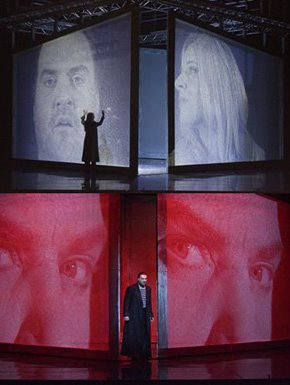
These days, mention Bryn Terfel's name and it is Wagner, not Mozart or Verdi, that first comes to mind. Last year it was Die Walküre at Covent Garden and the BBC Proms, and this winter it is The Flying Dutchman that is keeping the Welshman busy right in his homeland. The Welsh National Opera has mounted for him a new production of Wagner's romantic work, helping to fulfill Terfel's promise to the company that he would sing this taxing role when the company had a suitable house. The critics have all praised Terfel's singing and acting, but have been less kind to David Pountney's production which was first seen in Zurich, and which features projections by video artists Jane and Louise Wilson. Using an approach that vaguely reminds one of The Tristan Project, static close-ups of Mr. Terfel's face are rear-projected throughout the opera on two giant screens.
Anthony Holden in The Observer wrote the following review of this production which, to him, reminds him more of a space opera than anything else.

"Where Wagner Boldly Goes"

The Flying Dutchman Welsh National Opera, Millennium Centre, Cardiff

On the cover of Welsh National Opera's programme for its new version of The Flying Dutchman is a faux-naif nightscape reducing the universe to one-quarter sea, three-quarters brooding sky, dotted with white objects too large to be stars. Observant opera-goers might be forgiven for thinking the (uncredited) artist has got his (or her) proportions wrong, especially in the case of a work so steeped in the maritime. In fact, the picture is a clue to director David Pountney's characteristically bold new take on Wagner's first great meditation on solitude and redemption.

Space, to Pountney, has these days replaced Wagner's sea in the collective imagination as 'an image of the ultimately lonely, desolate place in which someone might be condemned to wander aimlessly'. Such is the plight of the legendary Dutchman, cursed to sail the high seas forever unless he can seize a fleeting chance, once every seven years, to find the love of a faithful woman.

When last he directed this opera, on the huge floating stage at the Bregenz festival in Austria, Pountney had to avoid the temptation to use real ships on the lake as he could not rely on real weather to reflect the shifting moods of Wagner's music. So he internalised the Dutchman's quest, setting it in an abstract house, 'the house of his mind'.

This remains largely true in this new staging, with no less a mind than Bryn Terfel's returning home to Wales, and the company where he began his career, to make his debut as the Dutchman in honour of WNO's 60th birthday. The trouble, as he roams space for two-and-a-half uninterrupted hours, is that so much of Wagner's music is still explicitly, all too audibly, about the sea.

Undeterred, Pountney reinforces his mise-en-scene with video images he came across by chance in Bilbao's Guggenheim Museum - pictures by sisters Jane and Louise Wilson of a crumbling Soviet space training centre in Kazakhstan. He then commissioned them to film extreme, often uncomfortably so, close-ups of Terfel and the girl who might just end his protracted quest.

Projected on to giant screens through which the two interact, these suggest that each may be a figment of the other's imagination, or at least someone other than they seem. Given that the girl is a dreamy adolescent in love with the romantic idea of the Dutchman, and that he sees her purely as a means of escape from his plight, this adds up to an effective variant on the over-familiar use of video images onstage, even if it does neither soloist any cosmetic favours.

It also turns the evening into a collision of archetypes rather than the conventionally torrid human drama. Roaming around a central platform of the girders so loved by this director (and too many others), rarely interacting except to each other's phantom images, rarely even touching for a couple supposedly in love, the two central figures take on dream-like dimensions of fantasy and illusion that cumulatively suit their roles in this otherworldly piece.

And they are majestically performed, Terfel's trademark snarls and gloriously rich baritone more than matched by the glacial beauty and sonorous reach of Swedish soprano Annalena Persson as Senta. Where he maintains a lofty detachment, singing to her projected image (or even his own) more than her corporeal self, she hurls herself towards her new-found destiny with as much physical as vocal commitment.

This involves the summary dumping of her childhood sweetheart, Eric, whose impossible longings and self-righteous indignation are touchingly captured by British tenor Ian Storey. You cannot imagine this wimp ever seeming an adequate son-in-law to Senta's scheming father, Daland, the unscrupulous materialist as powerfully enacted as sung by Israeli bass Gidon Saks.

A sensitive director of singers, with a sure enough sense of theatre to lend central moments a duly celestial stillness, Pountney cannot resist the occasional postmodernist intrusion. Where his own synopsis of the plot has Daland's crew becoming 'increasingly aggressive and provocative', for instance, he decks out a female chorus of all shapes and sizes in tediously unoriginal Barbie doll wigs to become the victims of a drunken gang-rape.

The childish graffito that Senta draws when singing of her love for the Dutchman is, by contrast, a clever conceit reminding us that she is a young woman way out of her depth in this saga, pimped by a greedy father to a lost soul who cares only about her fidelity.

It's an unremittingly bleak scenario, rendered all the bleaker by its transference from the foaming seas of Wagner's imagination to the boundless space of Pountney's. His decision to dispense with an interval, let alone the usual two, bolsters the epic scale of the work without quite turning it into an endurance test. But it also deprives the audience of the chance to work out exactly what's going on with a quick flick through the programme over a welcome drink.

I have said it before - and I'll say it again - it should never be necessary to read the programme to grasp what's happening in any theatre, operatic or otherwise. In this case, however, it sure helps, for all Pountney's protestations that his meaning should be 'completely understandable from what you see in front of you'.

Those who don't understand the sudden descent of spacemen towards the end, or the fibre-optic bulbs being manufactured by the female chorus, might even take the first video-projected images of some derelict institution to be a topical reference to Abu Ghraib. Fear not. Once you grasp that we're all wafting around the Milky Way, rather than being subjected to yet another stage protest about some dire contemporary hellhole, everything will gradually fall into place. Think of space as an ocean and Wagner's surging music will weave its magic. Succumb to Pountney's maverick vision and these world-class performers will help you understand why even early Wagner has a cult following.

With the impressive Carlo Rizzi in the pit, this exemplary ensemble is blessed with distinguished support from WNO's fine chorus and house orchestra, every stitch in Wagner's rich tapestry meticulously revealed, if, at times, underplayed for the sake of the onstage voices.

It may have got off to a slow start on the first night, but this is a reading which is bound to grow in confidence as the show moves from Cardiff to London, Birmingham and Bristol, where Robert Hayward takes over from Terfel and continues with the role in Milton Keynes, Liverpool and Swansea. If the visuals don't grab you, the aurals surely will.

Saturday, February 25, 2006

Mr. Wainwright Goes to the MET

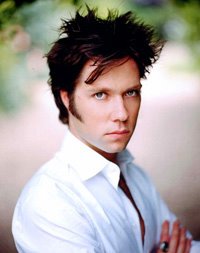
Singer Rufus Wainwright was a hit during the first intermission of today's MET's broadcast of Saint-Saëns' Samson et Dalila. He was just himself, and his bubbly persona was a good introduction to this artist. I am sure that a good number of broadcast listeners are not familiar with him or his music, and might only have heard of him for the first time after his name came up during the Peter Gelb press conferences in which the MET's new impressario announced that Mr. Wainwright is on the short list of composers commisioned to write a workshop opera under his proposed new project. Rufus Wainwright's music can best be described as alternative with, at times, strong leanings towards the operatic. For example, in the first cut of his latest album Want Two, a composition called Agnus Dei (which was alluded to in the intermission conversation he had with announcer Lisa Simeone), the composer takes the Latin text of the Catholic mass and sends it on a musical journey through time starting in a primitive Celtic world, then traveling to Moorish Spain, and finally coming to an impressive climax in the post-Romantic era of Mahler and Bruckner. He is very imaginative, very talented, and totally in love with opera. His young vibrant personality came through in the interview, sounding like an approachable celebrity, rather than a laconic, introverted artist. He showed insight when discussing his personal links between opera, the AIDS crisis and the affect that it has had on a young gay man like himself. He even showed a hint of nerves during the interview when he could not think of the name of Leontyne Price. On the other hand, although announcer Lisa Simeone conducted a fairly enjoyable interview, and did ask the right questions, I don't believe for a minute that she did not know that Mr. Wainwright had been commissioned by the MET to write some kind of work. If she really didn't, then I would recommend that she do her homework before stepping up to the mike.

Monday, February 20, 2006

Anthony Minghella's Butterfly

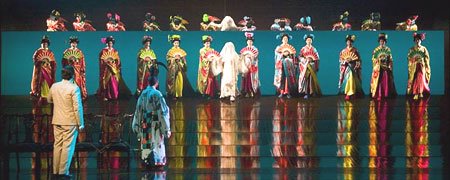
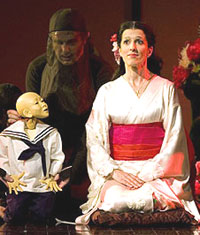
By all accounts, Anthony Minghella's Madama Butterfly at the English National Opera, and soon to open the 2006-2007 Metropolitan Opera season, is a masterpiece. It is innovative, bold, but still very much in the spirit of Puccini and western opera. Edward Seckerson in The Independent wrote that "This Butterfly is at once the simplest and most sumptuous thing we've ever seen in this theatre. It is the meeting of Japanese kabuki and Western opera but shot through with the expensive air and finely tuned manner of a Broadway show. When Butterfly's wedding party arrives, it too rises over a turquoise horizon and processes downstage as if seen through a shimmering heat haze."
He went on to report that the boldest innovation in the production is the use of puppets, in particular with the mute character of Butterfly's child, Sorrow. He writes: "Instead of a child, three wonderful puppeteers breathe tangible life into a little Japanese doll in a sailor suit. The physical detail, the restless, excitable, mother-clinging actions and reactions are such that a child actor could never give us and after a while you stop noticing the puppeteers and, like Butterfly, you see only genuine emotion and need in the impassive doll-face."
To me, the whole concept sounds quite wonderful, and my only concern with this approach to Butterfly is that the production could be swallowed whole by the sheer size of the MET. The London Coliseum is an intimate theater as opera houses go, and the subtleties of a little puppet are perfect for this jewel-box of a theater. Is it possible that it can work at the MET? Sounds to me like the patrons in the orchestra seats will be the ones who will end up receiving the full impact of Mr. Minghella's brilliant concept.

Sunday, February 19, 2006

This'll get'em in, by George!

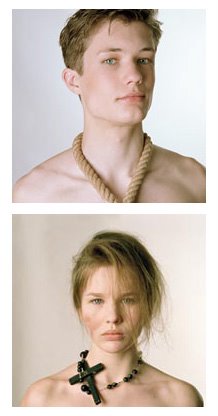
The English National Opera has been advertising their current season at the London Colisseum with plenty of captivatingly sexy images these days. Pictured on the top left is an image from the Billy Budd ad, and below an image for Dialogues of the Carmelites. In the hopes of dusting the cobwebs suggested by the word opera, the ENO's advertising campaign reveals a sleek world where the lyric theater promises to meet trendy London. The new ad campaign is designed to lure in members of Generation X and Y, Baby Busters, Yuppies, and Bobos who, up to now, have stayed away in droves from opera.

Across the Pond, the New York City Opera, among others, has also adopted similar ad campaigns to get the young people in. And although they have not been using flesh to fill seats, little tricks such as listing repertory using one word "hip" titles (Butterfly, Figaro) often appear in their advertising.

As the Metropolitan Opera prepares to welcome Peter Gelb, we are reminded that the MET has plans to replace the current Madama Butterfly production with the current smash hit at the ENO which has been helmed by superstar film director Anthony Minghella (The English Patient, The Talented Mr. Ripley). I am sure that as Mr. Gelb becomes entrenched in his new post at the MET that this is the style of advertising that will begin to appear to compliment the new productions that will be filling future repertory.

Saturday, February 18, 2006

The Goeran Gentele Revolution

The recent Peter Gelb news conferences have brought on many conversations about imminent winds of change that promise to swirl about the Metropolitan Opera. During a conversation I had at work with one of my colleagues, he wondered what the MET would be like these days if the brilliant Swedish empressario and director Goeran Gentele had not died so tragically right as he was starting his tenure in New York City. This, together with the above photograph of Leonard Bernstein conducting a vocal rehearsal of Carmen in 1972, inspired the following post.

The Goeran Gentele Revolution ended abruptly when he was killed in an automobile accident in July of 1972. Mr. Gentele had assumed leadership of the Metropolitan Opera after Sir Rudolph Bing's retirement. He had only been at the helm of the opera house for a few short weeks. His brilliant production of Carmen with James McCracken and Marilyn Horne, conducted by Leonard Bernstein became his posthumous legacy to the Metropolitan Opera. It was an amazing, abstract re-thinking of Bizet's work (with monumental bare white walls and blinding light) that shifted the focus of the work to Don José, away from the title character and, in doing so, brought a sense of doom to a work that had grown stale with endless repetition. On the musical side, Mr. Bernstein's tempi were the slowest one ever associated with this work, resulting in a score that sounded noble and filled with doom, instead of a collection of well-known, often-played arias and ensembles. A recording of this production is available from Deutsche Grammophon.

The Schuyler Chapin, and Anthony Bliss tenures led to the Joseph Volpe Era. Personally, it is hard to imagine this Carmen production under the present leadership. In the years that Mr. Volpe has led the MET, his creative eye grew to be more expensive, while at the same time his vision shrunk down to become more conservative. The MET thrived financially for some years, but after the events of the eleventh of September empty seats became the norm. Somewhere along the line, the MET ceased to become the place to be when it came to innovation, and this is the sad legacy that Mr. Volpe leaves behind. The unkindest cut of all was that Mr. Gentele's work was replaced by Franco Zeffirelli's current production, which has all the intimacy of Ringling Brothers.

Goeran Gentele is known to have said that "Opera is an 18th and 19th century art that must find a 20th century audience." I certainly hope that Mr. Gelb shares this opinion, and that he is able to lead the MET into the 21st century.

Saturday, February 11, 2006

The Upcoming Peter Gelb Revolution

From the tone of today's article by Daniel J. Wakin in the New York Times, the upcoming tenure of Peter Gelb as General Manager at the Metropolitan Opera will feature new operas, new productions, new broadcasts, and everything you can imagine that could possibly be called new. Needless to say, it appears that Mr. Gelb feels that the Metropolitan Opera is wearing knickers and that it needs to be catapulted into modern times with daring productions, HD-TV broadcasts, and iPod downloads. While all of this, personally, sounds very exciting to me, I really don't know where he is going to get the money without totally pricing the MET out of the reach of the fans who are the backbone of the house. Further, although I would love to see at the MET more of the kind of daring productions that are now old hat in Europe (the new Ring better be Eurotrashy -- we've been due for about twenty years!) without major bucks from government subsidy it is not going to happen. And if the MET's new Ring happens to take place inside a Russian submarine, or fifty-three miles west of Venus, will the old-guard, accustomed to Günther Schneider-Siemssen's Teutonic peaks accept this kind of radicalism and continue to patronize this institution? Clearly there are changes in the horizon for the Metropolitan Opera, but if Peter Gelb can make this house once again relevant in the New York art scene, then he will have accomplished his job.

Here is Mr. Wakin's article from today's Times:

"As Audience Shrinks, the MET gets Daring" by Daniel J. Wakin

Revolution is afoot at the Metropolitan Opera, the world's largest opera house, which has been plagued in recent years by declining attendance and budget woes.

Peter Gelb, who takes over in August as the Met's first new general manager in 16 years, has laid out broad-ranging plans to remake the venerable house, sharply increasing the number of new productions, commissioning more and different kinds of new works, bringing in a wave of high-profile theater and film directors and striding into the world of digital transmission.

This attempt to reconceive the Met as an institution more open to popular influences and more attractive to a wider public may well alarm opera traditionalists, who are the heart of the Met's audience. It is also a response to the long reign of the current general manager, Joseph Volpe, who has worked at the Met for 42 years.

"I told the board at the time of my choice that I wanted to take this great institution that had grown somewhat isolated artistically and reconnect it to the world," Mr. Gelb said.

Mr. Gelb's program calls for a collaboration with Lincoln Center Theater that will engage Hollywood directors like Anthony Minghella and Broadway directors like George C. Wolfe, as well as musical figures like the theater composers Michael John LaChiusa and Adam Guettel and the jazz musician Wynton Marsalis. Major conductors who have never appeared at the Met will make debuts, including Riccardo Muti, Daniel Barenboim and Esa-Pekka Salonen. The Met will install a gallery for works by contemporary painters, extending its reach into the visual arts. The artists include John Currin, Richard Prince and Sophie von Hellerman.

Mr. Gelb said he wanted to embrace new technology. Performances will be broadcast nationwide in high-definition movie theaters and made available through downloading, if agreements can be reached with the house's unions. CD's and DVD's could follow.

In a two-hour interview on Thursday, Mr. Gelb sketched out plans that could radically remake the house and influence opera houses around the world, given its size and influence. "My work at the Met is going to involve everything," he said, "even subtitles."

A former record company executive who produced Met telecasts in the late 1980's and early 90's, Mr. Gelb formally takes over on Aug. 1. But since January 2005 he has been working alongside the strong-willed Mr. Volpe.

Mr. Gelb, who is a son of Arthur Gelb, a former managing editor of The New York Times, said his plans were not meant as a criticism of the Volpe era. He noted that a sharp drop in opera attendance since 9/11 afflicted many institutions.

But he went on to say that the house had been "coasting" and that the old formula — counting on dedicated operagoers to fill the house for standard productions — no longer worked. He also took note of criticism that the Met has not attracted enough world-class conductors. Regarding singers, he said, it has "waited too long to jump on talent."

Mr. Volpe said his successor's approach might ruffle feathers. "Our audience loves standard opera done in a traditional way," he said. "But if it's very theatrical and well done they will be very happy with it. I think it's a good direction."

Mr. Volpe said he did not consider Mr. Gelb's plans a repudiation of his stewardship. "What I did, in my opinion, worked," he said. "If the new direction is successful, then you could say that the way the Met operated in the last decade should have been changed." If the audiences do not accept the new productions, he added, "then that's another result."

Martin Bernheimer, the New York-based music critic of The Financial Times, said Mr. Gelb appeared to be "desperately looking for a new audience and a new kind of opera."

"I think that's fine," he said. "But the question is, what will he do with the core audience while he's courting this new audience?"

Mr. Gelb said he wanted to create a "constant kind of excitement" by staging a new production every month, raising the average from four a year to seven. He will immediately scrap the tradition of an opening-night gala of big stars performing acts from several different operas.

"The idea that the Met has not opened a season with a new production in 20 years I find remarkable," he said. Hence, a new "Madama Butterfly," directed by Mr. Minghella and produced in cooperation with the English National Opera, will open the next Met season. It was a hit in London last fall.

Making such changes in the opera world, in which seasons are planned many years in advance, is unusual. But the Met had already scheduled an old "Butterfly" production for October, so that puzzle piece was replaced with a new one.

Mr. Gelb said that his goal with all the changes was to create bridges to a broader public. But the strategy also carries the risk of alienating traditional opera lovers and serious-minded critics. It remains questionable how congenial iTunes opera downloads would be to the typical Met attendee, whom the house has identified as a 62-year-old college graduate earning about $120,000.

Mr. Gelb acknowledged the need to keep traditionalists in the fold.

"My plans are not intended to frighten them," he said. "What I'm trying to do is to honor the aesthetic traditions of the Met while at the same time moving forward. If I were to function purely as a curator, then the Met would not continue to function and thrive."

The Met has cut its budget in midseason three years in a row, and in December it reported an expected box-office shortfall of $4.3 million. After selling more than 90 percent of its tickets in the 1990's, it is selling about 85 percent now, and a much larger proportion of them are discounted.

Mr. Gelb said he would change ticket prices next season to increase revenue. The highest-priced seats would rise from $320 to $375, and costs would go up for 60,000 seats out of the 857,000 total capacity next year. But the lowest ticket price would drop from $26 to $15, and 90,000 seats would decline in price.

The next three seasons have already been mostly planned, but Mr. Gelb said he had some influence, adding two new productions each season in 2007-8 and in 2008-9.

The first season fully planned by Mr. Gelb will be 2009-10. It will have seven new productions.

The season will open with a new "Tosca," possibly directed by George C. Wolfe, the former producer of the Public Theater. Karita Mattila will sing the title role for the first time. Angela Gheorghiu, a high soprano, will sing Carmen, a mezzo role. Matthew Bourne, a choreographer, and Richard Eyre will direct. The two collaborated on the musical "Mary Poppins," now playing in London.

The elusive Mr. Muti will make his Met debut with the early Verdi work "Attila," one of his signature operas. Mr. Salonen will conduct Janacek's "From the House of the Dead," directed by Patrice Chéreau. Renée Fleming will star in the early Rossini opera "Armida," directed by Mary Zimmerman. The next season, 2010-11, the Met will begin presenting a Wagner "Ring" cycle directed by Robert Lepage, a master of theatrical spectacle and technology who recently created the Cirque du Soleil extravaganza "KA" in Las Vegas. It will also present a commissioned work by the currently prominent Argentine composer Osvaldo Golijov.

Notably absent from Mr. Gelb's outline of his plans was a discussion of the repertory's more challenging works, like Berg's "Wozzeck" and "Lulu," which are close to the heart of James Levine, the music director and longtime artistic soul of the Met. When asked, Mr. Gelb said both would continue to have short runs in coming years.

"We have to balance the season," he said. "And Jimmy insists on that, and he's right."

Mr. Levine said he fully supported Mr. Gelb's plans. "What I think he wants to do is produce a noticeable change right away," Mr. Levine said, "where he will have a way in front of him to evaluate what works."

But he cautioned that financing was not a given and the Met's plans depended on whether guest artists do in fact appear. He cited the fragility of voices during winter and the whims of conductors.

"If all those conductors to whom Peter spoke really come and do what they've agreed to do," Mr. Levine said, "that will be really exciting."

One of the biggest and perhaps most controversial departures is the collaboration with Lincoln Center Theater, which Mr. Gelb said was designed to produce operas with better dramatic flow from unexpected composers and to give them a chance for improvement before hitting the stage.

The Met and the theater have commissioned works from a range of composers and playwrights, some of them outside the classical tradition. The pieces will be workshopped and then guided toward either the Vivian Beaumont Theater or the Met stage. The Met is holding open a spot during the 2011-12 season for the first product of this collaboration. The artists include the team of Jeannine Tesori and Tony Kushner, as well as Rufus Wainwright, Scott Wheeler and Michael Torke.

Mr. Gelb said that if a revenue-sharing agreement with the house's unions could be reached, he hoped to start movie house broadcasts next year. The Met would begin with six Saturday performances in its radio broadcast season, relayed to theaters outfitted with high-definition systems, for about $20 a ticket. Two movie chains are interested, he said.

"The idea is to really conceive of it as an event," he said, "because that's what's exciting about opera."

Wednesday, January 25, 2006

Thomas Hampson / Marilyn Horne

American Song, the Thomas Hampson recital at Carnegie Hall last Thursday was a critical and popular success. It happened on the nineteenth of the month, that is, two days after Marilyn Horne's birthday. Two days after the concert itself, an audio capture of the event appeared posted on a Usenet group. The great baritone performed some of the best songs by Barber, Ives, Rorem, Thompson, and others. It was a carefully selected group of compositions, chosen and presented by Mr. Hampson with a didactic tone that seemed to work most of the time. At the conclusion of the show he offered two encores of incredible beauty: Stephen Foster's well-known "Beautiful Dreamer," and Haydn Wood's poignant "Roses of Picardy." It was towards the end of the program, right before he sang the Stephen Foster song that Mr. Hampson turned to the audience (as he did throughout the concert to explain and complain -- more about that later) and dedicated the Foster song to Marilyn Horne for her birthday. On the subject of American song, all singers owe a debt of gratitude to Marilyn Horne. Her album "Beautiful Dreamer, The Great American Songbook" with the English Chamber Orchestra under the great Carl Davis has done a lot to promote popular, serious American music. The fact that a day before Mr. Hampson's concert it was reported that the legendary mezzo-soprano was diagnosed with localized pancreatic cancer, added to the poignancy of Mr. Hampson's dedication. I'm not sure if Marilyn Horne was present at Carnegie Hall, but a friend who was at the concert told me that Mr. Hampson turned to the side when he dedicated the song, seemingly talking directly to someone.

According to Anne Midgette, in the New York Times, "there was a sense of unruliness in the public from the start, when the first song was delayed by an audience member walking around the auditorium, and it continued with applause in the middle of sets that Mr. Hampson tried to quell, tactfully, repeatedly and unsuccessfully." Perhaps, the fact that Mr. Hampson talked a lot between numbers led to this kind of audience behavior. For instance, after he finished Walter Damrosch's setting of the poem "Danny Deever" in which a soldier is executed, Mr. Hampson said to the audience "That was Teddy Roosevelt's favorite song!" Was that random piece of trivia really necessary? It not only brought on laughter, but a woman in the audience stood up and interrupted Mr. Hampson by asking him why the soldier was executed.

I will end this report about the concert by once again quoting the beginning of Ms. Midgette's review: "A wave of laughter greeted the song's last line, and from the Carnegie Hall stage, the baritone Thomas Hampson looked at the crowd in bemusement. "All over the country they laugh at that!" he said. His perplexity was understandable. The text was Edward Arlington Robinson's poem "Richard Cory," set to music by John Duke. It describes a handsome, wealthy man who is the envy of his community. In the abrupt final line, this favored child of fortune "went home and put a bullet through his head." Wry, bitter, unsettling: yes. But funny?"

Sunday, January 15, 2006

Discovering Ugetsu Monogatari

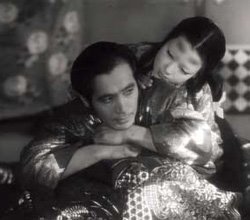
This weekend I discovered one of the masterpieces of the Japanese cinema: Kenji Mizoguchi's Ugetsu Monogatari. I had never seen this film, although I have known of its existence since the summer of 1977 when I first discovered foreign films. Ugetsu, with its contemplative theme of careless love, its fluid structure, and its subtle supernatural story is not the easiest of films, especially when compared to the more dynamic, more "American" cinema of Akira Kurosawa -- the director of The Seven Samurai, Rashomon, and Yojimbo. I'm glad that it took me all these years to get to the movie, since I don't think I would have liked it when I was a teen discovering Kurosawa's masterpieces. I probably would have found Mizoguchi's work vague, and perhaps boring. This is one of those movies that always ends up on the top ten lists of the greatest films ever made from critics from all over the world. I think I agree with these critics. The Criterion Collection has finally issued the film in a wonderful DVD version which, again, makes me glad that I waited to see it. Needless to say, this pressing from an original fine-grain 35mm print looks superb. You will enjoy this DVD release, with its amazing visual, its fine commentary and the well-made documentary about director Mizoguchi. So, if you are ready to step further beyond the films of Akira Kurosawa, you should give Ugetsu a try. I am sure that you will find it mesmerizing and totally unforgettable.

Saturday, January 14, 2006

Requiem for Sweeney Todd

The skeletal remains of Sweeney Todd, The Demon Barber of Fleet Street are on view eight times a week at the Eugene O'Neill theater. Stephen Sondheim's big operatic musical has been re-orchestrated, turned into a chamber work, and removed from traditional Victorian London. The setting of the work is now a room in an insane asylum (filled with Victoriana bric-a-brac) and populated with Michael Cerveris, Patti LuPone and a cast of eight incredibly talented singing actors and musicians. The result is a production that exasperates as often as it delights.

Most of the things that I liked about the original production (with Angela Lansbury and Len Cariou) are gone: the big orchestra, the big sets, and the big climaxes. In 1979, Hal Prince turned Sondheim's work into an unforgettable commentary on the Industrial Revolution's effects on the common man. It was a huge spectacle that catapulted Sondheim's work into the level of opera, took home Tony Awards for its creators and stars, and assured Sondheim's place in the pantheon of immortals. I remember falling in love with the work instantly (right from the first couple of bars from the organ) when I first heard it. My two visits to the original production at the then Uris Theater (now the Gershwin) were simply unforgettable theatrical evenings.

This production is a totally different experience, and if you have seen this work before this production will really challenge you. In fact, in order to appreciate the show's current run one has to be somewhat familiar with the work. If you are, then you will be more accepting of the production's conceits. The staging by British director John Doyle does not help the run-of-the-mill theatergoer or the neophyte to the work. Since everything takes place in one room, the audience is forced to imagine the various settings where the story takes place (streets, tonsorial parlor, bakehouse) and try to piece the story together from the lyrics and dialogue, which are beautifully enunciated by the cast. The short list of props includes a macabre black coffin, a ladder, and a symbolic tiny white baby coffin that Michael Cerveris clutches like the distant memory of his lost wife and child.

The most surprising and effective aspect of this production is the fact that the actors act, sing, and play all the musical instruments. This triple threat tour-de-force is something to behold, and it is quite surprising to hear how good they all are performing their various duties. Many of the actors play more than one instrument throughout the course of the show, and the new orchestrations are intelligent and quite lush. I do wish they would have gotten some older looking, drabier instruments, though. Patti LuPone's tuba is way too shiny, and Michael Cerveris' guitar is way too cheerful, colorful, and modern looking for this production.

Speaking of Michael Cerveris and Patti LuPone: they are very talented performers, and they are quite good in the roles of Sweeney and Mrs. Lovett. With his bald head, leather jacket, and pale make-up, and her Louise Brooks-like hair and torn fishnet stockings, they both look like escapees from a German Expressionist side-show. Overall, the singing is excellent from the leads and from everyone in the cast; likewise, the acting is superb. In the roles of Johanna and Anthony, Lauren Molina and Benjamin Magnuson are both making their Broadway debuts, and they are very memorable in their pivotal parts. Again, the same can be said of all ten members of the cast. This is a very tight ensemble, and I urge you to see the production because of this reason. However, if you don't know the work, make sure that at least you listen to it and get your bearings before you go. It will prove to be a less abstract, more enjoyable experience if you prepare.

I predict many Tonys for this production, so catch it before it closes. Sondheim's works, as a rule, don't last too long on Broadway, and it will be a shame if you miss this unusual version of one of our very own musical treasures.

Friday, January 13, 2006

Astrid Varnay Remembers Birgit Nilsson

The following letter was posted on the Internet newsgroup rec.music.opera. It is a personal note from soprano Astrid Varnay rememembering her friend and colleague Birgit Nilsson. Astrid Varnay was one of the great Brünnhildes of our time, and a staple at Bayreuth during the post-war Wieland Wagner years. Here at the MET I was fortunate to hear her live in the cast of the MET's premiere of Kurt Weill's The Rise and Fall of the City of Mahagonny. Here is her note:

Birgit Nilsson -- A Remembrance

Even with our helmets on, we never locked horns.

There were simply too many bonds that linked us inseparably: born in the same country - Sweden – under the same sign - Taurus - in the spring of the same year –1918. I got here first, on April 25th as the daughter of visiting Hungarian singers in Stockholm and she showed up on May 17th down the road a piece on her parents’ farm in Västra Karup in Skåne. She never stopped ribbing me about the fact that I arrived a couple of weeks before she did.

Once, after I had moved from Elektra to Klytämnestra, while she continued in the title role, I was on my way to a rehearsal, when behind me on the sidewalk I heard an abrasively cranky child whining incessantly "Mommy, mommy..." When I finally decided I could ignore this no more and turned around in exasperation to beg the parent to pay a little attention to the yammering kid, I realized that the "brat" was my friend Birgit. I did get her back, though. Years later on one of our many phone calls I feigned one of those very formal secretarial voices and inquired if I might speak to Madame Nilsson – when she took the bait and said: "This is she speaking," I switched to my own voice and said "It’s your mother!" It became an identifying mark for our many conversations over the years.

We were colleagues, not rivals. There was never any jealousy, although perhaps occasional, and I hope pardonably small surges of envy emerged on both sides. I coveted those effortless clarion high C’s, and she confessed that she would have enjoyed having some of my dramatic skills, although hers could be fairly incendiary. Actually we didn’t share that many roles. Apart from three or four pillars of both careers: Brünnhilde, Isolde, Fidelio and the aforementioned Elektra, our repertoires pretty much went their own ways. She never sang Ortrud, and I wouldn’t have touched Turandot with a Yang-Tse barge pole. And we loved singing together: Those performances and the joy of our collaboration forged a friendship that will remain affixed in my heart forever.

A talent like Birgit’s comes along – if you’re lucky – perhaps once in a lifetime. How fortunately we are that it happened in our lifetime. A friend and colleague like that is even rarer, and it was a blessing for me to have worked with her.

I’ll miss her greatly.

Astrid Varnay

Thursday, January 12, 2006

Birgit Nilsson: NY Times Bernard Holland Article


The New York Times

January 12, 2006
Birgit Nilsson, Soprano Legend Who Tamed Wagner, Dies at 87
By BERNARD HOLLAND

Birgit Nilsson, the Swedish soprano with a voice of impeccable trueness and impregnable stamina, died on Dec. 25 in Vastra Karup, the village where she was born, the Stockholm newspaper Svenska Dagbladet reported yesterday. She was 87.

A funeral was held yesterday at a church in her town, the presiding vicar, Fredrik Westerlund, told The Associated Press.

Ms. Nilsson made so strong an imprint on a number of roles that her name came to be identified with a repertory, the "Nilsson repertory," and it was a broad one. She sang the operas of Richard Strauss and made a specialty of Puccini's "Turandot," but it was Wagner who served her career and whom she served as no other soprano since the days of Kirsten Flagstad.

A big, blunt woman with a wicked sense of humor, Ms. Nilsson brooked no interference from Wagner's powerful and eventful orchestra writing. When she sang Isolde or Brünnhilde, her voice pierced through and climbed above it. Her performances took on more pathos as the years went by, but one remembers her sound more for its muscularity, accuracy and sheer joy of singing under the most trying circumstances.

Her long career at the Bayreuth Festival and her immersion in Wagner in general, began in the mid-1950's. No dramatic soprano truly approached her stature thereafter, and in the roles of Isolde, Brünnhilde and Sieglinde, she began her stately 30-year procession around the opera houses of the world. Her United States debut was in San Francisco in 1956. Three years later she made her debut at the Metropolitan Opera, singing Isolde under Karl Böhm, and some listeners treasure the memory of that performance as much as they do her live recording of the role from Bayreuth in 1966, also under Böhm. The exuberant review of her first Met performance appeared on the front page of The New York Times on Dec. 19, 1959, under the headline, "Birgit Nilsson as Isolde Flashes Like New Star in 'Met' Heavens."

Playing opposite Karl Liebl as Tristan, Howard Taubman wrote, "she dominated the stage and the performance."

When she appeared at the end of the first act to take a solo bow, he wrote, the audience "roared like the Stadium fans when Conerly throws a winning touchdown pass."

Like so many distinctive artists, Ms. Nilsson considered herself self-taught. "The best teacher is the stage," she told an interviewer in 1981. "You walk out onto it, and you have to learn to project." She deplored her early instruction and attributed her survival to native talent. "My first voice teacher almost killed me," she said. "The second was almost as bad."

Birgit Nilsson was born in 1918. Her mother, evidently a talented singer, began Ms. Nilsson's musical education at 3, buying her a toy piano. She began picking out melodies on it.

She once told an interviewer that she could sing before she could walk. "I even sang in my dreams," she added. A choirmaster near her home heard her sing and advised her to study. She entered the Royal Academy of Music in Stockholm in 1941.

Ms. Nilsson made her debut at the Royal Opera in Stockholm in 1946, replacing the scheduled Agathe in Weber's "Freischütz," who was too ill to go on. The next year she claimed attention there as Verdi's Lady Macbeth under Fritz Busch. A wealth of parts followed, from Strauss and Verdi to Wagner, Puccini and Tchaikovsky.

Her first splash abroad was 1951, as Elettra in Mozart's "Idomeneo" at the Glyndebourne Festival in England. From there, it was a short hop to the Vienna State Opera and then to Bayreuth. She took the title role of "Turandot," which is brief but in need of an unusually big sound, to Milan in 1958 and then to the rest of Italy.

Ms. Nilsson was suspicious of opera's recent youth culture and often remarked on the premature destruction of young voices brought on by overambitious career planning. "Directors and managers don't care about their futures," she once said. "They will just get another young person when this one goes bad."

In today's opera culture, the best managed voices tend to mature in the singer's 40's and begin to deteriorate during the 50's. (Singers like Plácido Domingo, flourishing in his 60's, might dispute such generalizations.) Yet at 66, when most singers hang onto whatever career remains through less taxing recitals with piano and discreet downward transpositions of key, Ms. Nilsson sang a New York concert performance of Strauss and Wagner that met both composers head-on.

"Ms. Nilsson did not sound young," Will Crutchfield wrote in The Times. "Soft and low notes were often precarious; sustained tones were not always steady." He continued: "The wonderful thing is that she doesn't let this bother her. There was never a sense of distress or worry."

The conductor Erich Leinsdorf thought that her longevity, like Flagstad's, had something to do with her Scandinavian heritage, remarking that Wagner required "thoughtful, patient and methodical people." Ms. Nilsson attributed her long career to no particular lifestyle or regimen. "I do nothing special," she once said. "I don't smoke. I drink a little wine and beer. I was born with the right set of parents."

In sheer power, Ms. Nilsson's high notes were sometimes compared to those of the Broadway belter Ethel Merman. One high C rendered in a "Turandot" performance in the outdoor Arena di Verona in Italy led citizenry beyond the walls to think that a fire alarm had been set off. Once urged to follow Ms. Nilsson in the same role at the Met, the eminent soprano Leonie Rysanek refused.

Ms. Nilsson was known for her one-liner humor. The secret to singing Isolde, she said, was "comfortable shoes." After a disagreement with the Australian soprano Joan Sutherland, Ms. Nilsson was asked if she thought Ms. Sutherland's famous bouffant hairdo was real. She answered: "I don't know. I haven't pulled it yet." After the tenor Franco Corelli was said to have bitten her neck in an onstage quarrel over held notes, Ms. Nilsson canceled performances complaining that she had rabies.

Ms. Nilsson was also a shrewd businesswoman and negotiated much of her own career. She never ranted or engaged in tantrums. She was also too proud to make outright demands. She would begin contract talks by refusing every offer and being evasive about her availability in general. This tack would continue until the impresario offered something she wanted. Ms. Nilsson's reply would be "maybe." Now in control, she would be begged to accept what she desired in the first place.

She could stand up to intensely wired conductors like Georg Solti as well. When Solti, in "Tristan und Isolde," insisted on tempos too slow for her taste, she made the first performance even slower, inducing a conductorial change of heart.

Partly because Ms. Nilsson was on the scene, Decca Records undertook the audacious and mammothly expensive project of making the first studio recording of Wagner's four-opera "Ring" cycle conducted by Solti and produced by John Culshaw. The effort took seven years, from 1958 to 1965. A film of the proceedings made her a familiar image for arts-conscious television viewers.

Ms. Nilsson's American career was derailed in the mid-70's by a squabble with the Internal Revenue Service, which had filed claims for back taxes. Several years later, cooler heads intervened: a schedule of payments was worked out, and Ms. Nilsson's ill-tempered hiatus from the United States ended. When she returned, Donal Henahan wrote in The Times, "The famous shining trumpet of a voice is still far from sounding like a cornet."

Ms. Nilsson appeared at the Met 223 times in 16 roles. She sang two complete "Ring" cycles in the 1961-62 season, and another in 1974-75. She was Isolde 33 times, and Turandot 52. The big soprano parts were all hers: Aida, Tosca, the Dyer's Wife in Strauss's "Frau Ohne Schatten," Salome, Elektra, Lady Macbeth, Leonore in Beethoven's "Fidelio," and both Venus and Elisabeth in Wagner's "Tannhäuser." For much of this time, the Met's general manager was Rudolf Bing. Ms. Nilsson, when signing a contract, was asked to name a dependent. She wrote in Bing's name.

James Levine, who conducted her in Wagner and Strauss at the Met, said yesterday: "Birgit was unique. Her voice, the dedication of her artistry, her wonderfully wicked sense of humor and her loyal friendship were in a class by themselves. I miss her already, as does the entire Met family." At Mr. Levine's 25th-anniversary gala at the Met in 1996, she spoke briefly and wittily, throwing in a brief and wholly professional Valkyrie hoot at the end.

Ms. Nilsson had by then retired to her childhood home in the Skane province of southern Sweden. Here her father had been a sixth-generation farmer, and here she had worked to grow beets and potatoes until she was 23. A decade ago an interviewer for The Times found her there: happy, serene and as unpretentious as ever. "I've always tried to remember what my mother used to tell me," she said. "Stay close to the earth. Then when you fall down, it won't hurt so much."

Wednesday, January 11, 2006

Birgit Nilsson Dies

The great Swedish soprano Birgit Nilsson died on Christmas Day in her native Sweden. It was only today that her death was reported in America. She was one of the greatest stars of our times, memorable in the roles of Turandot, Tosca, and Aida. It was in the works of Richard Wagner, however, that she will be remembered as one of the immortals. During the late 1950's and '60's she was the world's leading Brünnhilde and Isolde, and her recording of The Ring, conducted by Sir Georg Solti, (the first complete Ring to be recorded in stereo) was a memorable landmark event.

I was very lucky to hear her live in Richard Strauss' Elektra and Die Frau ohne Schatten at the Metropolitan Opera when she made her triumphal return to America in the early 1980's. Although past her prime, those performances had an unforgettable electricity, and those of us who were lucky enough to get tickets for these performances will never forget them. You can read more about Birgit Nilsson career by visiting the Wagnerian Sopranos section of Wagner Operas.

The following is the New York Times obituary:

STOCKHOLM, Sweden (AP) -- Birgit Nilsson, the farmer's daughter who became renowned in the world's great opera houses for her dazzling voice and among colleagues for her playful sense of humor, has died at age 87.

She died on Christmas Day, the Stockholm daily Svenska Dagbladet reported.

As word spread of her death two decades after she retired, the Swedish singer was remembered as one of the world's top Wagnerian sopranos.

''With Birgit Nilsson's passing, Sweden has lost one of its greatest artists,'' King Carl XVI Gustaf said in a rare statement.

''She was one of the greatest singers of the 20th century,'' said Menno Feenstra, artistic director at Stockholm's Royal Opera, who developed a close friendship with Nilsson after her retirement.

Feenstra called her vocal skills ''so solid and so 100 percent that you can hardly find a singer nowadays that has a technique like that.''

A funeral was held Wednesday at a church in her native town Vastra Karup in southern Sweden, with only her closest relatives attending, said Fredrik Westerlund, the church's vicar. He did not know when she died or the cause of death, but Nilsson was said to have had heart trouble in recent years.

Born on a farm, Nilsson reigned supreme at the world's opera houses during her career, which began in 1946 at the Stockholm Royal Opera as Agathe in Weber's ''Der Freischutz'' and continued until 1984.

She sang a wide variety of dramatic roles, but her reputation was based especially on her mastery of the most punishing in the repertory. Chief among these was Isolde in Wagner's ''Tristan und Isolde,'' which she sang for her sensational debut at New York's Metropolitan Opera on Dec. 18, 1959.

She was immediately hailed as a worthy successor to her fellow Scandinavian, Kirsten Flagstad, the Norwegian who owned the Wagner repertory at the Met during the years before World War II.

Other parts Nilsson made her own included Bruennhilde, the warrior maiden of Wagner's ''Ring'' cycle, the title role of Elektra in Richard Strauss' opera, and the heroine of Puccini's ''Turandot.''

''Birgit was unique!'' Met music director James Levine said in a statement. ''Her voice, her artistry, her sense of humor and her friendship were in a class of their own. I was so fortunate to hear her sing many times over the years, and eventually to work with her on several memorable occasions with Wagner and Strauss.''

''The thing that was remarkably wonderful about her was that she had no conceit. She was completely modest,'' Jon Vickers, her frequent Tristan, said in a telephone interview from his home in Bermuda.

At her peak, Nilsson astounded audiences in live performance with the unforced power of her voice, which easily cut through the thickest orchestrations, and with her remarkable breath control, which allowed her to hold onto the highest note for seemingly endless amounts of time. Her interpretive powers grew as her career developed, and she became a moving artist as well as a vocal phenomenon.

Her reputation in operatic lore was enhanced on Dec. 28, 1959, when she sang a performance of ''Tristan'' opposite three different tenors. Her scheduled co-star, Karl Liebel was ill, and so were his two ''covers,'' Ramon Vinay and Albert DaCosta. Met general manager Rudolf Bing perusaded each of them to go one for a single act so the performance wouldn't have to be canceled.

Nilsson also was renowned for her playful sense of humor. Once asked what was the chief requirement for singing Isolde, she replied: ''Comfortable shoes.''

Johanna Fiedler, in her book about the Met, ''Molto Agitato,'' tells the story of Nilsson's unhappiness with the gloomy lighting on which Herbert von Karajan insisted for his production of the ''Ring.'' To register her objections, she appeared on stage during a 1967 rehearsal of ''Die Walkuere'' wearing a coal miner's helmet with searchlight and wings.

''Karajan just looked at her, put his head down and conducted,'' Vickers recalled. ''He wouldn't look at her.''

Another legendary moment came after one of her frequent battle-of-the-high-note contests with tenor Franco Corelli during the second act duet from ''Turandot.'' Enraged that no matter how he tried she could hold onto the climactic high C longer than he could, Corelli apparently got his revenge during their third-act love scene by biting her on the neck instead of kissing her. Nilsson is said to have telephoned Bing to cancel her next performance with the explanation, ''I have rabies.''

Nilsson recalled the episode in an Oct. 30, 2003, phone interview with the AP following Corelli's death.

''He neither bit nor kissed me. It all ended appropriately in any case,'' she said.

Nilsson sang with the Met 222 times in 16 roles, making her finale at the October 1983 centennial gala. Her last appearance on the Met stage came more than a decade later, when she took part in an April 1996 gala celebrating Levine's 25th anniversary with the company. After some gracious remarks, she launched into Bruennhilde's ''ho-yo-to-ho'' battle cry from ''Walkuere,'' delivering -- at age 77 -- a performance that would have been the envy of any younger soprano.

Nilsson made her American debut at the San Francisco Opera on Oct. 5, 1956, as Bruennhilde, and sang at the Lyric Opera of Chicago from 1956-74. She sang Bruennhilde in the 1960s recording of Wagner's Ring Cycle with Sir Georg Solti and the Vienna Philharmonic, considered by many the definitive rendition.

She appeared 232 times at the Vienna State Opera from 1954-82, and the Vienna Philharmonic, the company's orchestra, made her an honorary member in 1999.

''If there ever was someone that one can call a real star today and a world-famous opera singer during her time then that was Frau Nilsson,'' said Ioan Holender, director of the Vienna State Opera.

Her music education started at age 3, when her mother, an accomplished amateur singer, bought Birgit a toy piano, on which she learned to pick out melodies.

''I sang before I could walk. I even sang in my dreams,'' she told reporters soon after her opera debut.

After retirement, she continued to teach master's level courses in singing.

Although she studied at Sweden's Royal Academy of Music, Nilsson said she learned most of her musical skills on her own.

''I'm mostly self-educated. I discovered early how wonderfully easy it was to sing in big localities. In small rooms my voice got tired,'' she told a Swedish reporter once.

Despite her worldwide recognition, Nilsson said she was nervous before every major performance.

''Before a premiere, on the way to the opera, I'd hope for just a small, small accident, it didn't need to be much, but just so I would not have to sing,'' she said in a 1977 interview on Swedish TV.

Nilsson married Swedish restaurateur Bertil Niklasson in 1949. The couple had no children.

------

Associated Press writers Mike Silverman and Ronald Blum in New York, Mattias Karen in Stockholm and George Jahn in Vienna, Austria, contributed to this report.
Tuesday, November 08, 2005

Robert Wilson's new Ring in Paris


Here is the New York Times Review of Robert Wilson's new Ring in Paris.

November 2, 2005

Audiences Love a Minimalist 'Ring' Cycle; Critics Aren't Sure

PARIS, Nov. 1 - Productions of Wagner's "Ring des Nibelungen" have one thing in common: rarely do director, designer, conductor, orchestra and singers all emerge unscathed. The reason is simple. Audiences and critics often embark on this four-opera cycle with firm views on how its immense musical and mythical universe should look and sound.

Still, with Robert Wilson's "Ring," first presented at the Zurich Opera from 2000 to 2002 and now at the Théâtre du Châtelet here, Parisians at least know what to expect. Over the last three decades, in both opera and theater, they have grown used to Mr. Wilson's signature stagecraft of dramatic lighting, costumes in solid colors, minimalist décor and stylized acting. (Forget about naked Rhinemaidens, burning castles and helmeted Valkyries.) The question was how this abstract approach would serve Wagner's monumental work.

So far, opinions are divided or, rather, fragmented. Audiences have responded with great enthusiasm to "Das Rheingold" and "Die Walküre," the first two works in the "Ring." In contrast, French critics have dissected the productions to identify what they liked and disliked, with their sharpest criticism aimed at Christoph Eschenbach, who is conducting the Orchestre de Paris.

But the final verdict must await the new year. The last chapters, "Siegfried" and "Götterdämmerung," will be presented in January and February, followed by two complete cycles from March 30 to April 15. And in April, Plácido Domingo will replace Peter Seiffert as Siegmund in "Die Walküre."

Of course, the basic "look" of Mr. Wilson's "Ring," with its strong echoes of Japanese Noh theater, is unlikely to change. Indeed, as Mr. Wilson has done before in, say, "Parsifal" and Debussy's "Pelléas et Mélisande," rejecting what he calls "decorative" illustration of the narrative, he uses austerity and self-control to create a space in which music and libretto can breathe freely.

Here his lighting is the star: innumerable shades of color reflect the changing mood of the plot, while spotlights isolate the face or hands of silhouetted figures. The gods, including the one-eyed Wotan, seem no less otherworldly. Wearing Frida Parmeggiani's single-color, neo-Cubist costumes, they move with almost robotic gestures. But even the "human" lovers, Siegmund and Sieglinde, avoid any physical contact.

"Above all, I try not to impose my interpretation on the work in order to leave room for interrogation," Mr. Wilson explained in an interview in the Châtelet's program book. "Theater is often too dictatorial. A writer, director or designer has an idea and insists on it. This leaves no room for exchanges, for other ideas."

Defending the sobriety of his approach to the "Ring," he added: "In my view, with a work that is already full of overwhelming emotions, a production that is equally moving and emotional makes no sense."

What this means in practice is that it is left largely to the orchestra and voices to convey the drama. In "Das Rheingold," for instance, the giants Fasolt and Fafner, who want to ransom Freia for gold, tower over the set, but they are menacing only in the words they sing. Somewhat more sinister is Alberich, who takes the gold of the Rhinemaidens in exchange for renouncing love.

In both "Das Rheingold" and "Die Walküre," the cast pleased the audience more than it did the critics. Jukka Rasilainen's Wotan, Mr. Seiffert's Siegmund, Petra-Maria Schnitzer's Sieglinde and Linda Watson's Brünnhilde were all warmly applauded, but French critics felt that the singers were somewhat miscast. In contrast, there was unanimous praise for both the timbre and stage presence of Mihoko Fujimura's Fricka, the guardian of marriage.

Mr. Eschenbach, never much loved by French music critics since taking over the Orchestre de Paris in 2000, fares less well. Writing in Le Figaro, Christian Merlin said he had "nothing of an opera conductor," adding that he failed to control the "thunder" of the orchestra's brass. In Le Monde, Marie-Aude Roux wrote that his conducting was "heavy, despite some often enigmatic and disturbing tempo changes."

Yet every "Ring" audience is also crowded with Wagner experts, and they, at least, went overboard with cheers for Mr. Seiffert and Ms. Schnitzer's long love duet, which dominates Act I of "Die Walküre." Even Mr. Eschenbach was heartily applauded - if only to drown out some boos - at the final curtain of this opera.

Nonetheless, the program interviews illustrate how the director and conductor of the same production can have different views of Wagner's 15-hour masterpiece.

"The Ring is a family saga," said Mr. Wilson, a Texas-born American. "It is a children's story. It has a god, dwarves, giants and bad guys. I would not want to make my 'Ring' too heavy, too intellectual. All true theater people I know have a little child hidden inside them."

But for Mr. Eschenbach, who shares Wagner's German nationality and culture, the composer was inspired by the "very pessimistic" philosophy of Feuerbach and Schopenhauer. " 'Der Ring des Nibelungen' is a dark work," he noted, "full of uneasiness, about capitalism and the obsession for power and money."

That said, whatever the interpretation, the "Ring" is always an occasion, above all in Paris, where it was last staged at the Châtelet in 1994, but where the Paris National Opera has not taken it on since the mid-1950's.

And Wagner lovers can look forward to 2006. After completion of the Châtelet's cycle, the Bayreuth festival is planning a new production of the "Ring." For Parisians, the Aix-en-Provence festival may be more convenient. Starting next summer, with Sir Simon Rattle conducting the Berlin Philharmonic in a production by Stéphane Braunschweig, the four operas of the "Ring" will be presented in successive years through 2009.

Thursday, August 25, 2005

The Pillowman Nears the End of its Run

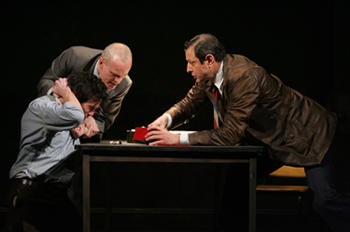
The Pillowman, Martin McDonagh's macabre play, is closing in a few weeks after a successful, but short run on Broadway's Booth theater. I saw it twice this summer, and read the work after my first visit. My reaction to the play was one of wonder and awe both times I saw it. Pretty much the same reaction I had when years ago I saw the original Broadway run of Amadeus with Ian McKellen, a play I was also fortunate to see twice. Although The Pillowman does not possess a performance of the grandeur of the young McKellen's, it is an amazingly written work, and it ranks with Peter Schaffer's play as one of the most memorable nights one could have in the theater. The cast of The Pillowman is spectacular, with Jeff Goldblum and Billy Crudup giving memorable performances, Zeljko Ivanek giving a puzzling reading of his character, and the amazing young actor Michael Stuhlbarg giving one of the most satisfyingly poignant performances now on Broadway as a mentally retarded innocent, who proves to be not as innocent as he first appears.

Part of the fun of going to see this play was waiting after the performance for autographs. This is a very generous cast with the fans, and Jeff Goldblum stays night after night until the bitter end signing autographs and taking pictures with everyone -- especially with the ladies. The talk of the town is that everyone wants to work with him because he is such a class act. It was fun, for instance, to have Mr. Goldblum sign my script of the play, ask me where I bought it and have him comment on the fact that he had not seen this version of it. (The current orange-covered version of the play, published by Faber & Faber, lists both the British National Theater cast as well as the American Booth Theater cast).

Although, structurally, the American version of the play (in two acts) works better, in my opinion than the three-act format as published, the British cast must have been something to behold. I would have loved to have seen Jim Broadbent in the role of Tupolski. Ever since I saw this fine actor playing Sir W.S. Gilbert in Mike Leigh's film Topsy Turvy, I have come to respect him as one of the finest character actors of his generation. He was even very good in the movie Moulin Rouge, which must have taken a lot of effort to pull-off. The British cast also included David Tennant in the role of Katurian K. Katurian. I didn't know who this actor was until I got into the British Sci-Fi series Dr. Who this summer and realized that he will be playing the Doctor next season.

Personally, I will miss The Pillowman once it finishes its run in a few weeks. It is rare that a play can provide an audience with chills and thrills, while at the same time offering them beautifully crafted performances, and a script of Kafkaesque beauty and complexity. I don't think that I will have a chance to see The Pillowman again before it closes, and I don't think that I really want to. I would like the memory of those two performances to linger on. Along with Doubt, and the revival of Who's Afraid of Virginia Woolf?, The Pillowman was responsible for a great season for drama on Broadway. Let's hope that next season proves to be of the same high caliber.

Friday, August 12, 2005

Bayreuth, Salzburg and the BBC Proms

It has been a fun summer of listening, recording and designing CD covers for the Internet webcasts of the European summer festivals that started in late July with the premiere of the new production of Tristan und Isolde at Bayreuth, and which continued with the Salzburg festival and the BBC Proms at the Royal Albert Hall in London.
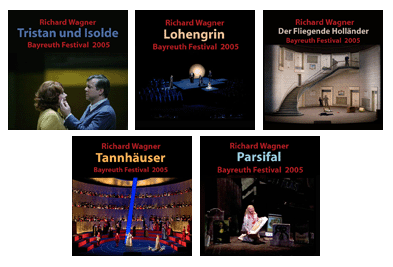
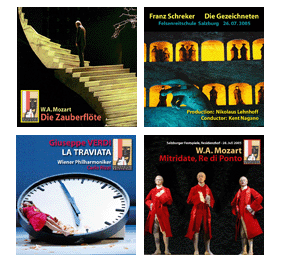
I recorded all five operas from Bayreuth this season, and also designed front and back CD covers for these recordings. Pictured here are the front covers to the five operas that Bayreuth presented this summer.
The Salzburg festival has presented thus far many exciting productions of well-known as well as rare works. This year's productions of Mozart's Die Zauberflöte and Mitridate, Re di Ponto are previews of next year's celebration of the 250th anniversary of the birth of Mozart. This landmark event will be celebrated at Salzburg (the city of Mozart's birth) with productions of all the composer's operas. This year the festival also featured productions of Verdi's La Traviata with Anna Netrebko, Rolando Villazón and Thomas Hampson, as well as Nikolaus Lehnhoff's production of the rarely performed Die Gezeichneten, an opera by Austrian composer Franz Schreker. I also recorded these works and designed the CD covers that you see on this page.
One of the highlights of the BBC Proms this year was the reprise of the season's Royal Opera production of Wagner's Die Walküre. Not only did this prom feature Plácido Domingo, Waltraud Meier and Lisa Gasteen as Siegmund, Sieglinde, and Brünnhilde respectively, but it marked the debut of Bryn Terfel in the role of Wotan. The fact that these performances are now broadcast over the Internet is truly wonderful. The thunderous ovation that can be heard in my recording from the oversized crowd at the Royal Albert Hall at the end of each act tells the whole story. For the CD cover to this recording I decided to start with the official logo from this year's BBC Proms. Unlike the covers for Bayreuth and Salzburg, I avoided all photographs of the artists and the production, and simply listed the date of the performance and the cast.

Saturday, August 06, 2005

"Die Gezeichneten" at Salzburg

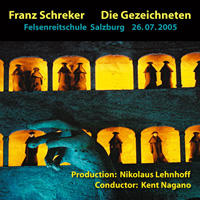
It has been quite an exciting Salzburg Festival this summer. As I reported earlier, Mozart's Die Zauberflöte with Riccardo Muti at the helm is an enticing prelude to the upcoming celebration of Mozart's birthday next year. Now, a nearly forgotten work by an almost forgotten composer is being performed at the Felsenreitschule to great acclaim. The work is Die Gezeichneten (The Marked Ones) by Austrian composer Franz Schreker. The production is by Nikolaus Lehnhoff and the musical direction by Kent Nagano. Readers of this blog and visitors to my Wagner site will recognize this to be the creative team of the marvelous production of Wagner's Parsifal from Baden-Baden that was captured on DVD and released this year.

I heard the live broadcast of Die Gezeichneten last week, recorded it, and designed the cover that you see above. What is immediately striking when you hear Schreker's work is his great lyricism and his adept abilities as orchestrator. Listeners will immediately call it "Strauss-like" when they first hear it. Indeed, for many music critics of his day, it was Schreker and not Richard Strauss who was the heir to Wagner. Unfortunately, the tide of political events that led to World War II virtually erased Schreker's name and his works from memory. As a half-Jew, Shreker saw his works banned in his native Austria and he was unable to secure any commissions or adquire any teaching posts. He died in 1934 from complications brought on by a stroke.

Here is Jeremy Eichler's review from the New York Times:

SALZBURG FESTIVAL REVIEW; With a Disturbing Vision of Utopia Lost, a Forgotten Modernist Is Remembered

By JEREMY EICHLER

The Austrian composer Franz Schreker was one of the great dreamers of early-20th-century music, a cartographer of distant sonic utopias and a prophet of their demise. His fame reached its height in German-speaking Europe around 1920, when his operas rivaled Strauss's in popularity, and he was hailed by some as the true heir to Wagner. But he was crushed by the double blow of shifting Weimar fashion and then the Third Reich.

As a progressive composer of half-Jewish descent, he was dismissed from prominent teaching posts, his music later banned. He died of a stroke in 1934 and his reputation lay in tatters for decades after the war. He was surely the most successful composer of his generation to simply vanish from music history.

But Schreker's return may finally be drawing near. His works are once again being performed in Austria and Germany, and Tuesday night a new staging of his apocalyptic opera, ''Die Gezeichneten,'' was unveiled here as the opening production of the prestigious Salzburg Festival. Directed by Nikolaus Lehnhoff, with Kent Nagano leading his Deutsches Symphonie-Orchester Berlin, it was an engrossing evening that conveyed not only the vertiginous beauty of Schreker's music, but also the composer's theatrical gifts, his penchant for probing the unconscious drives and boundless yearnings of his characters in a world that is crumbling around them.

''Die Gezeichneten'' (''The Branded'') was completed in 1915, and though the action is set in a mythical 16th-century Genoa, it is a product of tumultuous fin-de-siècle Vienna and the heady last days of the Austro-Hungarian Empire. It tells the story of a wealthy hunchback, Alviano Salvago, who detests his appearance and is filled with such hunger for beauty that he creates an island paradise, an Elysium of art and natural wonders. But Alviano soon learns that corrupt noblemen have discovered a secret grotto on the island and, spurred on by their leader, Tamare, they have been abducting the daughters of the city to indulge in violent orgies there.

Alviano tries to avert disaster and donates Elysium to the citizens of Genoa, but before the transfer occurs, he is seduced by Carlotta, a painter of hands and souls who has been secretly observing him and persuades him to sit for a portrait. He falls desperately in love and they are engaged to marry, but she loses interest after her painting is complete and soon becomes prey to the rapacious Tamare. The final scene takes place in the grotto, where Alviano discovers Carlotta's betrayal, shoots Tamare dead and staggers off, a broken shell of a man.

Schreker wrote the steamy libretto himself, and it is a prescient meditation on the limits of aesthetic refuge; on 19th-century notions of beauty that were premised on repression, be it social, psychological or sexual; and on the quick free-fall of any utopia to its opposite extreme.

These were bread-and-butter themes for the Vienna moderns, and writers like Hofmannsthal and Schnitzler charted this terrain with far more subtlety and complexity. But Schreker had at his command a tool he could wield like no one else: the orchestra.

He was an unsurpassed master of timbre who possessed an almost mystical relationship with the very idea of sound. But unlike his fellow Viennese composers, Schreker never expelled himself from the garden of tonality. His lush and sensuous musical language was built on extensions of a late-Romantic grammar. He was, in other words, the rarest of musical creatures: a modernist who never got the memo on grim austerity, a progressive composer who forgot that ornament was crime. Instead, he found ways to push boundaries from within a tonal universe, stacking chords on top of one another, stretching chromaticism to its outer limits and swaddling his expressionist musical dramas in intoxicating swirls of color.

''Die Gezeichneten'' was one of his most popular operas, and Mr. Lehnhoff has created a staging that is sometimes fuzzy on the details but true to its dark heart. Seeking to universalize Alviano's plight, he has made the character's deformity purely psychological. (His self-loathing drives him to secret cross-dressing, a cliché of German ''director's theater'' but it somehow works here.) More harmful to Schreker's concept is Mr. Lehnhoff's decision to stage all three acts on the ruins of the destroyed Elysium, rendered as the rubble of a giant godlike statue, thereby visually anticipating the opera's end and eliminating the suspense that might have been built from guarding the secret of the distant paradise.

But the director's most striking revision is to the murderous orgies of the third act. He challenged himself to convey the shock of Schreker's original, but how do you do that when modern viewers have been so anesthetized by television and film, not to mention Stanley Kubrick's ''Eyes Wide Shut,'' which was based on a roughly contemporary novella by Schnitzler? Mr. Lehnhoff's answer is pedophilia. At the work's final climax, it is revealed that the ''daughters of Genoa'' who had been abducted to the grotto are in fact quivering little girls who look scarcely 10 years old. The stomach turns; the shock is achieved.

Without previous exposure to Mr. Lehnhoff's work, one might chalk this up to more German directorial scandal-mongering. But his riveting ''Makropulos Case'' at the Brooklyn Academy of Music of 2001 suggests a deeper mind at work. I left feeling duly disturbed but also skeptical about how well this solution integrated with Schreker's original vision.

The cast struggled valiantly with Schreker's demanding vocal writing. Robert Brubaker was affecting and sympathetic if also underpowered as Alviano, Michael Volle was a suitably muscular Tamare, and Robert Hale sang with ample depth in the supporting role of the Duke Adorno. As Carlotta, the soprano Anne Schwanewilms was the standout, with an icy radiance to her voice and a mesmerizing stage presence.

Mr. Nagano led his ensemble in a masterfully paced reading of the score, showing an intuitive feel for Schreker's palette with all its blends and subtle shading. At the opera's most riveting moments, the sound had a way of billowing out from the orchestra, like a soft wind blowing from a place unseen.

Tuesday, August 02, 2005

Magic Mozart at Salzburg

While the magic continues at Bayreuth through the month of August, over in Austria, the Salzburg Festival has begun. As the classical music world gets ready for the 250th anniversary of the birth of Wolfgang Amadeus Mozart, the Salzburg festival presented two of Mozart's works, one written when the composer was barely fourteen years old, and the other being his last theater work. The following is the New York Times review of these two events.

Mozart Resounds in a City He Hated

SALZBURG, Austria, July 31 - If only Mozart could see his hometown now. His letters are full of disdain for Salzburg, which he saw as hopelessly narrow-minded and parochial. As he wrote to his father, he felt constantly undervalued by his employer here, the Archbishop Colloredo, whom he despised "to the point of madness." He finally ended his service to the court on "that happy day" in 1781 and described to his father being booted out the door by Colloredo's deputy, with what is surely the most famous such kick in music history.

As Salzburg gears up for the 2006 celebrations of the 250th anniversary of Mozart's birth, people don't talk very much about that kick. These days, when it comes to Mozart, the streets of this fastidiously groomed Baroque city are spilling over with pride - or at least, business acumen. You can hardly walk one block without bumping into Mozart's image plastered on, well, just about anything you could conceivably buy: T-shirts, candlesticks, perfume, umbrellas, napkin rings, beer mugs, shot glasses, and on and on, not to mention the ubiquitous chocolate-pistachio-marzipan treats called Mozartkugeln. What would Wolfgang think? Imagine one of those irreverent peals of laughter that Tom Hulce kept uncorking when he played the composer in the film version of "Amadeus."

The Salzburg Festival itself goes easy on the marzipan, but it is still deeply committed to making 2006 a banner Mozart year. A brand-new 29 million-euro (about $35 million) concert hall, the House for Mozart, is being built to open just in time for next year's summer festival, which will feature a rare cycle of all 22 of Mozart's stage works. Among these, 10 will be brand new productions, with a starry assortment of conductors, orchestras and directors. Others will be revivals, including two new productions that had their premieres last week at the festival: "Mitridate, Re di Ponto" and "Die Zauberflöte."

The festival's artistic director, Peter Ruzicka, sensibly suggests that to demythologize Mozart's genius, one needs exposure not just to the late great works but also to the entire course of his growth, juvenilia and all. On Thursday night, the festival gave this year's guests an early introduction to that lesser-known Mozart with Günther Krämer's new production of "Mitridate," staged in the courtyard of the city's grand 17th-century Residenz.

Written for a Milanese audience when the composer was only 14, "Mitridate" is first-rate early Mozart, an opera seria that is astounding for someone that age, and yet provides only a glimpse of what was to come. Its plot, adapted from Racine, centers on the great warrior Mitridate, who is to marry Aspasia when his sons, Sifare and Farnace, learn that he has died in battle with the Romans. They compete for Aspasia's hand, but their hopes are shattered and their lives endangered when their father returns alive. Much groveling and chaos ensue, interspersed with beautiful arias in which the characters pour their inner torment into fantastically ornate vocal lines. The writing was in fact demanding enough to keep the work off the stage for most of the last century.

The opera is also dramatically underdeveloped, and therefore ripe for some insightful direction. Mr. Krämer has instead given it a flashy modern look full of visual interest, but not enough beyond that. The crux of the interpretation is a brilliant two-tiered set designed by Jürgen Bäckmann, who makes ingenious use of mirrors; during the opera's opening few minutes, for example, a phalanx of Mozart-doppelgängers appear to be running up the walls. The same extras later slide down a slope coated with thick black sand and return to perform a strangely stylized yogalike dance.

It all proved too distracting, though fortunately the second half was more focused and character-driven. Over all, one wished Mr. Krämer had probed deeper inside the work rather than making mischief at its edges. Still, this was rather tame director's theater, and the conservative - and very glittery - Salzburg audience cheered the production team on opening night.

The first-rate cast also won well-deserved applause, including Richard Croft in the title role, Bejun Mehta as Farnace, Miah Persson as Sifare, Netta Or as Aspasia and Ingela Bohlin as Ismene, a princess in love with Farnace. Marc Minkowski led his Musiciens du Louvre-Grenoble in a superbly lithe and buoyant reading of the score. Opera on period instruments is still rare at the Salzburg Festival, but this performance should set the standard.

A more familiar and altogether not-too-shabby band was in the pit of the Large Festival Hall two nights later: the Vienna Philharmonic under Riccardo Muti. The occasion was Graham Vick's "Zauberflöte," another near miss. It offered a provocative take on Mozart's most famous opera but got lost somewhere in the onstage field of giant sunflowers.

That is where Zarastro's secret lair is located, and this interpretation seeks to reverse the usual symbols and upend the ennobling message typically found in the work's Masonic-inspired libretto. Rather than a source of light and moral wisdom, Zarastro's order is shown to be a dark place of shadows and stagnation. The Queen of the Night, sung with solid top notes by Anna-Kristiina Kaappola, is dressed all in white, and Zarastro, sung with great resonance and depth by René Pape, carries a double-barreled shotgun. The priests are old and emaciated; a giant staircase, presumably leading to higher spiritual ground, sits broken in two. Clearly, Mr. Vick is getting at a vision of Enlightenment run afoul, the language of universal freedom abused as a mere cover for power politics.

This is a sharp-edged and arguably timely reading, but unfortunately, Mr. Vick seems to lack the courage of his convictions. Zarastro is not sinister enough. His lair, rather than merely shadowy, should have been a place of real darkness. Tamino, sung respectably by Michael Schade, also loses his redemptive potential by being portrayed here as a suburban teenager who runs around in a rugby shirt, sneakers and an aw-shucks attitude.

Papageno, dressed in colorful 1970's grunge, was sung to fine comic effect by Markus Werba; Genia Kühmeier was an affecting Pamina. There were also some wry comic touches in the opening scenes, as when the Queen of the Night makes her grand entrance by showing up in Tamino's bed. Mr. Vick also nods amusingly to C. S. Lewis with a Narnia-esque use of wardrobe closets as gateways to various magical worlds.

Mr. Muti kept the Enlightenment satire a safe distance from the score, leading the overture with broad-gestured dignity. And what a pleasure to hear the Vienna Philharmonic in an opera pit, catching the unsuspecting ear by surprise with its nimble sweet-toned woodwinds and lush velvety strings.

Even if neither production ultimately took flight, both gave an enticing taste of what should be in store for next year: little-known Mozart given real attention, and the most famous Mozart reconceived. After 2006, Jürgen Flimm will take over as the artistic director of the festival. Here's a suggestion for his first season of programming in 2007: give Mozart the summer off. The poor man will have earned it, and it would do a tremendous service by refreshing his music here, maybe even engendering some critical debate about the use and abuse of his myth. O.K., admittedly, in this town, it's a long shot.

"Mitridate, Re di Ponto" continues for seven more performances at the festival, Friday through Aug. 25; "The Magic Flute," for eight performances, tonight through Aug. 28.