Friday, July 24, 2015

More Green Hill Shenanigans


The following article appeared on The Guardian:

It’s that time of year again: the balmy nights of late spring are the augurs of the annual ritual of blood-letting in northern Bavaria, when the remaining Wagners do their best to tear each other apart in public on the eve of the Bayreuth Festival. 

This week’s fun on the Green Hill concerns the following: it was announced over a year ago that Eva Wagner-Pasquier would be leaving her co-managerial duties with her half-sister Katharina at the end of this season. But that’s not enough, it seems. Malevolent forces somewhere within the poisonous, Nibelheimisch politics of Wagner’s Bayreuth mean, apparently, that Eva isn’t even allowed to be seen anywhere in the environs of the festival theatre, otherwise their star conductor Christian Thielemann will apparently humph off in a massive schtropp and not conduct Tristan und Isolde in the production that Katharina is directing to open the festival on 25 July. 

Allegedly, that is: Thielemann denies it, as do key partners in the festival organization, but Wagner-Pasquier’s lawyer seems to confirm the rumours. And, in a personal statement, Daniel Barenboim has called the treatment she is being subjected to as “inhumane.”  “I thought you couldn’t take away people’s freedom of movement – unless they were criminals,” he added.

And all of this comes on top of Kirill Petrenko, the Ring’s conductor and the sole unsullied hero of Bayreuth’s current production of the tetralogy, voicing his disapproval at the late, late replacement of his Siegfried, Lance Ryan, with Stefan Vinke describing the treatment of Ryan – and Wagner-Pasquier – as “unprofessional and wholly undignified”, and saying that only his responsibility to and respect for his colleagues have stopped him from cancelling altogether. 

So, are Bayreuth and the Wagner clan in crisis? Far from it: Bayreuth just wouldn’t be Bayreuth without its annual curtain-raiser of gossip and scandal. Let’s instead be grateful to everyone at the Green Hill for the drama that makes it an on- and offstage saga that just keep on giving, year after year.

Thursday, July 23, 2015

Shenanigans on the Green Hill

Lots of news to report.  First, a poster advertising Opening Night of the Bayreuth Festival (on the left) is now available. The festival will begin this Saturday with a performance of Tristan und Isolde, a new production by Katharina Wagner. The composer's great-granddaughter shocked audiences with her strange, irreverent production of Die Meistersinger. This new production of Tristan will be shown on German theaters on August 7.

There are also reports that the rehearsal period for this festival has not gone smoothly. Already two sopranos have bowed out of this new production, and now the latest news is that there is growing animosity between Kirill Petrenko and Christian Thielemann. The root of this animosity might stem from the fact that Mr. Petrenko has just been named chief conductor of the Berlin Philharmonic, a position that Mr. Thielemann coveted as a result of being a disciple of Herbert von Karajan who was appointed music director for life of this orchestra in 1955.

Currently Evelyn Herlitzius is singing the role of Isolde.  She replaced Anja Kampe a few weeks ago. However, the singer has not stormed out of Bayreuth and will honor her contract to sing the role of Sieglinde in this year's revival of Frank Castorf's dreadful Ring production. It is interesting to note that Ms. Kampe is Mr. Petrenko's companion, and Mr. Thielemann is conducting the new production of Tristan.  You do the math!

Further news about Katharina's Tristan reveals some early pictures of this new production.
This beautiful stage image bears more than a passing resemblance to the "New Bayreuth" style of Wieland Wagner, Katharina's uncle, who revolutionized the festival when he took over the reins in 1951. In an effort to get rid of all vestiges of Nazism that the festival had acquired, thanks to the many times that Adolf Hitler attended during the 1930s, Wieland Wagner employed light and darkness to re-invent the Wagnerian world. It became a style much imitated around the world.
An interesting image from what can only be Act II of the opera.  Though the centerpiece of this work is the glorious love duet between the title characters, it seems that Katharina is underlining the impossibility and the danger of this elicit love affair by placing the two characters on opposite sides of a turnstile, while Tristan seems to be choking his beloved.
Georg Zeppenfeld as King Marke looks more like a pimp from a 1970s blaxploitation film.

As always, opening night of the Bayreuth Festival is an event, and this production will, I'm sure, divide audiences and further the debate over the kind of productions that are being presented at the Green Hill these days.

Sunday, July 12, 2015

The Great Jon Vickers is Dead

Jon Vickers, the great Canadian tenor who excelled in such operatic roles as Otello, Tristan and Peter Grimes died at the age of 88 of Alzheimer's disease. I was lucky to have thrilled to his colossal singing in my early days of opera-going, at the end of the 1970s at the MET. He was a shining star in roles which ranged from Handel to Britten, and his performances of Otello, Pagliacci, The Bartered Bride, and most memorably, Parsifal, were unforgettable. Likewise, he shared the stage with some of the great sopranos of the post World War II era, from Maria Callas to Birgit Nilsson, with whom he sang many memorable performances of Richard Wagner's Tristan und Isolde all over the world.  Unfortunately, I never saw him sing a performance of Samson et Dalilah, one of his signature titanic roles, which he brought to life with his huge voice. Nor was I lucky enough to thrill to his great Florestan in Beethoven's Fidelio.  Luckily, many of these performances were recorded, and quite a lot exists in video as well.

Below is video of Jon Vickers performing Otello, from 1978, from the stage of the Metropolitan Opera. This was one of the first "Live from the Met" telecasts. Here we have the duet "Dio ti giocondi" from the beginning of Act III.  Renata Scotto sings the role of Desdemona, and the memorable production was designed by Franco Zeffirelli.  The young James Levine conducted.

Thursday, July 02, 2015

Jurassic World: More of the Same

Mankind's twisted dream to play God is at the heart of the best horror movies in cinema history. It is the driving force behind not just Frankenstein but every other movie that features a mad scientist throwing a monkey wrench in the machinery of the natural universe, only to be punished for his folly, usually by his own creation. It is also the primal essence of Michael Crichton's novel Jurassic Park and the Steven Spielberg franchise adapted from that bestseller that features the original film, two sequels, and now a reboot: Jurassic World, also produced by Amblin Entertainment, Spielberg's company, and directed by Colin Trevorrow, a helmer who is not afraid to liberally pay homages to the earlier films and its famous creator.

If you remember Jeff Goldblum's line in The Lost World, the uneven sequel to the first film, then you're already pretty familiar with the main plot of this new film. Back in 1997, reprising the role of Dr. Ian Malcolm, the character quipped as he once again stared at the ferocious biological dinosaurs that DNA cloning had brought back to life, and the initial sense of wonder that it produced on people: "Oh, yeah, Oooh, Aaah, that's how it always starts. Then later there's running and um, screaming." In Jurassic World there is plenty to Oooh and Aaah. We are back in Isla Nublar, a remote island near Costa Rica, where the original Jurassic Park was built. Now an amazing resort, a la Disney World, has emerged from the ruins of that failed enterprise where the tourists can indulge in the fantasy of having a close encounter with a host of extinct creatures. There's even a petting zoo where the kiddies can ride the mild baby herbivores. But to satisfy the spectators blood lust there is also a show where the carcass of a dead shark is eaten whole by a gigantic Mosasaurus, an aquatic carnivore, who jumps out of his pool, like a killer whale, splashing those in the stands. The scene is one of the early highlights of the film, and it is a magnificent example of cgi at its best.

The plot is pretty basic. Two brothers are sent on a dream vacation to Jurassic World where their aunt (Bryce Dallas Howard) is the operations manager of the place. Even though she is supposed to personally give the kids the VIP tour of the park, she is too busy recruiting corporate sponsors for a new attraction called Indominus Rex, a genetically modified Frankenstein of a dinosaur made from the DNA of several dangerous predatory creatures. Meanwhile, Owen Grady (Chris Pratt), a Velociraptor trainer, and Great White Hunter type, warns the powers-that-be that Indominus Rex poses a real threat because it  has lived in isolation all its life. Further, Vic Hoskins (Vincent D'Onofrio) believes that the raptors can be trained for military use. This is the "Oooh and Aaah" section of the film.

But what would the Jurassic Park franchise be without the running and the screaming?!

And there's plenty of that as Indominus Rex, tired of his isolated existence, escapes from his walled enclosure in search of freedom and a viable second act to this film. Its escape is followed by four Velociraptors busting out, and most thrilling of all the spectacular flight of escapee winged Pterosaurs, who descend on the park's visitors, like a squadron of fighting planes, and attack them like the Avialae descendants of dinosaurs in Alfred Hitchcock's The Birds. There's running for ya! Also, there's the sight of Ms. Howard racing through the island's thicket in her business suit and 4 inch heels. Soon to become a camp classic! And speaking of classics, the film manages to channel the spirit of King Kong as well as the original Jurassic films.

In the Judeo-Christian tradition trying to be a creator is bad enough, and it has to be punished, but the producers of Jurassic World also know that we live in a secular society. Therefore, the bad guys in this film are not the scientists who originally cloned these creatures, but the shady men who represent the corporate greed that leads to the destruction of the enterprise. It's the one interesting take on the Frankenstein myth that the Jurassic franchise has added, and it is a formula that adds some interest to an otherwise predictable journey to a man-made segment of the Mesozoic Era.

Wednesday, July 01, 2015

Booing at the Royal Opera House

The opening night performance of the opera William Tell, by Giacomo Rossini was booed at the Royal Opera House, Covent Garden because of the on-stage dramatization of a rape scene with nudity. The following excerpts are from an article on the BBC website:

The Opera House issued a statement after the performance... apologizing for any distress caused. Director of opera Kasper Holten said: "The production intends to make it an uncomfortable scene, just as there are several upsetting and violent scenes in Rossini's score. We are sorry if some people have found this distressing."

Holten said the scene "puts the spotlight on the brutal reality of women being abused during war time, and sexual violence being a tragic fact of war." Rossini's opera of the Swiss patriot, William Tell, who shoots an arrow that splits an apple atop his son's head, has been directed by Damiano Michieletto and stars Canadian baritone Gerald Finley as Tell and American tenor John Osborn.

Osborn told Reuters after the performance that the scene "maybe ... went a little longer than it should have. But it happened and I think it's an element you can use to show just how horrible these people were that were occupying this town," he said. "If you don't feel the brutality, the suffering these people have had to face, if you want to hide it, it becomes soft, it becomes for children."

The Stage gave the production one star. George Hall called it a "dire evening" in which the "gratuitous gang-rape" scene provoked "the noisiest and most sustained booing I can ever recall during any performance at this address. Intellectually poverty-stricken, emotionally crass and with indifferent stagecraft, the result is nowhere near the standard an international company should be aiming at", he said.

Mark Valencia writing for What's on Stage pointed out that first night booing is "a fast-growing problem at Covent Garden that doesn't happen at other opera houses. It's become standard practice for the director of practically every new production to be jeered by practiced factions in the audience who object to ideas that go beyond the literal reading of an opera," he said.

But at last night's first night "the perpetrators did something unheard of: they booed during the music. And they did so loudly and long." They also booed at the end of the performance when the production team came on stage for the curtain call.
The opera is Italian director Damiano Michieletto's debut at the Royal Opera House.

Friday, June 26, 2015

Dmitri Hvorostovsky Diagnosed with Brain Tumor

The following appeared in the New York Times a few days ago:
 
The celebrated Russian baritone Dmitri Hvorostovsky has a brain tumor and has canceled all engagements through the end of August, according to an announcement posted Wednesday on his website.
“He has recently been suffering from serious health issues, and a brain tumor has just been diagnosed,” the statement said. “Although his voice and vocal condition are normal, his sense of balance has been severely affected.”
The site said that he would begin treatment this week and that he remains “very optimistic for the future.”
Mr. Hvorostovsky, one of the best-loved baritones in the world, is still scheduled to appear in September at the Metropolitan Opera in a star-filled production of Verdi’s “Il Trovatore,” featuring Anna Netrebko as Leonora.

Wednesday, June 24, 2015

Mad Max: Fury Road

A.O. Scott, in his insightful review in the New York Times of the film Mad Max: Fury Road, wrote that this film isn’t "about heroism... it’s about revolution." Perhaps that is the reason why this franchise reboot by its original director feels as fresh as the original film did back in 1980 when it was just an Australian low budget, sleeper exploitation movie starring a then unknown Mel Gibson. George Miller has gone back to his original creation and he has brought with him an arsenal of talent to bring it up to date. Junkie XL's musical score, with its deep string chords and clever riffs on Giuseppe Verdi's Requiem, is a memorable asset to the film. Likewise, master cinematographer John Seale agreed to come out of retirement for this film, and his work is spectacular. All shot digitally, using an arsenal of new cameras including the Arri Alexa Plus. It is one of the most beautifully shot films in recent memory.

Once again we are in a post-Apocalyptic world (devoid of any visible zombies, although I'm sure they are out there in the vast empty wasteland that Earth has become) where gasoline and water are scarce commodities, and where the dignity of what's left of mankind has been trampled by ruthless chieftains like Immortan Joe (Hugh Keays-Byrne) who keeps a harem of women, and whose army of War Boys capture Max (Tom Hardy). Our eponymous hero is a loner who can easily be an American hero right out of the pages of James Fenimore Cooper. He is taken prisoner by Immortan Joe's men and turned into a "blood bag" for a sick War Boy named Nux (Nicholas Hoult). When Imperator Furiosa (Charlize Theron) drives off-course in her mission to find gasoline, Immortan Joe realizes that she has betrayed him by stealing some of his women, one of whom is pregnant. And the chase is on!  This is when the movie gets loud, down and dirty: but you wouldn't have it otherwise. It is, after all, a Mad Max movie!

But this film goes beyond the twisted metal and explosions that are the bread and butter of the summer cinematic season. At the heart of Fury Road is a tale of vengeance and redemption, all major themes of the American western, a genre that this film often pays tribute to, especially in its photographic wide open vistas and in the depiction of its laconic hero. Or heroine, for that matter. This film is very much about Ms. Theron's character: a damaged, but strong-willed, valiant woman with a prosthetic arm. She belongs to the same breed as Julie Christie in Robert Altman's McCabe and Mrs. Miller or Claudia Cardinale in Sergio Leone's Once Upon a Time in the West. By far, it is the feminist film of the year.

The film is also impressive when it comes to the amount of images that linger in one's mind. George Miller knows how to set up a scene and how much to hold a shot so that it becomes indelible. The opening sequence of Max chomping down on a live two-headed gecko, and a truly surreal nighttime shot of people on stilts walking through a poisonous bog are two memorable moments from this film.

Finally a winner in a summer season of many forgettable films. 

Sunday, June 21, 2015

Julie Kent Bids Farewell to ABT

Julie Kent, who for many ballet fans represent the epitome of the all-American ballerina, bid farewell to her artistic home, American Ballet Theater, after an amazing 29 year career with the company. She chose Sergei Prokofiev's demanding Romeo and Juliet for her swan song, and with her partner for the evening, principal dancer Roberto Bolle, she gave her all in a passionate performance that at times seemed the work of a much younger artist, while at the same time it was obvious that her Juliet came with a lifetime of technique, experience, and elegance.

It was a sold-out audience that was there to celebrate Ms. Kent's career, and her entrance in the second scene of Act I caused such a deafening roar that it must have been difficult for the performers to hear the music. As the evening went on, her flawless performance turned into a love fest for the audience. It was truly a perfect evening for her, and for the rest of the company, and one of the highlights of this year's ABT season.


The ovation at the end of the evening went on for close to twenty minutes.  The great curtain of the Metropolitan Opera parted and the assembled cast, each with a flower in hand, tossed them in her direction, while petals rained down from the rafters.  Meanwhile in the audience not a single soul left the place, and everyone remained on their feet. Then, there was the parade of colleagues onstage, all bearing flowers, positioning them in the middle of the stage, creating a mountain of flora. These included Xiomara Reyes and Paloma Herrera, who earlier in the season had their very own memorable ABT farewells. One of the last to pay her tribute was ABT's Associate Artistic Director Victor Barbee, a former dancer with ABT, and Ms. Kent's husband. There were some tender ovation moments as her children William and Josephine shared the stage with their mom.

It was an evening that few will forget, but as ABT finishes the last two weeks of the season, I'm sure that on everybody's mind is the question of who will fill the spots of these three artists who were so much an integral part of the company.  It promises to be a very interesting 2016 season.

Thursday, June 04, 2015

The Walk will open the 53rd NY Film Festival

I received the following announcement from the Film Society of Lincoln Center:

The Film Society of Lincoln Center announced today that Robert Zemeckis’s The Walk will make its World Premiere as the Opening Night selection of the upcoming 53rd New York Film Festival (September 25 – October 11), which will kick off at Alice Tully Hall. A true story, the film is based on Philippe Petit’s memoir To Reach the Clouds and stars Golden Globe nominee Joseph Gordon-Levitt as Petit, the French high-wire artist who achieved the feat of walking between the Twin Towers in 1974. The Walk will be the second 3D feature selected for the Opening Night Gala since Ang Lee’s Life of Pi in 2012 and also marks Zemeckis’s return to the Festival after Flight, the 2012 Closing Night Gala selection. The film will be released in 3D and IMAX 3D on October 2, 2015.

New York Film Festival Director and Selection Committee Chair Kent Jones said: “The Walk is surprising in so many ways. First of all, it plays like a classic heist movie in the tradition of The Asphalt Jungle or Bob le flambeur—the planning, the rehearsing, the execution, the last-minute problems—but here it’s not money that’s stolen but access to the world’s tallest buildings. It’s also an astonishing re-creation of Lower Manhattan in the ’70s. And then, it becomes something quite rare, rich, mysterious… and throughout it all, you’re on the edge of your seat.”

Robert Zemeckis added: “I am extremely honored and grateful that our film has been selected to open the 53rd New York Film Festival. The Walk is a New York story, so I am delighted to be presenting the film to New York audiences first. My hope is that Festival audiences will be immersed in the spectacle, but also to be enraptured by the celebration of a passionate artist who helped give the wonderful towers a soul.”

Wednesday, June 03, 2015

Margaret Juntwait is dead at 58

Margaret Juntwait, Former WNYC Host, and the Voice of the Metropolitan Opera, died today at the age of 58. In the history of the Metropolitan Opera Radio Broadcasts she was only the third host, and the first woman to hold this position. She will be missed.

Sunday, May 24, 2015

Tomorrowland is Pure and Preachy Disney

The basic premise of Tomorrowland, the new Disney film from director Brad Bird, is that half the world tries to build up Mother Earth in the morning, while the other half tears it down overnight.  Mankind has an incredible inventive gift that has led humanity to wonderful achievements, however we are a race that is also inherently bent on destruction, and this dark aspect seems to be taking over our current civilization.

The story begins in 1965 with the young Frank Walker (who will grow up to be George Clooney) who attends the New York World's Fair and brings with him a half-baked jetpack gizmo that he has invented. While being rejected by Hugh Laurie (who turns out to be the villain in the piece, a fact that you know right from his first appearance) he meets the mysterious child Athena (Raffey Cassidy) who introduces him, via a magical pin, to the world of tomorrow: a remarkable skyscraper city, half Fritz Lang's Metropolis, half modern-day Dubai, which ultimately is reminiscent of a 1950's conception of the future.  In other words, it reminds one of the sleek "Tomorrowland," one of the theme lands of Disneyland/Disney World.

The future, according to the gospel of Disney, is a clean-cut place with the kind of architecture that brings to mind the futuristic designs of the theme parks as well as the memorable structures of Spanish architect Santiago Calatrava. His amazing City of Arts and Sciences in Valencia, Spain, for instance, seems to be the blueprint for Scott Chambliss's production designs.

But the land of tomorrow is rotten from within: it is crumbling and heading into dystopic destruction. To set things right, Athena summons Casey Newton (Britt Robinson), a teenager who has been sabotaging the dismantling of a NASA launch pad near Cape Canaveral where she lives. Obviously this is a teen who cares about space travel, and in the logic of this film one of the good guys. Her meeting with Athena, who gives her one of the magical pins, is the call to adventure that sets her on a journey where she meets the older Frank Walker, now a grizzled, discontented George Clooney living in the sticks, in a run-down house filled with interesting futuristic gadgets. The meeting of Casey and Frank, the catalyst that will bring the narrative to a climax, unfortunately takes way too long to happen. At 130 minutes the entire movie feels too overproduced and definitely too long.

Watching Tomorrowland is very much like attending the future section of EPCOT.  The sense of optimism overwhelms you. Nothing wrong with that. Frank Capra built a career based on it, and so did Walt Disney! What I find a bit troubling are the constant self-references. The entire film is a Disney infomercial. The Pirates of the Caribbean franchise was based on a park ride, but the films, especially the first of the series, was so successful artistically that you forgot the shameless plug and you concentrated on the new myth the film was developing. No such luck with Tomorrowland, which looks to the future, but deep down is just interested in first week earnings.

Saturday, May 23, 2015

Mad Men ends by Big Sur


In his own words, Mad Men creator Matt Wiener could not believe that 150 people kept the ending to the show a secret. Well, make that 151. It was hard, but somehow I did it. It amazes me that this ending was in place in Matt's head right from the start of the series, and it managed to remain intact all the way to the end. It shows total knowledge of the character and the situations surrounding him in the drama. And by the way, keeping such a big secret, knowing me, takes amazing determination and will power! Never mind that I had to keep it for about five years.

But seriously, it was the best ending, the only ending possible to the series. It dashed away any gory hopes that Don Draper would end up a suicide, falling out of a building, his body descending in slow-motion, like the Vertigo inspired logo to the show.  Don has been falling now for many seasons, there was no need to belabor the point. The series ended with us inside Don's mind, as he dreams up what is arguably the greatest ad campaign for a product ever to come out of Madison Avenue. Bravo!

Sunday, May 17, 2015

Helen Mirren as Queen Elizabeth II in The Interview

All Hail Helen Mirren!  She is not only the Toast of Broadway, she is its reigning current queen as long as she plays Queen Elizabeth II in Peter Morgan's fantasy play The Interview.

The author (who also wrote Frost/Nixon and the screenplay for The Queen, an Oscar winning performance for Dame Helen) imagines what occurs during the weekly private meetings that the monarch has had with a queue of Prime Ministers, starting with a crotchety, self-serving Sir Winston Churchill, through the controversial Sir Anthony Eden, the down-to-earth Labour PM Harold Wilson, with whom Queen Elizabeth had a very close rapport, and the mighty Margaret Thatcher, whom the Queen saw as a fellow traveler as well as a very real rival for power. The play also includes a couple of scenes with John Major, whom we learn was not wholly prepared to lead a nation when it was his turn at the dispatch box, the very angry, and very Scottish Gordon Brown, and David Cameron, the UK's current Prime Minister. There is also a very small cameo by Tony Blair, but surprisingly the author does not imagine a one-to-one interview with the well-known leader of "New Labour."

When Dame Helen is on stage she rules. Our eyes are glued to her. This is part stagecraft, part stage presence. When Churchill appears center stage for his interview, puffing on a cigar, as portrayed by the physically imposing Dakin Matthews, he is a great dinosaur of a politician. The scene has been staged by director Stephen Daldry so perfectly that our eyes cannot help but shift momentarily to him. This gives Dame Helen (and her dressers) enough time to perform one of her many lightning fast costume changes right on stage. Suddenly she is transformed into the young, uncrowned queen welcoming her first Prime Minister who carries an agenda as big as his girth. It is early magic in a production that is filled with such delightful moments.

Among the visitors to Buckingham Palace two Prime Ministers stand out: John Major (Dylan Baker), and Harold Wilson (Richard McCabe). Each of these scenes plays beautifully in contrast to the other. Mr. Baker portrays a weak, but very human John Major, a politician unable to escape from the shadow of his "Iron Lady" predecessor. Likewise, Mr. McCabe plays the droll Mr. Wilson who knows that politically he has to push his socialist agenda to a woman who was born with a silver spoon in her mouth. Despite their social class differences, the play portrays their relationship in the warmest of ways. It is the most satisfying interview of the evening, and Mr. Morgan even dramatizes a trip by Mr. Wilson to Balmoral Castle for a rainy weekend in Scotland with the Royal Family.

This is an evening of sheer artistry on Broadway.  A unique play where even the interval (or intermission, as we say in the States) has a very British atmosphere.  It is a not to be missed production, and  one of the big contenders for this year's Tony Awards.

Saturday, May 16, 2015

Balanchine and Stravinsky at the NYC Ballet

 Last Saturday afternoon I attended the New York City Ballet. They performed four of the great Igor Stravinsky, George Balanchine collaborations: Apollo, Agon, Duo Concertant, and Symphony in Three Movements. These classic works, that collectively have come to be known as the "black and white" ballets, due to the fact that the dancers are costumed in primarily these two colors, are staples of this company, and are brought back year after year to the delight of seasoned ballet aficionados and young audiences coming to these works for the first time.

Apollo is the oldest of these ballets.  Stravinsky composed the music in 1927, and the twenty-four-year-old Balanchine choreographed it a year later.  A host of great dancers have passed through this iconic role throughout the decades. It is the only Balanchine creation that puts the male dancer on the forefront. The short video below features Chase Finlay, a NYC Ballet principal dancer, explaining his approach to dancing this role.


Duo Concertant is a unique creation that features two dancers as well as a pianist and a violinist, all on stage. The short work examines the equal relationship that exist (or ought to exist) between music and dance. The piece takes the musicians out of the pit and places them side by side with the dancers. Saturday's results also included an interesting juxtaposition between the seasoned age of the musicians versus the youthful quality of the dancers. I'm not sure if this was an original intention of Mr. Balanchine.

The performance concluded with the amazing Symphony in Three Movements, a hyper-kinetic Stravinsky composition from 1945 that on the one hand looks back to his atonal beginnings back with Sergei Diaghilev and The Ballets Russes and dares to look forward toward the future of music. Listen closely with your eyes closed, and you will hear the nervous minimalism of a John Adams.  However most ballet goers will not close their eyes especially when a dancer of the caliber of Amar Ramasar is dancing in it. Mr. Ramasar has been a soloist since 2006, and he was a principal dancer in Chichester Psalms, the Leonard Bernstein, Peter Martins ballet that I performed with the NYC Ballet when I was a member of the Juilliard Choral Union.

If you missed the black and white Stravinsky, Balanchine ballets this season, I would not worry.  I am certain that they will be performed again next year to the delight of young and old.

Thursday, April 23, 2015

Calixto Bieito comes to the MET

The New York Times reported today that Calixto Bieito, the iconoclastic, Catalan opera director will be making his Metropolitan Opera debut during the 2017-2018 season.  He will be staging Giuseppe Verdi's great work La Forza del Destino, in a co-production with the English National Opera. The production will be seen in London (sung in English) the year before it comes to New York where it will be sung in the original Italian.

His productions have been called offensive by some, and brilliant by others. His Parsifal, which has been featured on this website, takes place in a post-apocalyptic world, where the old knight Gurnemanz is a defrocked priest turned drug pusher, and, at the conclusion of the production, the character of Parsifal undresses and is carted away to be cannibalized by the rest of the opera's survivors. Another of his productions, Verdi's Un Ballo in Maschera, staged for the Gran Teatre del Liceu in Barcelona, featured a scene in a public bathroom.

Peter Gelb said that he expected that the new production of Forza "would stimulate audiences, not shock them."  He also added that the production would be set during the period of the Spanish Civil War.

Wednesday, April 08, 2015

Verdi's Don Carlo at the MET

Arguably Giuseppe Verdi's greatest work, Don Carlo is a massive five act affair that started its life at the Paris Opéra in 1867 as Don Carlos, with a French libretto that was later translated into the Italian version that is often performed these days. An intense, brooding, dark work set in stern, despotic Spain during the reign of Philip II, the opera examines the conflicts between the personal and the political, and the often clashing relationship between religion and the monarchy during the time when the Inquisition tried to maintain Spain loyal to the Vatican and Holy Mother Church.

The current Nicholas Hytner production (a co-production of the Royal Opera, Covent Garden) is pretty tame when it comes to the direction and costumes by Bob Crowley.  However, the sets, also by Mr. Crowley, tend towards the minimalist in a geometric sort of way in some scenes, while in others, shafts of light, coming through windows, lend an air of expressionism. It is a production that does not offend the sensibilities of the conservative New York opera crowd, but neither does it propel the drama into an epic level.

This opera lives or dies by its principal singers, and the MET has assembled a cast of impressive soloists headed by the amazing Ferruccio Furlanetto, who these days owns the role of Philip II. His deep bass has matured into the kind of instrument that is able to express the anguish of a character who has married a woman who has never loved him, and raised a son who threatens his power. His failure as a husband is now compounded with the thought that in order to save his kingdom he might have to sacrifice his son. Mr. Furlanetto beautifully conveys the character's agony as he realizes the church might not be able to absolve him of the murder of his first born. His is one of the great opera characterizations of our times.


Rounding out the cast is a splendid Yonghoon Lee in the title role. The young Korean tenor was in amazing voice on Monday night, and delivered a memorable performance. Dmitri Hvorostovsky was also in good voice as the faithful Rodrigo, although I have always found his intake of air before launching into a phrase to be, at times, as loud as his singing. On Monday night it was louder than I can remember in a while. Ekaterina Gubanova was a sonorous, memorable Eboli, while Barbara Frittoli took longer than I wanted for her to settle into the role of Elisabeth. Finally, it's great to see James Morris still singing these days. In the autumn of his years the bass-baritone has settled into the comprimario world effortlessly. But I don't think that the Grand Inquisitor is the role for him. His voice always had a light timbre and this character requires a threatening cavernous voice. When the Philip is darker than the Inquisitor then there's something wrong.

But that might be a little too much to protest about. The orchestra, under the direction of the great Yannick Nézet-Séguin, played beautifully, offering a sonorous cushion for the cast. It is great to have him as the music director of the Philadelphia Orchestra, which means that he is only two hours away from New York City. In the unlikely event that he were to become the new music director of the New York Philharmonic in 2017, after Alan Gilbert leaves, he would only be steps away.  But that just might be way too much to ask.

Monday, April 06, 2015

Gigi is back on Broadway

The MGM motion picture Gigi is perhaps the studio's last great musical before the genre became a dinosaur. This original musical for the screen, directed by Vincente Minelli and produced by Arthur Freed, proved to be a box office bonanza, and, as in the team's previous hit an American in Paris, Gigi won the Oscar for Best Film of 1958, as well as eight others.  As a matter of fact, it won an Academy Award for every category in which it was nominated, a record at that time. With its irresistible French cast headed by Maurice Chevalier, and co-starring Louis Jourdan and Leslie Caron, the movie was pure champagne, and the Alan Jay Lerner and Frederick Loewe score was a delightful recreation of fin de siècle Paris.  For the composer and the lyricist/screenwriter it was a fitting followup to their Broadway smash hit My Fair Lady two years earlier.

In 1973, Gigi opened on Broadway with additional songs written by Lerner & Loewe. It boasted an all-star cast headed by legends Alfred Drake and Agnes Moorehead, and featuring Maria Karnilova and Daniel Massey. A newcomer, Karin Wolfe, played the title role. It was the second Broadway show I ever saw as a kid, and I loved it, but it proved to be a disappointing flop. The frequent absences of many of its stars and the fact that Ms. Moorehead was diagnosed with cancer during its run did not help matters. It played for only 103 performances at the Uris Theatre (now called the Gershwin.) Thankfully, RCA Victor recorded an Original Broadway cast album which is still available on CDs.

A new production of this property is set to open at the Neil Simon Theatre, and I caught one of its previews last week. The original concept, adapted by Heidi Thomas, consists of taking scissors and shuffling songs around. The original musical opener, for instance,  "Thank Heaven for Little Girls," originally sung by Honoré Lachaille, has now been transformed as a duet for Mamita and Aunt Alicia, and moved to the middle of the first act. It works, but it settles the show into a somewhat safe zone, as if Ms. Thomas thought that a middle aged man singing about little girls could only spell pedophilia for today's audiences. Howard McGillin, who plays Honoré, gets very little to do as a result.  He is still the narrator of the story, but in name only. Since he is not given the chance to profess to the audience his credo, his character quickly develops a hollow center. His second big number "I'm Glad I'm Not Young Anymore" is also turned into a duet, this time with the great Victoria Clark who plays Mamita. One begins to ask oneself if Honoré's presence is even required. Mr. McGillin tries to bring him to life, but when you remove the character's guts there's very little that any actor can do to animate him once again. Mr. McGillin may not have the genuine Gallic charm of Chevalier, it is true, but at least give the guy a chance to do something important with his role. Interestingly, when the songs are left to the original characters, the thing works. "I Remember it Well," sung by Honoré and Mamita, this time sung in a street of Paris, and not by the beach of Trouville, maintains the raison d'être of the original film and its gentle charms stops the show. Likewise, Corey Cott as Gaston sings a winning version of the title song.

The show's director, Eric Schaeffer, and his choreographer Joshua Bergasse believe that bigger is better. They have taken the film's grand moment, for instance, when Gigi, Mamita and Gaston celebrate in their house with a bit of the bubbly, and they have turned it into a giant production number. "The Night they Invented Champagne" is now a wild, drunken romp through nighttime Paris, free of absinthe drinkers, of course: after all, it is a family show. The same technique is applied to "She is Not Thinking of Me" and "The Contract," a jewel of a number that was written for the 1973 show.  In each case Mr. Bergasse's choreography seems forced and overblown to giant proportions. It gives one the feeling that the cast is really trying hard, but it ends up being too much artifice for my taste.

With the name above the title, Vanessa Hudgens, a pop star graduate of the Disney High School Musical franchise, plays the title role with believable results. Her best moments are when she's being sassy, trying to cheat Gaston at cards. Her voice is adequate for the role, more pop than Broadway, but she gets away with it. In any event, her youthful zeal carries her performance, and I'm sure that she will settle into the part nicely, provided that the show runs for a while.  I'm afraid that the New York critics will be merciless towards it, however, and as in 1973 you're going to have to act fast if you want to catch it.

Sunday, March 29, 2015

Holy Week Starts in Seville, Spain

 It's that time of the year once again, when masked men and women, wearing the garb of medieval penitents, carrying candles, walk alongside ancient statues transported in baroque platforms around the old, windy streets of Seville. It's Holy Week. And if you happen to be in this fabled city, you experience it in a very special way. For seven days the faithful remember with solemn resignation the passion and death of Jesus Christ with elaborate processions, some even having a curious, almost out-of-place, festive atmosphere, while others are gloomy and silent as the grave. This should all lead to a kind of rejoicing since Christ rises from the dead on the seventh day.
 It might seem odd to most of the world to see thousands of masked figures walking alongside their treasured images of Christ and Mary, his mother. To outsiders, these life-sized representations of the Virgin all look the same, and for Americans, in particular, the sight of hooded men in white robes can only bring to mind bigoted times south of the Mason-Dixon line. You're going to have to forget all of that if you want to get to the bone marrow of what goes on in the streets of Seville, and "live" Holy Week, as the locals say. These are age-old customs that can trace their lineage back to the times of the Inquisition when Spain was fighting to remain staunchly Catholic while the rest of Europe was trying on for size the Protestant experiment.

During the time of the Franco dictatorship, these processions seemed a natural outcropping of the conservative, reactionary times of the dictatorship. However, forty years after the demise of Fascist Spain, Seville and its Holy Week processions are more popular than ever, and the role of women is stronger these days than it was ever thought possible in the long history of this event.

Those knowledgeable of Scripture understand that the mystical trajectory of the week from darkness to light is a very special time for believers.  For the majority of people crowding the streets of Seville, it is a week of cultural tradition rather than religious fervor, and it is marked by seven days of little sleep. At its conclusion most "Sevillanos" just get sad that the greatest week in their calendar has come to an end.  Luckily, their sadness does not last for long. The beginning of the April Fair, another fabled cultural event, tends to dispel the gloom rather quickly.

If you would like to experience Holy Week in Seville, it is being broadcast live.  Just follow this link: http://elcorreoweb.es/elcorreotv/

Friday, March 20, 2015

Peter Gelb and the MET from The New Yorker

In this week's issue of The New Yorker there is an interesting, in-depth article about Peter Gelb and the financial crisis that the Metropolitan Opera is facing.  Unfortunately, unless a few factors change in the near future, things are starting to look bleak for one of America's most important institutions.

The photograph by Richard Burbridge on the left, which accompanies The New Yorker article, has prompted many in social media to exclaim "would you buy a used opera from this man?"

For a short while, the article is available for free at this link:  http://www.newyorker.com/magazine/2015/03/23/a-fight-at-the-opera

Tuesday, February 24, 2015

It's Meta Cinema All Over Again

It if happens once, it's a fluke. But if it happens three times, then we can actually say that a trend has been born in Tinsel Town. In the last four years, the Academy of Motion Pictures Arts and Sciences has awarded the coveted Best Picture Oscar to a film that basically presents a story about its own production. In other words, the textbook definition of meta cinema. Like Federico Fellini's 8½ or Truffaut's Day for Night, the latest batch of award winners represent the latest effort by today's filmmakers to present films that are actually about the film itself.  

The Artist started this latest trend. The 2011 French romantic-drama made in the style of a black-and-white silent film, took home the Best Picture award, and stole the hearts of many movie-goers who never thought of asking themselves why anyone would make a silent film in our times. This was followed by the memorable Argo, a film that recounts the story of how the CIA managed to rescue a group of Americans diplomats who were being held hostage in Teheran by making the Iranians believe that they were making a Sci-Fi film.

This year, Birdman, or (The Unexpected Virtue of Ignorance) might have put the crowning touch on this trend -- or the kiss of Death. Alejandro González Iñárritu's brilliant rumination on superhero films, Raymond Carver and Magical-Realism surrounds the story of one washed-up, ego-maniacal actor yearning for a comeback by staging a vanity Broadway play destined to flop. Capturing it all, Emmanuel Lubezki's fluid camera, gives us the illusion that all has been done in one slick take, while ironically reminding us that we are watching a movie about a movie.

Sunday, February 22, 2015

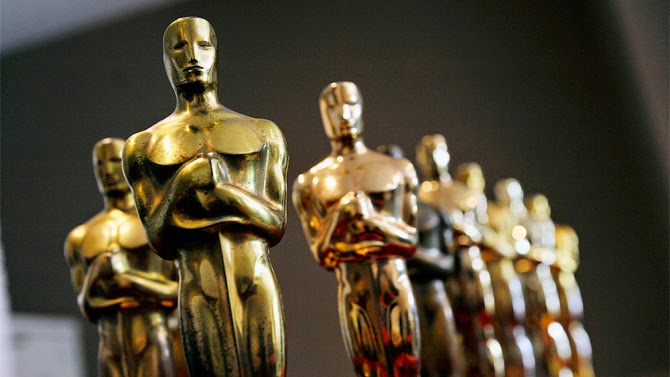
Tonight's OSCARS: My Updated Picks

The Oscars are finally here. I predict the following will be the big winners tonight:
BEST PICTURE: "Birdman"
BEST ACTOR: Eddie Redmayne
BEST ACTRESS: Julianne Moore
BEST SUPPORTING ACTOR: J.K. Simmons
BEST SUPPORTING ACTRESS: Patricia Arquette
BEST DIRECTOR: Alejandro González Iñárritu
BEST CINEMATOGRAPHY: Emmanuel Lubezki
BEST FOREIGN LANGUAGE FILM: Leviathan.

Wednesday, February 18, 2015

The Iceman Cometh at BAM

Eugene O'Neill, America's greatest and most celebrated playwright, spent the last years of his productive life exorcising the demons of his past. In his last creation, the posthumous Long Day's Journey into Night he succeeded in putting to rest the ghosts of his parents and his dead brother in four agonizing acts filled with remorse and guilt, and soaked with a generous amount of whiskey.

In his previous play The Iceman Cometh, finished in 1939, but not given its Broadway premiere until 1946, O'Neill resurrected the down-and-out creatures of the night that inhabited his Greenwich Village hangout, a dump called "Jimmie-The-Priest's," where the young, alcoholic soon-to-be Nobel Laureate paid three dollars a month to stay, drink and solidify his morbidity among a group of the walking dead. In the play, the establishment became "Harry Hope's Saloon," described by Larry Slade, one of the principal dwellers of these lower depths as ''the No Chance Saloon... the End of the Line Cafe, the bottom of the Sea Rathskeller! . . . it's the last harbor. No one here has to worry about where they're going next, because there is no farther they can go."

It was in such a place that O'Neill first came into contact with the many "pipe dreams" that were harbored there. It was here that he tried unsuccessfully to commit suicide, then contracted tuberculosis (in those days, a disease tantamount to a death warrant), and miraculously recovered to have a rebirth as a writer. He was all of 24 years old.

Chicago's Goodman Theatre has brought its production of The Iceman Cometh to The Brooklyn Academy of Music's Harvey Theater, meticulously staged by its artistic director Robert Falls, and starring Nathan Lane and Brian Dennehy, among a cast of veteran stage actors all of whom are excellent in their parts.

Stephen Quimette as Harry Hope, the proprietor of the joint, is truly unforgettable in a role that requires him to rage at his customers for never paying him, and later on to quake in his boots at the thought of leaving his establishment after 20 years of being a shut-in. John Douglas Thompson, as an African American one-time owner of a gambling house delivers his monologues about racial inequality in America with an elegant pride. John Hoogenakker as a Harvard Law School alumnus is heart-breaking as a young lost soul riddled with DTs, and Lee Wilkof as Hugo Kalmar, an aging one-time anarchist, dreams of halcyon future days when all will drink champagne underneath the willow trees.

Nathan Lane and Brian Dennehy as Hickey, the traveling salesman with a newly-found Messianic streak, and Larry Slade, a staunch Irish son-of-a-gun who patiently waits for death, but fails to be persuaded by Hickey's phony spiels, are the bastions of any production of this play. Both offer titanic performances. Mr. Dennehy is perfectly cast as the ex-anarchist who has seen too much of life, and now simply waits for the endgame from inside a bottle of rotgut. Mr. Lane, might not be physically the classic Hickey (a la Jason Robards, Jr. or Lee Marvin of famed previous productions), but his buoyant stamina, and his ability to play a cynical con-man, while entertaining drunks with a bawdy joke about the sexual peccadilloes of the iceman prepare us for his shattering monologue in the last act: the longest soliloquy O'Neill ever wrote, and the true test for any Hickey. Mr. Lane passes with flying colors.

The Iceman Cometh is about the lies that we tell ourselves in order to keep on living. In this tragedy O'Neill holds up the mirror up to nature, and in it we see ourselves experiencing a true catharsis. This play, like most of O'Neill's great works, offers us a rare chance to look at ourselves, and this marvelous production gives us a chance to learn a little more about our human condition.

Sunday, February 01, 2015

Protester at MET Premiere

A pro-Ukrainian protester jumped on the stage of the Metropolitan Opera last Thursday, and held up a sign equating Vladimir Putin with Adolf Hitler. This happened after a performance of Tchaikovsky's Iolanta, conducted by Valery Gergiev and starring Anna Netrebko. Recently, both the Russian conductor and soprano megastar have been under fire for their support of Putin's intervention in the Ukraine.  Here is a report about the event:

Les Contes d'Hoffmann at the MET

When they tell the story of the Peter Gelb years at the Metropolitan Opera, and they get down to the new productions that he brought to the house, I am sure that Bartlett Sher's kaleidoscopic vision of Jacques Offenbach's Les Contes d'Hoffmann (with sets and costumes by Michael Yeargan and Catherine Zuber) will be at the head of the list. This was a creation that was originally devised for Rolando Villazón and Anna Netrebko -- a perfect vehicle to follow their Willy Decker produced La Traviata smash at Salzburg the previous summer. Of course, the Mexican tenor sensation became mysteriously ill, and was replaced by Maltese tenor Joseph Calleja, who also dropped out of a few performances due to illness. Tenor David Pomeroy covered for Mr. Calleja. Meanwhile, Netrebko sang all of the initial performances and soared, giving one of the most memorable performances of the year.  Her Antonia became one of the highlights of her MET career, eclipsed, perhaps this season by her astonishing turn as Lady Macbeth. The original production was conducted by James Levine, who back in December of 2009 was still able to walk to the podium. Later on in the season, Mr. Levine will come back to this production with a fresh, new cast.

Yesterday, Yves Abel, the young Canadian conductor led an excellent performance that was broadcast in HD throughout the world. Vittorio Grigolo, in excellent voice, played Hoffmann with the kind of aplomb we all expect from anyone taking on this challenging part. He knows how to use his voice for the MET. He knows that it pays to push a little more while maintaining vocal focus. The result is a big voice which audiences react positively to. An accomplished actor, he was even able to drape a tablecloth around his shoulders, crouch down and perform a kind of bear dance shuffle along the apron of the stage in a reprise of the Kleinzach number, a stage direction vaguely reminiscent of a Jewish man with a prayer shawl, and an obvious reference to Offenbach's German-Jewish heritage.

The women in Hoffmann's life were a mixed lot yesterday. Although Kate Lindsey playing the dual role of Nicklausse and The Muse was a believable actress, at times her deep mezzo was overwhelmed by the orchestration. Likewise, Hibla Gerzmava was a stentorian Antonia but her voice was just large and unfocused. As the doll Olympia, Erin Morley's light coloratura fared much better, and she was able to convey the robot-like qualities of the role quite nicely. Christine Rice was a memorable Giulietta, lending beautiful harmonies for the well-known Barcarolle that begins the Venetian act.

Thomas Hampson is touch-and-go these days. Yesterday, his voice sounded drier than usual, and he resorted to force it during some dramatic moments. Overall, it was an uneven vocal reading of the four villains, but not terrible. His stage presence and manicured-perfect acting made up for any of the vocal low points along the way.

I am looking forward for this production's return this season with a new cast, and featuring the return of Mr. Levine. 

Monday, January 19, 2015

The Oscars Are Almost Here!

What an interesting year in movies 2014 was! Once again, the small, indie film is being given a chance to take center stage in this year's Academy Awards ceremony.  Here are my picks.  The ones in red are the ones that I feel should win. The ones with an asterisk (*) are the ones that I anticipate the members of the Academy will choose.

Best Picture
“American Sniper”
“Birdman or (The Unexpected Virtue of Ignorance)”
“Boyhood”
“The Grand Budapest Hotel”
“The Imitation Game”
“Selma”
“The Theory of Everything”  *
“Whiplash”

Actor
Steve Carell in “Foxcatcher”
Bradley Cooper in “American Sniper”
Benedict Cumberbatch in “The Imitation Game”
Michael Keaton in “Birdman or (The Unexpected Virtue of Ignorance)”
Eddie Redmayne in “The Theory of Everything” *
Supporting Actor
Robert Duvall in “The Judge”
Ethan Hawke in “Boyhood” *
Edward Norton in “Birdman or (The Unexpected Virtue of Ignorance)”
Mark Ruffalo in “Foxcatcher”
J.K. Simmons in “Whiplash”

Actress
Marion Cotillard in “Two Days, One Night”
Felicity Jones in “The Theory of Everything”
Julianne Moore in “Still Alice” *
Rosamund Pike in “Gone Girl”
Reese Witherspoon in “Wild”

Supporting Actress
Patricia Arquette in “Boyhood”
Laura Dern in “Wild”
Keira Knightley in “The Imitation Game” *
Emma Stone in “Birdman or (The Unexpected Virtue of Ignorance)”
Meryl Streep in “Into the Woods”

Animated Feature
“Big Hero 6” Don Hall, Chris Williams and Roy Conli *
“The Boxtrolls” Anthony Stacchi, Graham Annable and Travis Knight
“How to Train Your Dragon 2” Dean DeBlois and Bonnie Arnold
“Song of the Sea” Tomm Moore and Paul Young
“The Tale of the Princess Kaguya” Isao Takahata and Yoshiaki Nishimura
Adapted Screenplay
“American Sniper” Written by Jason Hall *
“The Imitation Game” Written by Graham Moore
“Inherent Vice” Written for the screen by Paul Thomas Anderson
“The Theory of Everything” Screenplay by Anthony McCarten
“Whiplash” Written by Damien Chazelle

Original Screenplay
“Birdman or (The Unexpected Virtue of Ignorance)” Written by Alejandro G. Iñárritu, Nicolás Giacobone, Alexander Dinelaris, Jr. & Armando Bo
“Boyhood” Written by Richard Linklater *
“Foxcatcher” Written by E. Max Frye and Dan Futterman
“The Grand Budapest Hotel” Screenplay by Wes Anderson; Story by Wes Anderson & Hugo Guinness
“Nightcrawler” Written by Dan Gilroy

Cinematography
“Birdman or (The Unexpected Virtue of Ignorance)” Emmanuel Lubezki
“The Grand Budapest Hotel” Robert Yeoman
“Ida” Lukasz Zal and Ryszard Lenczewski
“Mr. Turner” Dick Pope *
“Unbroken” Roger Deakins

Costume Design
“The Grand Budapest Hotel” Milena Canonero *
“Inherent Vice” Mark Bridges
“Into the Woods” Colleen Atwood
“Maleficent” Anna B. Sheppard and Jane Clive
“Mr. Turner” Jacqueline Durran
Director
“Birdman or (The Unexpected Virtue of Ignorance)” Alejandro G. Iñárritu *
“Boyhood” Richard Linklater
“Foxcatcher” Bennett Miller
“The Grand Budapest Hotel” Wes Anderson
“The Imitation Game” Morten Tyldum

Documentary Feature
“CitizenFour” Laura Poitras, Mathilde Bonnefoy and Dirk Wilutzky
“Finding Vivian Maier” John Maloof and Charlie Siskel
“Last Days in Vietnam” Rory Kennedy and Keven McAlester *
“The Salt of the Earth” Wim Wenders, Juliano Ribeiro Salgado and David Rosier
“Virunga” Orlando von Einsiedel and Joanna Natasegara

Documentary Short Subject
“Crisis Hotline: Veterans Press 1” Ellen Goosenberg Kent and Dana Perry
“Joanna” Aneta Kopacz
“Our Curse” Tomasz Sliwinski and Maciej Slesicki
“The Reaper (La Parka)” Gabriel Serra Arguello *
“White Earth” J. Christian Jensen

Film Editing
“American Sniper” Joel Cox and Gary D. Roach
“Boyhood” Sandra Adair
“The Grand Budapest Hotel” Barney Pilling
“The Imitation Game” William Goldenberg
“Whiplash” Tom Cross *

Foreign Language Film
“Ida” Poland
“Leviathan” Russia *
“Tangerines” Estonia
“Timbuktu” Mauritania
“Wild Tales” Argentina

Makeup and Hairstyling
“Foxcatcher” Bill Corso and Dennis Liddiard
“The Grand Budapest Hotel” Frances Hannon and Mark Coulier *
“Guardians of the Galaxy” Elizabeth Yianni-Georgiou and David White

Original Score
“The Grand Budapest Hotel” Alexandre Desplat *
“The Imitation Game” Alexandre Desplat
“Interstellar” Hans Zimmer
“Mr. Turner” Gary Yershon
“The Theory of Everything” Jóhann Jóhannsson

Original Song
“Everything Is Awesome” from “The Lego Movie”
“Glory” from “Selma” *
“Grateful” from “Beyond the Lights”
“I’m Not Gonna Miss You” from “Glen Campbell…I’ll Be Me”
“Lost Stars” from “Begin Again”

Production Design
“The Grand Budapest Hotel” *
“The Imitation Game”
“Interstellar”
“Into the Woods”
“Mr. Turner”

Animated Short Film
“The Bigger Picture” Daisy Jacobs and Christopher Hees
“The Dam Keeper” Robert Kondo and Dice Tsutsumi
“Feast” Patrick Osborne and Kristina Reed
“Me and My Moulton” Torill Kove *
“A Single Life” Joris Oprins

Live Action Short Film
“Aya” Oded Binnun and Mihal Brezis
“Boogaloo and Graham” Michael Lennox and Ronan Blaney
“Butter Lamp (La Lampe Au Beurre De Yak)” Hu Wei and Julien Féret
“Parvaneh” Talkhon Hamzavi and Stefan Eichenberger *
“The Phone Call” Mat Kirkby and James Lucas

Sound Editing
“American Sniper” Alan Robert Murray and Bub Asman
“Birdman or (The Unexpected Virtue of Ignorance)” Martín Hernández and Aaron Glascock
“The Hobbit: The Battle of the Five Armies” Brent Burge and Jason Canovas *
“Interstellar” Richard King
“Unbroken” Becky Sullivan and Andrew DeCristofaro

Sound Mixing
“American Sniper” John Reitz, Gregg Rudloff and Walt Martin *
“Birdman or (The Unexpected Virtue of Ignorance)” Jon Taylor, Frank A. Montaño and Thomas Varga
“Interstellar” Gary A. Rizzo, Gregg Landaker and Mark Weingarten
“Unbroken” Jon Taylor, Frank A. Montaño and David Lee
“Whiplash” Craig Mann, Ben Wilkins and Thomas Curley

Visual Effects
“Captain America: The Winter Soldier”
“Dawn of the Planet of the Apes”
“Guardians of the Galaxy”
“Interstellar” *
“X-Men: Days of Future Past”

Monday, December 29, 2014

A Smash on VOD: The Interview

The Interview, out on limited theatrical release and VOD as a result of the Sony Pictures hacking scandal and alleged threats from the government of North Korea, might just be the silliest, most sophomoric film to have gotten world-wide news coverage. Though way too much has been written about this movie already, Sony has announced that it has made $15 million, which makes it a groundbreaking VOD success, and definitely something to spill more ink about.  Let me get my poisoned pen.

Though the film tries to be a satire of a contemporary dictator, it lacks the talent to take its mission to the end, preferring to veer away from political mockery and head downhill to the lowest of the lowest burlesque. As expected, the result is no Ernst Lubitsch's To Be or Not to Be or The Great Dictator, Charlie Chaplin's brilliant sendup of Hitler's Fascist Germany. Both of these classics were released in the middle of World War II, and each offered insightful satirical parody while commenting on the nature of evil. The Interview, instead, knocks loudly at the door of Pyongyang and then runs away. More or less that's the nature of the humor throughout the film. That, and a penchant for anal penetration jokes.

James Franco overplays Dave Skylark, the kind of obnoxious TV talk host that drools all over Eminem (in a surprisingly understated performance) after the rapper admits on the air that he is gay. Inside the booth, Seth Rogen is Skylark's producer, who after meeting a college buddy who is now a senior producer on 60 Minutes, begins to understand that the product he's putting out is garbage. He conceives the brilliant idea to travel to North Korea, and land an interview with Kim Jong-un. However, when the CIA finds out about this unlikely, unexpected road trip (which Skylark continually compares to the journey in The Lord of the Rings), agent Lacey (Lizzie Caplan), like a siren, bewitches the two cable news dodos into assassinating the North Korean leader.

As far as good taste is concerned, it all goes downhill as soon as the pair arrive in North Korea. The Supreme Leader (Randall Park) is a psychological mess whose father has trained him from childhood that it is gay to drink margaritas. No doubt, this has led Kim Jong-un to make sure that his people believe that he has no need to urinate or defecate. Needless to say, his butthole does not fail to make an audio appearance during the course of the film. And there you have it, folks: there's the big difference between this film and, say, The Great Dictator. When Chaplin played with a globe of the world, bouncing it up and down, it becomes a comic/chilling moment. Here, the most graceful thing this dictator can do is to rip one out for laughs.

Too bad, because the film starts out a bit more promising. Following an old-fashioned Columbia Pictures logo, the angelic face of a Korean girl, singing about her hatred of the United States of America, appears in closeup. "May your women all be raped by beasts of the jungle while your children are forced to watch!" she sings. And as the camera pulls back, a nuclear warhead launches into the sky. If only the movie would have continued at this level.

My biggest fear about this entire mess is that I can already see Dave Skylark making a comeback (like a low-grade James Bond) in a future adventure.  Let's hope that everyone involved thinks thrice before this happens.

Sunday, December 07, 2014

Die Meistersinger is back at the MET

The Otto Schenk, Günther Schneider-Siemssen production of Richard Wagner's Die Meistersinger von Nürnberg is back at the Metropolitan Opera, playing for seven performances, including an HD telecast of the Saturday matinee on December 13.  I will be in the house for that performance.

These are turning out to be very important performances.  To begin with, it is the only Wagner opera that the MET will be presenting this year, and all the performances are slated to be conducted by James Levine, who is experiencing a tremendous year, celebrating his full-time comeback to the MET after a prolonged illness.
This is also the last time that this famed production will be seen at the MET.  The conservative staging will be retired, and in its place the Metropolitan Opera will present in the future the new Stefan Herheim production (pictured above) that premiered at the Salzburg Festival last summer. Mr. Herheim is a world famous proponent of "Regietheatre" and his production of Parsifal, which I saw at the Bayreuth Festival in 2012, takes extensive liberties with the plot of the opera. Michael Volle, who sang the role of Hans Sachs in that Salzburg production will be singing some of the performances this year, although house bass-baritone James Morris (who sang Hans Sachs last time this production was mounted) will be singing the majority of the performances.

Peter Gelb has made sure that Mr. Volle will be singing the HD telecast, and he is already in conversation with the singer about singing the role of Wotan next time the MET mounts their controversial staging of the "Ring."

Friday, December 05, 2014

Birdman

 Birdman or (The Unexpected Virtue of Ignorance) is a major achievement from Alejandro G. Iñárritu, the director of Amores Perros and Babel. Playing Riggan Thompson, a once popular actor famous for his superhero films, Michael Keaton gives a phenomenal, one in a lifetime performance. His character yearns to make it back into the limelight, this time as the writer director of a labor of love Broadway play based on the Raymond Carver short story "What We Talk About when We Talk About Love."

Riggan might be a decent stage actor and might have even nailed it as a playwright, but his inner voice, the thunderous growl of his alter-ego Birdman overwhelms his entire on-the-edge present existence.  Even when he is in the lotus position, meditating in his underwear, and levitating off the ground in his dressing room of the St James Theater, his former incarnation is constantly taking over, overcrowding his mind.

The film is an expressionistic backstage journey through Riggan's mind as it slowly begins to drift south throughout the play's previews. Magnificently photographed by Emmanuel Lubezki, who won an Oscar last year for the cinematography of Gravity, the film gives the appearance that it was shot in one long, continuous take: no doubt, the director's homage to Alfred Hitchcock's Rope, which pulled the same balancing act trick back in 1948.

Birdman is also referential to a host of artistic icons, and particularly right at home when it channels the Magical-Realism of 1960s Latin American literature. Riggan is able to levitate and make objects smash to the ground with a wave of his hand like any one of the Buendía children in Gabriel García Márquez's One Hundred Years of Solitude. He is also able to soar up to the skies, in the middle of a colossal cgi fracas, and defeat a winged gigantic creature who threatens to destroy Manhattan from the rooftops, like a latter-day King Kong.

But it is the performances in this backstage drama that propel this film forward. Think of Birdman as a magical-realist All About Eve but with the ghost of an action hero and references to Roland Barthes and Jorge Luis Borges. Not only is Michael Keaton the perfect actor to play a former action hero movie star searching for a come back vehicle (its been almost thirty years since the release of Tim Burton's Batman), but Edward Norton manages to play a fictionalized version of himself, with all the complexities that those in the know say he brings to a set.  Emma Stone and Naomi Watts also shine, as well as Zach Galifianakis, playing against type, as Keaton's feet-on-the-ground manager.

Birdman is a smash hit in quite a lot of levels, and it will certainly bring Academy Award nominations for many categories. I predict an Oscar for Mr. Iñárritu's fascinating, multi-faceted screenplay, and without a doubt, another statuette in a row for Mr. Lubezki's amazing cinematography that I predict will be talked about and studied by future filmmakers for years to come.