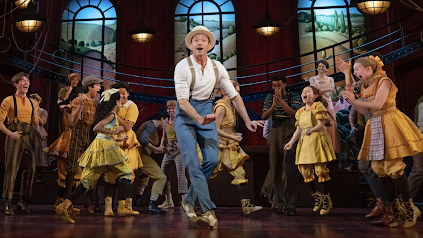
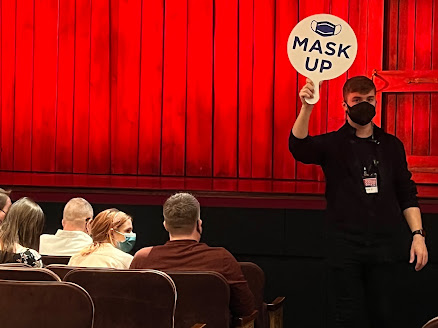
Yes, Broadway has been back for a while, stumbling out of the COVID-19 nightmare in spurts. But this afternoon was MY first time back inside a Broadway theater since 2020. And if it wasn't for the masked crowds and a new job for ushers (see the picture below) the magic is back, and the audiences are more excited than ever.
The official blog of Vincent's Casablanca HomePage and Wagner Operas. Click the links below to explore my sites.
Richard Wagner's Operas
Thursday, February 24, 2022
Broadway is Back: THE MUSIC MAN
Sunday, January 16, 2022
A new RIGOLETTO at the MET
Mr. Sher began his association with the MET at the start of Peter Gelb's tenure. His production of The Barber of Seville featured an extension of the stage in front of the orchestra pit -- the infamous passerelle that many critics pointed out was not made for the MET's acoustics. There were also cartloads of pumpkins, and a giant anvil that threatened to fall on the characters Wile E. Coyote style. Perhaps his most successful production at the MET is his staging of The Tales of Hoffman, with its René Magritte bowler hats and homages to different films from Federico Fellini to Ingmar Bergman.
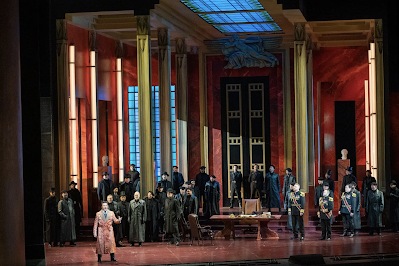
This season Mr. Sher has staged a new production of Rigoletto, Giuseppe Verdi's masterpiece of 1851. As is the current trend in opera staging, God forbid the director set the scene according to the wishes of the original creators. So, instead of traveling to Mantua we get Germany during the period of the Weimar Republic. Now, I have to be careful here criticizing the change of locale. After all, this opera is based on a Victor Hugo play (Le Roi s'Amuse) which takes place in the depraved French court of François I. Verdi's lyricist Francesco Maria Piave thought it best to transfer the scene to Italy. So, the original setting of this work is the depraved court of the Duke of Mantua, a made-up person who was based on Vincenzo Gonzaga, a 1500's royal scoundrel whose family motto, according to the program notes on the playbill, was "Forse che si, forse che no" (Maybe yes, maybe no).
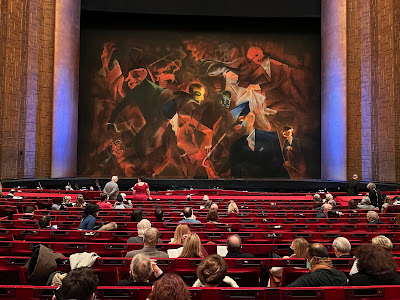
As we come in the auditorium we are faced with a show curtain filled with nightmarish characters right out of the canvases of Max Beckmann, Otto Dix and George Grosz. But again: why Germany's Weimar Republic? Certainly the unit set built on the MET's turntable (which spins around too much for my taste) by Michael Yeargan recreate a period of grandiose Fascist architecture that was already entrenched in Mussolini's Italy years before Hitler brought Fascism to Germany.Why not set it in Fascist Italy, then? All the ingredients are there. There's the work of poet Gabriele D'Annunzio, whose writings serve as the precursor of the ideals of Italian Fascism. And of course, there's Pier Paolo Pasolini's film Salò, or the 120 Days of Sodom, a work very much entrenched in the work of D'Annunzio. If you want depravity don't look any further. Salò is the GOAT.
Piotr Beczała has returned to play the Duke, as he did in the last MET production of this work which took place in Las Vegas. He returns with a more mature voice. It is now deeper and his memorable ringing timbre of years past seems to be disappearing. Could it be that he has sung too many performances of Lohengrin at the Bayreuth Festival, a role that many tenors stay away from because it tends to cloud the voice? I would recommend Mr. Beczała to stay away from the swan boat and concentrate more on the Italian and French repertory.
Quinn Kelsey is a huge, bruiser from Honolulu Hawaii with a voice to match. His instrument fills the house, and then some. It is not a particularly beautiful sound, but then again if you are playing a hunchback jester you want a growl in your voice, and Mr. Kelsey can provide that in spades.
For me, if the Sparafucile stinks, then the opera doesn't work. What I mean is that he has to have a strong sustained low F that ends the Act II duet with Rigoletto. Thank goodness the MET has re-hired Italian basso Andrea Mastroni (he made his MET debut in this role in the previous production). Once again he made a vocally chilling assassin, and that outstanding low F is his bread and butter. He has sung this role everywhere from Covent Garden to Madrid.
Unfortunately, I did not get to hear Rosa Feola as Gilda. She could not sing because she had just gotten boosted and was suffering through the effects of the injection. The understudy was announced from the stage. It was a late cancellation for Ms. Feola so there was no paper insert in the programs. So, I have no idea who I heard. She did have a pretty soprano voice, and her "Caro Nome" was greeted with a healthy ovation. MET audiences always treat understudies well, especially if they are able to deliver.
Daniele Rustioni, the new principal guest conductor of the Bavarian State Opera led an enthusiastic reading of the score. Under his direction, the orchestra brought out the transparent and sonorous beauty of Verdi's orchestration which many times is just taken for granted. Particularly fine was the backstage storm chorus, one of the great innovations of this score.
So, there's a new Rigoletto in town. Maybe not the most memorable of productions, but the New York crowd will continue to support this staging as long as the MET management fills it with fine international singers.
Sunday, November 28, 2021
Licorice Pizza by Paul Thomas Anderson
I saw this film in 70mm at the Village East theater, a landmark building that presented Yiddish entertainment at the beginning of the century. Very few people will be able to tell you who played this house. I noticed the young crowd around me that gathered to see this movie, and I realized that even fewer had any clear memory of the 1970's. And yet, PT Anderson's film, filled with such loving nostalgia for days gone by, his days gone by, resonated with this young audience. The director presented a very personal story, but he also knows that if you grew up at the turn of the century in New York's Jewish ghetto, or in the Taxi Driver New York blight, or in any other decade, or any place on Earth, one thing is certain: everyone goes through adolescence and everyone falls in love. That is the simple reality and universal theme of this film.
So, the director's approach is to mine his memory banks. Episodes of his life are beautifully recreated, focusing on a young 15 year-old high school student and child actor Gary Valentine (Cooper Hoffman) and his pursuit of Alana Kane (Alana Haim), a twenty-something who eventually becomes his business partner and main squeeze. Together, they travel the landscape of Southern California at a time when prices were so low that a high school kid could open a water bed store and sell one to Jon Peters (a hilarious Bradley Cooper) during the time the ex-hairdresser turned producer was dating Barbra Streisand.
In PT Anderson's coming-of-age enchantment, Old Hollywood is still hanging on as the new lions are storming the gates. We don't get a glimpse of Stephen Spielberg or George Lucas in this film, but figures like Jack Holden (Sean Penn as William Holden), and Rex Blau (Tom Waits as an aging film director -- a John Huston / John Ford composite), play memorable parts in this film. The movie is also filled with cameos. Blink and you'll miss John C. Reilly, a PT Anderson stalwart, as Herman Munster. But you won't forget Christine Ebersole as a Lucille Ball-like character who beats up Gary after he commits a faux-pas on live TV.
The San Fernando Valley has never been portrayed so charming before. Especially during the gas shortage sequence, when Gary runs past lines of cars to the tune of David Bowie's "Life on Mars?" In this film we find a softer PT Anderson. Boogie Nights, Magnolia, and The Master were tough subjects, and his scalpel had to be sharper and cut deeper. Here, the director's main prop is his camera (he takes the DP credit for the first time), and it seems that his main concerns are to present a rosy recreation of his coming-of-age years, and to make sure Cooper Hoffman and Alana Kane come out of this as bright new Hollywood stars. Not a bad reason to create this film. Cooper's dad, the late Philip Seymour Hoffman had a long association with PT Anderson, the actor giving some of his best, defining performances under this director's lens. Now is the time for a new generation to spring forward, as the director turns his gaze back to the past.
Friday, November 26, 2021
Stephen Sondheim is Dead
His shows almost never made money. Sure, when he started out at first as the young lyricist to Leonard Bernstein's music in West Side Story that show was a hit. And so was Gypsy, for which he almost wrote the music, however Ethel Merman did not want to star in a show written by an unknown composer. So Stephen reprised his role as lyricist, this time to Jules Stein's great score. He was soon to come into his own as a composer and lyricist with his farce A Funny Thing Happened on the Way to the Forum.
And then, magic happened. His collaboration with director Harold Prince produced some of the greatest American musicals. Lightning kept striking every time. Follies, Company, A Little Night Music, Pacific Overtures, Sweeney Todd the Demon Barber of Fleet Street, Sunday in the Park with George, Merrily We Roll Along, Into the Woods, Assasins, and Passion. There were Tony Awards galore, as well as the Pulitzer Prize. If you have followed his career you have your favorites. I know I fell in love with Sweeney Todd the moment I heard the downbeat chord on the organ that begins the score. For Sondheim it was a revenge story, for director Hal Prince it was about the dehumanization of man during the Industrial Revolution.
Definitely the Stephen Sondheim musical was not the feel good, warm and fuzzy product that Broadway audiences expected. The shows made very little money, but he was expanding the horizons of musical theater. He couldn't compete with the likes of an Annie, Les Misérables or with Andrew Lloyd Weber's British invasion. And, of course, he just could not bring in the crowds that were starting to flock to the corporate Disney shows that were filling the theaters.
I remember a radio interview Sondheim gave at the time of the premiere of Sweeney Todd, a show I got to see three times. He was talking about the struggle to find a musical language to fit a particular show. He reminisced about Pacific Overtures, a daring show about the opening of Japan in the 1800's and the eventual westernization and commercialization of the country. Like Richard Rodgers in the 1950's who struggled with how Eastern to make the music of The King and I, Sondheim could not get the feeling for this show right. Until, as so often happens, one day it hit him. In the staccato rhythms of Spanish flamenco music somehow he found the necessary voice for his show about Japan's floating kingdom. I never forgot this incredible journey of discovery that this artist went through, and was able to tell us about it. At that moment I realized that Sondheim was not just the cerebral creator of Broadway entertainment. He had become a musical advocate for the globalization of music. The show was the customary Sondheim flop. Imagine a show where the Americans are the bad guys for destroying the beautiful traditions of Japan, playing during 1976: the year where jingoism was at its highest as America celebrated its Bicentennial.
As a composer Sondheim was unique among his peers. Everybody always said one did not leave the theater humming a Sondheim score. That might have been true, but what was always certain was that his choice of a musical idiom fitted the show like a glove. His music could be brassy as in Company, operatic with a touch of the gothic as in Sweeney Todd, and even minimalist and filled with a dash of pointillism in Sunday in the Park with George. And sometimes it could just simply sway in perfect Johann Strauss three quarter time in A Little Night Music, one of my favorite Sondheim shows, adapted from Smiles of a Summer Night, one of the great Ingmar Bergman films.
We have lost one of the great ones. I do not think we will see another one like him in our lifetime.
Monday, November 15, 2021
30 year-old "Meistersinger" returns to the MET
The month of November saw the Metropolitan Opera stage a revival of their 30 year-old production of Richard Wagner's Die Meistersinger von Nürnberg. This decision created a unique event in the world of opera. Here in the year 2021, when "Regietheatre" has become the norm, even on these shores, the MET dared to mount a production completely devoid of any agenda or director-driven point of view: the norm on the great operatic stages around the world these days. Nowhere to be found on the MET stage was the Lilliputian world that director Stefan Herheim created for his 2013 staging of this work at the Salzburg Festival. And certainly, the MET was staying clear of the World War II political treatise of Barrie Kosky's Bayreuth staging, with its exploration of the inherent antisemitism prevalent in the work.
The MET staging, which played its last performance this season on Sunday (and which might be the last time this production is staged), is an epic imagining of this work created at a time when this opera company envisioned each staging in its repertory to last the minimum of twenty years. It was the way the MET operated under Joseph Volpe, who ran the institution from 1990 to 2006. Thus, Günther Schneider-Siemssen's beautiful sets might have cost a lot of money, but the institution would get it all back in those twenty years. Little did the creators of this production envision that thirty years down the road the MET would still be presenting their work. The only creators who remain alive are director Otto Schenk and choreographer Carmen De Lavallade, both in their 90's.
But why is this production still being mounted in a world-class opera company when similar institutions are experimenting with newer styles that break traditional stagings? The answer lies in the very fact that the New York opera audience is essentially a conservative one, resistant to watching their favorite operas in newer, more daring stagings. The Stefan Herheim production almost made it to the MET, but at the last moment that idea was scrapped, and the old production remained.
What audiences saw this November was a return to a simpler world of opera, where the composer still ruled, and where the director's job involved nothing more than the recreation of the vision of the composer. What the MET did do is populate these old sets with some of the great Wagnerian artists available today. All of them European, most of them German, and the large majority veterans of many summers at the Bayreuth Festival. Here was Klaus Florian Vogt, that amazing tenor with the sweet, youthful voice -- offering a clear antidote to Jonas Kaufmann's baritonal fach. There was also Michael Volle, who clearly owns the role of Hans Sachs at the moment, with his intelligent, humanistic approach to this wise character. There was also Johannes Martin Kränzle who, in my opeinion, can't be beat in the role of Sixtus Beckmesser, whether he is wearing a Jew's head in Mr. Kosky's current production at the Green Hill, or in this production which showcases his great comedic skills. And let's not forget Georg Zeppenfeld who belongs in the same league as René Pape when it comes to interpreting the great Wagner bass roles.
But the drawing card to this revival was soprano Lise Davidsen who continues her meteoric rise in the opera world. What a voice, and what a season she will have at the MET! Upcoming performances include two soprano roles in Richard Strauss's operas: the title role in Ariadne auf Naxos and Chrysothemis in Elektra. Antonio Pappano conducted this mighty work with a sure hand, letting the orchestra show off its brilliant playing. His reading was transparent rather than pompous. His reading of the third act prelude was one of the most beautiful I have ever heard in any opera house.
It was a great pleasure to see this staging once more, but, as gorgeous and intelligent as this production might be, let's face it: I think we are all ready to see a new MET Meistersinger soon.
Saturday, October 09, 2021
PARALLEL MOTHERS at the NY Film Festival
Before it has even opened to the public, the movie has already gathered a controversial pre-release vibe in the United States when a kind of furor arose a few weeks ago over the film's advertising poster which shows a nipple dripping mother's milk. America's puritanical ways play right into Almodóvar's penchant for shocking the public; this time around with a maternal image. But then again, he's been stirring the pot since the early days of the "Movida" movement in Spain, the post-Francisco Franco years when moral restrictions were lessened and liberty came back to Spain. This is the period when he came to prominence with such early amateurish "shockers" as Pepi, Lucy, Bom until he hit his stride with 1988's Women on the Verge of a Nervous Breakdown, one of the many great films in his oeuvre.
At last night's screening, Dennis Lim, director of Programming at Film at Lincoln Center, introduced the film by saying that there is a new political urgency in this film not seen before. Although this film does focus on the unresolved murders that occurred during the Spanish Civil War which led to a Fascist government in Spain that lasted into the 1970s, nearly all of Almodóvar's films shed a light on Spain's troubled past. Their sense of liberation, sexually and sociological, are a reaction to the forty-some-odd years that Spain endured under Franco's regime.
In 1997, Almodóvar released Live Flesh (Carne trémula) in which a young, pregnant prostitute during Franco's Spain (Penélope Cruz's first performance under his direction) gives birth to an illegitimate child in a Madrid bus. The film then goes forward in time to the present post-Franco Spain as we follow the child now an adult. Parallel Mothers once again casts Ms. Cruz as a pregnant photographer this time sharing her modern Madrid hospital room with a pregnant teen, newcomer Milena Smit, who is the director's latest muse, and who gives an amazing performance. It is only her second film.
The film also features some familiar faces from Almodóvar's past. Rossy De Palma, a stalwart in the director's list of films, received applause when she first appeared. Likewise, the audience also recognized the likes of Julieta Serrano, who is also an Almodóvar favorite going back to the days of Women/Breakdown.
The film was shot in the expected vivid, colorful palette of José Luis Alcaine, the director's longtime working cinematographer.
The film will be released by Sony Pictures Classics, who have been by Almodóvar's side since the beginning. In his post talk, the director urged any Academy member in the audience to vote for this film, and if nominated, to vote for Milena Smit, who has clearly become Trilby to his Svengali. Something tells me that Ms. Smit is already a permanent member of the roster of Almodóvar's women, and that we are going to see a lot of her in the future. A star is born!Sunday, October 03, 2021
"The French Dispatch" at the NY Film Festival
The movie is a loving Valentine to The New Yorker magazine as well as being filled with all kinds of homages to French cinema. The movie presents stories that go back to some famous articles that originally appeared in the pages of The New Yorker. For example, Mavis Gallant's article "The Events in May: A Paris Notebook" about the student riots in 1968 serves as a vehicle for Timothée Chalamet, Frances McDormand and Lyna Khoudri to engage in a love triangle in the protest-filled streets of Paris, while Anderson channels the look and gritty black-and-white of Jean-Luc Godard and other members of the Nouvelle Vague.
In another tangential vignette, Jeffrey Wright gives us an impersonation of a fictitious writer that mixes James Baldwin with a dash of food critic AJ Liebling as he recounts a story to TV host Liev Schreiver of a bizarre kidnapping that ends up turning into an animated sequence during the concluding minutes.
In perhaps the most enjoyable section of the film, Benicio Del Toro is an incarcerated artist in love with a female prison guard, beautifully played by Léa Seydoux, while art dealer Adrien Brody lays some schemes to make money off the prisoner's art work. As he tells Del Toro's character “All artists sell their work. That’s what makes them artists.” The segment, also shot in black-and-white, brings to mind Jean Renoir's film Boudou Saved from Drowning, and it is based on a 1951 New Yorker article by SN Behrman about shady art dealer Lord Duveen.
All the different segments always come back to the offices of the French Dispatch, whose editor-in-chief, played by Bill Murray, bears a more than slight resemblance to Harold Ross, The New Yorker's co-founder and fabled first editor.
What binds all of this together is Anderson's love of the magazine and his love of France. From the point of view of cinema, the glue in this film is his, by now, familiar geometric mise-en-scène, which in this film he exploits to the nth degree. Arguably, this is the most Andersonian of all his films. Everything is neatly arranged within a frame whose aspect ratio, for reasons that remain unclear to me, keeps changing from academy ratio to widescreen. He used the same technique in his earlier film The Grand Budapest Hotel. If you dig his symmetrical, structural compositions you are in for a treat. However, after a while, the constant reliance on tableaux and strict visual order cries out for some good old fashion visual chaos. And although at times Anderson allows his brilliant cinematographer Robert D. Yeoman to hand-hold the camera, the Andersonian world must adhere to unity and order all the time.
Saturday, September 25, 2021
The Tragedy of Macbeth at the NY Film Festival
William Shakespeare's Macbeth, by my count, is the fourth time a major filmmaker attempts to adapt Shakespeare's arguably bloodiest, and also shortest of all his tragedies. This time around Joel Cohen, going solo after his brother Ethan Coen announced recently that he may be through with show business, has given us his interpretation of the Scottish play, and what an amazing visual feast it is.
The Coen brothers have always been very particular about the powerful images that grace their canvases. This time, Joel Cohen has decided to shoot the film in black and white and present it in Academy Ratio. This choice gives the film a timeless look. It makes us think of Orson Welles's moody, shadow-filled film interpretation of this play. Or perhaps, Akira Kurosawa's brilliant Throne of Blood, where the setting shifted to feudal Japan. Thanks to the brilliant cinematographer Bruno Delbonnel the images transport us to another time. The whole production was shot in sound stages making even exterior
shots seem oppressive and lacking any true daylight. The sun never
shines in this production (does it ever really shine in Scotland?), and
this is another aspect of this production that works well.
Comparing it to other genres, this film brings to mind the brooding atmosphere of Laurence Olivier's Hamlet as well as the look of a Val Lewton horror film. Actually, to be more precise, and fitting, this movie looks like a medieval Film Noir. And given the Bard's plot involving a woman urging her husband to commit murder, as Joel Cohen noted in the Q&A that followed yesterday's showing of the film at the New York Film Festival, this comparison is quite apt. The Double Indemnity, black widow, pulp vibe of Shakespeare's play was one of the things that drew Mr. Coen to this project.
Our childhood reading of this play constantly brings us back to the Bard. Macbeth is my favorite Shakespeare play. It is also a favorite of Frances McDormand who plays Lady Macbeth in this film. I read this work in junior year of high school, Ms. McDormand revealed last night that she was asked to recite the sleepwalking scene during her early school days. For Denzel Washington, who plays the title role, his introduction to Shakespeare happened while he was a pre-med major at Fordham University at Lincoln Center. At the urging of his teacher and mentor Robert Stone (who was also my teacher) he played the title role in Othello on the Fordham stage. The rest is history.
Personally, I always love to see what directors do with the roles of the witches. In the groundbreaking stage production of the 1930's, which moved the setting to Haiti, director Orson Welles and producer John Houseman hired Haitian Voodoo witch doctors to play these parts. In this film, Kathryn Hunter assumes all three roles, and all I can tell you is that you will not soon forget her. She is a subtle, weird presence on the screen, and thus really terrifying: the stuff of nightmares.
The leading roles are masterfully handled. Mr. Washington is a capable Shakespearean as he has proven many times in the past, and Ms. McDormand, who has played her role on stage, is really a wonder to behold in this film. I was a severe critic of her performance in Nomadland, which was filled with way too many of her own personal mannerisms and thus never allowed me to fully enter into the story. Here, by contrast, she assumes the role of Lady Macbeth and magic happens: Frances McDormand, the producer and Oscar-winning actress disappears.
But ultimately, it is the directorial work of Joel Cohen, going solo for the first time, which is the big winner here. The entire movie is filled with images you will not soon forget. There is one shot in particular during Lady Macbeth's sleepwalking scene that is as brilliant as anything that cinematographer Gregg Toland achieved for Welles in Citizen Kane.
Last night, while Mr. Coen was presenting his work, he noted a longstanding superstition connected to the play. “You probably know it. You’re not supposed to speak the name lest some horrible catastrophe befall you or the production. This is a superstition that all of us making the movie blithely ignored until Friday the 13th of March, 2020. Then we all got religion and after months passed and the show finally got back on its feet we started referring to it simply as ‘the tragedy,’” he said,
He ended his remarks by saying “I’d like to point out that just because it’s a tragedy doesn’t mean you can’t have a good time. So enjoy the tragedy.”
You too will be able to enjoy this Apple Original Films and A24 terrific production when the film officially opens at the end of the year.
Saturday, July 25, 2020
Bayreuth 2020
Bayreuth 2020 has been canceled due to COVID-19, but music will continue over the Internet. Below is the complete schedule of the alternate Bayreuth Festival 2020.
There will be a live event featuring conductor Christian Thielemann with members of the Festival Orchestral alongside Camilla Nylund and Klaus Florian Vogt.
Performance Date: July 25, 2020
Simon Steen-Andersen will present “The Loop of the Nibelung,” an audiovisual exploration of the Bayreuth Festival Hall featuring music by Wagner with singers and members of the Festival Orchestra. The concert will be streamed on the official website and BR-Klassik Concert page.
Performance / Streaming Date: July 28, 2020
The company will present three different productions of the Ring from 2013, 1988, and 1976. Audiences will get to check out the Castorf version from 2013 on BR-Klassik.
Streaming Date: July 25-28, 2020
Patrice Chéreau and Pierre Boulez’s iconic 1976 “Ring” will be shown on ARD-alpha and BR-Klassikon.
Streaming Date: August 7, 2020
Finally, Kupfer’s 1988 version of the “Cycle” will be presented via 3sat media library, br-klassik.de, and the official Bayreuth Festival website.
Streaming Date: July 25, 2020
In addition to presenting the three Rings, the company will also present a 1958 production of “Lohengrin” by André Cluytens on BR-Klassik.
Streaming Date: July 29, 2020
Herbert von Karajan’s 1952 “Tristan und Isolde” will be broadcast on BR-Klassik.
Streaming Date: July 30, 2020
Additionally, BR-Klassik and the Bayreuth Festival will present videos such as “Opera crash course Wagner, “Classic Shorts,” “The Ring Profiles,” and “Wagner ABCs.”
Monday, July 13, 2020
The Washington Red Tails?
A few years ago, John's University decided to change the name of their team, the Redmen, despite the fact that the university claimed that the name originated, not in Native American culture, but in the fact that the athletes wore red. This explanation did not really hold water, for the mascot of the team was a cigar store statue of a Native American whom the students nicknamed "Chief BlackJack." Since 1994 the team has been known as "The Red Storm."If you are a Cleveland Indians fan you know about Chief Wahoo. The mascot, a blood-red face of a Native American with the widest grin you ever saw, was eliminated in 2018. The question is, during these revolutionary times, will the team continue to be called the "Indians?"
So, now that the name "storm" has already been taken, what will the new Washington football team be called? Many are hinting at the name "The Washington Red Tails," as a homage to the Tuskegee Airmen, a group of African American U.S. Air Force servicemen who served honorably in World War II. You might remember that there was a film made with Cuba Gooding, Jr. about these American heroes. The film presented the story of a group of men who were largely forgotten during the Jim Crow period of American history. The name "Red Tails" would appease those who believe that the name Redskins is offensive, it would be in keeping with the #BlackLivesMatter movement, and it would satisfy those who see the relationship between the sport and the military.
The only thing I see that might be a drawback to their name change is the actual name itself. For instance, take the New York Jets. Their name implies speed and modernity. Whether or not their "flight plan' has been that successful in the recent past seasons is another story. However, what images do you get when you consider that the Red Tails were P-51 Mustangs propeller planes? Can these relics of aviation offer any hope of speed and power in today's NFL, or is merely the romanticizing of their World War II endeavors enough to drive the new team forward?
With the NFL season only a few weeks away, the team better decide, and quick.
Wednesday, July 08, 2020
Ciao, Ennio
So close was their partnership (only equaled perhaps by Eisenstein and Prokofiev in Alexander Nevsky) that Leone created sequences just to feature the inventive music of Mr. Morricone. Just think of that marvelous sequence in Once Upon a Time in the West when mail-order bride Claudia Cardinale arrives by train to meet her future husband and his family, who have all been already gunned down by bad guy Henry Fonda. The sequence is pure Morricone: wordless, lyrical. It makes time stand still.
Tuesday, July 07, 2020
No San Fermín
This year they have the right to sing this song from the start of the feast because the whole thing is cancelled as a result of the COVID-19 pandemic.
Nonetheless, a handful of people of Pamplona gathered yesterday in front City Hall to put on their red bandannas around their necks, just as if the feast had been starting. There was, however, no "chupinazo," the yearly launching of a rocket from the balcony of the mayor's office that signals the start of the feast. Below is a report about these events:
Friday, July 03, 2020
Hamilton on Disney+
On the one hand, it is glorious that the show was captured live on the stage of the Richard Rodgers Theatre before the original cast disbanded. Generations to come will have a chance to debate this hip-hop recreation of Alexander Hamilton's life as they watch a pristine 4K capture, showing up close the performances of the show's composer lyricist Lin-Manuel Miranda, but of the many actors who started out as virtual unknown and became stars during the initial run of the play: Leslie Odom, Jr. as Aaron Burr, Anthony Ramos as John Laurens, Daveed Diggs as the Marquis de Lafayette, and Phillipa Soo who plays Eliza Schuyler.
After a statue of George Washington was pulled down in Portland, Oregon by angry protesters, having the first president of the United States dramatized and fictionalized in the musical will not please everybody. Of course, the role is played by Christopher Jackson, an actor who considers himself African-American. Although I'm sure he is proud of his work, and his association with Miranda (they go way back to Miranda's first show In the Heights), I wonder what his feelings are about playing a slave owner in this new normal society?
The racial terrain of the United States is more troubled than ever. Trump will be at the Mount Rushmore monument for a Fourth of July fireworks show this weekend. Will the monument be the cause of controversy as the president of the United States stands under the visage of those former presidents whose statues have come down recently?
Tuesday, June 30, 2020
New Woody Allen movie at San Sebastian Film Fest
Rifkin's Festival is Woody Allen's new film, and it will premiere at the San Sebastian Film Festival. Since Spain has been able to flatten the COVID-19 curve and lower it, the festival is set to go in September. According to Yahoo News, the film was "shot last summer in and around the northern seaside resort itself, the
story centers on an American couple who come to its international film
festival and are swept up by the fantasy of cinema and the charm and
beauty of Spain." The movie stars Austrian actor Christoph Waltz, and American Gina Gershon.Woody Allen was greeted with protests last year when he was shooting the film. As Yahoo News reports "The screening will be a significant moment for Allen who's seen his career stalled as a result of the #MeToo movement against sexual harassment, which revived decades-old allegations he sexually abused his adopted seven-year-old daughter in the early 1990s."
He has denied all claims which were first leveled by his then-partner Mia Farrow. Mr. Allen was cleared of the charges following a series of
investigations.
Yahoo News goes on to report that "the sexual harassment firestorm has fueled a growing backlash against him and last year his most recent romantic comedy A Rainy Day in New York ended up being released in various European and Latin American countries rather than in the US."
Saturday, June 20, 2020
Ian Holm: Dead at 88
In 1985 he graced the screen with what is perhaps his most complex character in Mike Newell's neo-noir Dance With a Stranger. Sir Ian nearly stole the picture as a humiliated gentleman caller, emasculated by Miranda Richardson's Ruth Ellis, the last woman to be hanged in England.
Sir Ian's recent performances included Bilbo Baggins in Peter Jackson's Lord of the Rings and Hobbit films, as well as David Cronenberg's Naked Lunch, and Martha Fiennes's Chromophobia, in which he had a comic sex scene with Penélope Cruz.
In today's obituary Peter Bradshaw wrote in The Guardian that "there was always a cool, rational, weighted intelligence in Ian Holm. On screen, he was never exactly a heart-on-sleeve performer; he did not need or even appear to want the audience’s sympathies. Holm could be a mandarin and almost priestly presence, but always with a pressure cooker of emotion inside. He brought a commanding strength and a stillness to his work, a less-is-more economy that gave him what few theatrical knights have had since Olivier: equal success on stage and screen. He was a character actor with star quality."
Thursday, June 18, 2020
No Wagner at the Green Hill
Since 2008, Ms. Wagner has been at the helm of the festival her great-grandfather founded – initially with her half-sister Eva Wagner-Pasquier as co-director, and since 2015 she has bared that responsibility alone.
Over the years, It has also become very noticeable that Ms. Wagner has gained a considerable amount of weight -- never a good thing. The pressures of the job, no doubt, as well as the natural aging process have surely been responsible for this. It could be, perhaps, that her illness, whatever that is, has something to do with it. Reports from Bayreuth assure the public that Ms. Wagner's illness is not related to the Coronavirus outbreak.
Sunday, June 14, 2020
The Castorf Ring is on YouTube
But that did not stop Mr. Castorf to change just about everything else in the four part music drama. Das Rheingold took place in the USA along Route 66 at a cheap motel. Die Walküre's drama was moved to the oil fields of Azerbaijan, while Siegfried took place under a fictitious Mount Rushmore that replaced the American presidents with famous communist leaders, and Götterdämmerung featured Berlin's Alexanderplatz with its famous World Clock filled, not with tourists, but hungry crocodiles.
Just to prove that I'm not making any of this up, you can see the whole bloody thing for yourself. The production has appeared on YouTube, and if you are interested in Wagner (which is why you are here!), and especially if modern opera stagings are your cup of tea, take a look at the embedded Youtube links I have provided.
I suggest you go to it right away. These videos tend to disappear overnight rather fast because, perhaps, they should have never been uploaded in the first place. But such is the nature of the Internet. Enjoy this production, if such a thing is possible. Oh, and by the way, if you close your eyes you will hear some marvelous singing in all the operas. And maybe this is the best way to "enjoy" Castorf's Ring.
Does anybody know if there are plans to release this Ring on DVD/BluRay?
Thursday, June 11, 2020
Not Diverse Enough
Wednesday, June 10, 2020
Gone with the Wind is pulled out of HBO Max
So as not to be accused of blind censorship, HBO Max has decided that the film will be suppressed temporarily -- perhaps until things cool down on the streets of America and the world -- and promises that the film will come back with, to quote an HBO spokesperson, "a discussion of its historical context." What does this mean? Does it mean that if you want to stream the film you have to sit through a preamble round table of experts (that you will be unable to fast forward!) who will explore how the movie is a prime example of America's 1930's racist past? Perhaps something similar to what was done when Warner Brothers released their Looney Tunes cartoon collection on DVD/BluRay with a short introduction by Whoopi Goldberg reminding us that these cartoons are a product of a racist time in our country.
Is it fair to censor a film whose screenplay was worked on by novelist F. Scott Fitzgerald, screenwriter Ben Hecht and Sidney Howard, who ultimately received the screen credit (and a posthumous Best Adaptation Oscar) for his work? Whatever the film's faults it is a work of art which should never be censored, as many different examples of artistic expression were suppressed and burned during Germany's National Socialism days.
And let's not forget that before there was GWTW, there was The Birth of a Nation, the incendiary 1915 silent movie from film pioneer D.W. Griffith. Based on a novel by Thomas Dixon, whose title was The Clansman: A Historical Romance of the Ku Klux Klan, the film has been controversial from its first showing. On the one hand, it is famous for legitimizing the new art of motion pictures, and giving cinema its grammar, and on the other hand for showing the Klan as the savior of the new South. Any discussion of GWTW must begin with Birth. Louis B. Mayer, the head of Metro-Goldwyn-Mayer (who distributed GWTW) paid D.W. Griffith $25,000 for the exclusive rights to show Birth of a Nation in New England. Mayer made millions. When making GWTW, producer David O Selznick made sure that the more incendiary aspects of the novel would not be adapted to the screen. Gone was the "N" word, and there was no mention of the Klan anywhere. In the great scene when Ashley Wilkes (Leslie Howard) is wounded and Frank Kennedy (Carroll Nye) loses his life it's as a result of a raid on a black shanty-town whose members had attacked Scarlet O'Hara (Vivien Leigh) a few days before. I am sure that the raiders wore the white hoods and sheets during that mission, but producer Selznick made sure that they had disrobed before returning to their women folk.
Seems a shame to suppress a film which tried really hard in its day to show compassion for the African American experience. Seems also a shame that modern audiences will not be able to enjoy the performance of Hattie McDaniel, the first African-American actress to win the Academy Award.
While writing this piece, a friend sent me the following information from deadline.com:
"While HBO Max pulled Gone with the Wind –temporarily — from its streaming offering on Tuesday, Amazon has reaped the rewards of the controversy that ensued. The 1939 classic shot to the top of Amazon’s movies and TV bestseller list overnight and on Wednesday occupied the number 1 slot, the number 8 slot and the number 9 slot. It did so in different iterations: DVD, Blu-ray and the 70th Anniversary Edition.
With the exception of what seem to be single copies being offered — and immediately snapped up — on the site, Victor Fleming’s Civil War-era film has sold out in every format. One Blu-ray copy was being offered for $334.01."
I fear the knee-jerk reactions that we have seen played out around the country since the awful death of George Floyd. The same impulsive force that has caused HBO Max to ban the film. I fear that the pendulum swinging so violently to the left will have a direct impact on the possibility of a change of government in the upcoming presidential election in November. How does the old saying go...?
"The road to hell is paved with good intentions."
Thursday, June 04, 2020
No MET Opening Night
Traditionally, the Metropolitan Opera Chorus returns for rehearsals for the new season in August. Things being what they are currently, and in addition to the massive protests going on in the country, where social distance seems to be all but a forgotten footnote to the national rage, makes it clear that the traditional festive Opening Night, the official New York City beginning of the new art season, just wasn't going to happen.
So, the opera will remain dark and solitary for a few more months. In his letter to subscribers, Peter Gelb wrote about a possible opening December 31st, the traditional day for the New Year's Eve Gala. Let's see what happens.